Tag Archives: occupational therapy (OT) tools

Occupational therapy (OT) tools include equipment and materials used to support sensory integration, motor skills, coordination, and functional independence in children.

Teacher and two children coloring

Is Handwriting an Endangered Skill?

There are numerous arguments surrounding the viewpoint that handwriting may become an endangered skill. Some common reasons include:

  • Digital Advancements: Some argue that typing skills are more relevant in today’s world than traditional handwriting.
  • Efficiency: The speed and efficiency of typing may outpace the time-consuming nature of handwriting.
  • Access to Information: Information readily available online may diminish the perceived importance of memorizing and manually transcribing information.
  • Emergence of Voice Recognition: As voice recognition technology advances, speaking into devices may replace the need for written communication.

It’s crucial to counterbalance these points by discussing the benefits of handwriting, including its role in fine motor skill development, cognitive processes, and potential impact on memory retention. Occupational therapists practitioners (OTPs) at Therapro advocate for a holistic approach that incorporates both traditional and digital skills.

The Significance of National Handwriting Day

On January 23rd, Therapro celebrates National Handwriting Day, coinciding with the birthday of John Hancock, one of America’s founding fathers known for his large, dramatic signature on the Declaration of Independence. Before the advent of computers, handwriting was essential for the communication of ideas. Teaching handwriting is a cornerstone of literacy, fostering letter recognition, and supporting the development of motor and visual memory skills. The act of handwriting has been thought to be important for memory retention and activating neural pathways associated with strong reading skills.

Evidence-Based Practices for Handwriting Development

The reasons OTPs, teachers, and parents value handwriting skills are grounded in evidence-based practices. Research suggests that interventions focusing on specific prerequisites, including core strength, postural stability, attention, fine motor coordination, visual perception, and visual-motor integration contribute to improved handwriting skills in children.

Learn to Build ABCs game

Activity-Based Practice:

Let's Do It write workbook for writing readiness

Use Handwriting Curricula that Include Sensorimotor Activities:

  • Handwriting curricula can be designed to include exercises that address sensory processing, fine motor skills, and perceptual-motor integration to support comprehensive handwriting development.
Here's How I Write

Self-Assessment Practice:

  • Engaging students in the assessment process can improve learning and motivation. Using a tool like Therapro’s Here’s How I Write (HHIW) assessment, students can be active participants in the process. With HHIW student’s self-assess aspects of handwriting like letter formation, spacing, and overall legibility.
  • This process promotes self-reflection and empowers students to take an active role in improving their handwriting skills.

Co-Teaching and Collaboration with Teachers:

  • OPTs and teachers can collaborate to implement strategies that address handwriting challenges in the classroom.
  • This may involve modifying assignments, providing accommodations/adaptations, or offering specialized support to individual students.
Slant board

Understanding the interactive relationship among motor, sensory processing, perceptual-motor, and language skills is crucial for effective handwriting development.

Recognizing the Enduring Value of Handwriting

In a world dominated by digital devices, handwriting is perceived by some as an endangered skill. The decline in traditional activities like handwriting due to smartphones and computers should not overshadow its enduring value. Handwriting is not just a functional skill; it is an integral part of a child’s holistic development, influencing cognitive, motor, and emotional aspects. Recognizing the importance of handwriting allows for more targeted and effective interventions based on evidence. Balancing technology with the preservation of traditional skills is key. National Handwriting Day on January 23rd serves as a reminder of its historical and cultural significance. As we embrace technology, let’s not overlook the unique benefits that handwriting brings to cognitive development and personal expression.

Tools For A Successful Handwriting Journey

The list below is just a few of the many tools and resources available from Therapro that provide handwriting support.

For all of your handwriting needs be sure to visit Therapro.com!

Guest Blogger: Filomena Connor, MSOT – Retired

Therapro Games Bundle: Letter Treasure Hunt, Novenops, and Trunks

Boosting Skills with Games!

In the world of education and therapy, finding engaging and effective tools to boost skills can be a game-changer. Fortunately, Therapro has developed a trio of unique games designed to not only boost skills but to also make learning an exciting adventure. In this blog we are exploring how the games Trunks, Letter Treasure Hunt, and Novenops are helpful tools for boosting skill development.

Trunks: The Game of Motor Memory

“Remember, perform, and succeed!”

	
Trunks®: A Game: boosting Motor-Memory skills

Trunks is the brainchild of an occupational therapist, carefully crafted to promote memory, motor sequencing, and cognitive skills. The concept is simple yet brilliant: players draw a card, study the given action, and then perform it from memory. But here’s the twist – on their next turn, they draw an additional card and must execute both actions in the correct order without peeking.

The real magic lies in the creation of a “trunk,” a series of four cards that, when combined, forms an elephant’s trunk. Through this engaging game, players not only sharpen their memory and sequencing abilities but also enhance their attention to detail and focus. Trunks is an excellent therapeutic tool for those seeking to strengthen cognitive and motor skills in a fun and interactive way.

Watch the short video below for a review of Trunks by physical therapist, Laurie Gombash!

Letter Treasure Hunt: A Multisensory Learning Adventure

“Learning to write, one treasure at a time.”

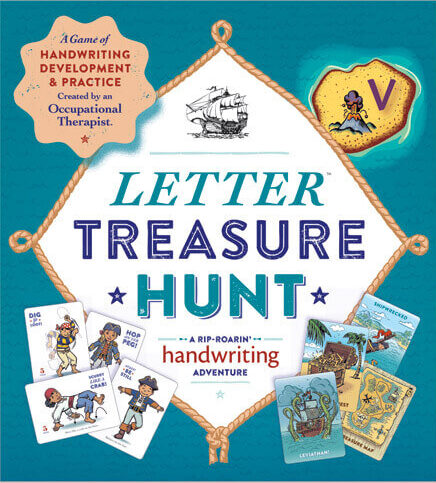
Letter Treasure Hunt game: boosting handwriting skills

Letter Treasure Hunt is a game that seamlessly blends handwriting skills, gross motor challenges, and language development. It’s an exciting adventure where children explore the world of letters while engaging in activities that improve their handwriting and motor coordination.

In this game, kids embark on a quest to discover hidden treasures, all while completing ‘captain’s orders’, fun gross motor tasks that challenge balance, coordination and strength. This dynamic blend of gross motor challenges not only keeps children active but also enhances their physical development. Moreover, the game fosters language skills by encouraging communication among players.

Letter Treasure Hunt is the perfect example of how education can be both fun and effective, making it an excellent choice for parents, teachers, and therapists looking to boost various skills in an engaging manner.

Watch the short video below for a review of Letter Treasure Hunt by physical therapist, Laurie Gombash!

Novenops: Mastering Grammar through Play

“Grammar made fun, one card at a time.”

NOVENOP is an acronym created from the words NOun, VErb, NOun, and Phrase and is a board game for children of ages 6 and up

Novenops is a game that focuses on enhancing the player’s understanding of the basic elements of grammar. With 60 carefully designed cards, this game creates a captivating learning experience that continuously reinforces sentence structure concepts. As players progress, their word familiarity improves, subsequently boosting their reading and writing skills.

The beauty of Novenops lies in its ability to turn grammar lessons into an enjoyable activity. By gamifying language learning, it removes the traditional barriers associated with grammar education and replaces them with excitement and engagement. It’s an ideal tool for educators and parents who want to transform grammar from a chore into a rewarding adventure.

Watch the short video below for a review of Novenops by physical therapist, Laurie Gombash!

Therapro’s games— Trunks, Letter Treasure Hunt, and Novenops —are shining examples of how education and therapy can be both effective and enjoyable. These games are not only designed to boost skills but also make the learning process a memorable and fun experience. Whether you’re a therapist, educator, or parent, consider incorporating these games into your toolkit to unlock the full potential of skill development. With Therapro, learning is an adventure waiting to be discovered!

ezpz Mini Feeding Set

Facilitation of Feeding Skill Development

Feeding specialists must select appropriate tools when facilitating feeding skill development. There are a myriad of materials available that make it challenging for therapists to select the tools that match the needs of their pediatric clients. Therapro is always in quest of useful, practical, and therapeutic oral-motor and feeding tools that will promote feeding skill development. Innovative designs are widely available to therapists and families for utensils, cups, and oral tools that are designed to help advance oral development and feeding skills. We’ve reviewed extensively what is available to therapists and families, and are able to offer these new items from ezpz with our stamp of approval. All materials used are safe and a breeze to clean.

ezpz Oral Development Tools used for Facilitating early Feeding Skill Development

Oral Development: Oral Development Tools are designed to provide oral sensorimotor input for babies and youngsters who are beginning to explore their mouths. The 3 tools (loop, smile, and stick) are easy to grasp and provide smooth and textured surfaces. They can be used without food to explore oral movement for pre-speech activities, provide oral sensation, and can also be dipped in liquids and graded food textures to facilitate oral motor skills of the lips, tongue, jaw, and cheeks. The Oral Development Tools are a great tool for facilitating early feeding skill development.

The ezpz Developmental Utensil Set

Utensils: The Developmental Utensil Set consists of utensils for infants age 4 months+ called Tiny Spoons; Mini Utensils (fork and spoon) for infants age 12 months; and Happy Utensils (fork, spoon, and knife) for children 2 years+. The entire set consists of 7 utensils that can be used as the child’s feeding skills develop.  The Happy Utensils are available as a separate set that encourages safe and successful self-feeding. These utensils are a great tool for facilitating the development of scooping, piercing, spreading, and cutting needed for successful self-feeding.

Developmental Cup Set

Cups: The Developmental Cup Set is a developmental training system for teaching cup and straw drinking skills. It introduces open cup drinking for infants 4 months+ using a Tiny Cup (2 oz). The Mini Cup and Straw Training System is the next level with a 4 oz cup, screw on lid and flexible, durable straw for infants 9 months+. For the older toddler (2 years+), the Happy Cup and Straw System consists of an 8 oz cup with screw on lid and flexible, durable straw. The system promotes oral skills including lip closure, lip rounding, tongue cupping and elevation. All 3 of the cups are available individually as well as in the set.

These ezpz tools are a great resource for facilitating feeding skill development. You will be able to examine and try out these new products and many more when you visit Therapro’s exhibit at the ASHA Conference in Boston on November 16-18. We’ll see you then!

Guest Blogger: Filomena Connor, MSOTR, Retired