
All posts by Therapro

Exploring Chewy Tubes Oral Motor Tools

The Chewy Tubes Oral Motor Tools family offers a wide range of products designed to support oral motor deChewy Tubes Oral Motor Toolsvelopment and sensory needs in children and adults. These safe, durable, and versatile tools are ideal for improving chewing, biting, and self-regulation skills, making them an essential part of occupational and speech therapy. Whether used for sensory input or as part of a therapeutic intervention, Chewy Tubes help individuals develop the necessary oral motor skills to thrive in daily activities.
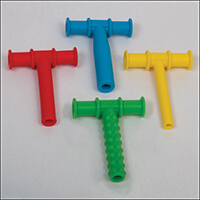
Which of the Chewy Tubes oral motor tools is right for your child? With this guide, you’ll be able to pick the perfect resistance and style.

Yellow (smooth)

The Yellow Chewy Tube is used with a smaller jaw, typically infants and children up to 2 years old and individuals who cannot open the jaw very wide. The Yellow Chewy Tube features a narrow stem of 3/8″ OD.

Red (smooth)

The Red Chewy Tube is typically used with toddlers, older children and adults to provide a smooth surface for practicing biting and chewing skills. The Red Chewy Tube features a stem of ½” OD.

Green (knobby)

The Green Knobby Tube offers increased sensory input from the raised bumps along the bitable stem. It provides a slightly firmer bitable surface. The Green Knobby Tube features a stem of 9/16″ OD.

Blue (smooth)

The Blue Chewy Tube is the largest and firmest of the Chewy Tubes. It is intended for adolescents and adults with developmental disabilities, autism or sensory integration disorders. The Blue Chewy Tube features a stem of 5/8″ OD.

Red Super Chew (knobby)

The Red Super Chew offers a solid yet bumpy surface for practicing biting and chewing skills. The closed loop handle is easily grasped by little fingers. The Red Super Chew features a stem of 9/16″ OD.

Green Super Chew (smooth)

The Green Super Chew offers a solid and smooth surface for practicing biting and chewing skills. The closed loop handle is easily grasped by little fingers. The Green Super Chew features a stem of ½” OD.

Ps and Qs

Ps & Qs provide a smooth and solid surface for practicing biting and chewing skills. The Q is wide enough for bilateral chewing activities and the P is especially easy to grasp by small fingers or those with low muscle tone.

Chewy Tube handles have corrugated ridges to assist the grasp – especially useful for those who are visually impaired.
It’s Everywhere!! The Therapro Guide to Getting Putty Out

Do you LOVE our therapy putty, but HATE when it gets stuck to something it’s not supposed to? We do, too – so we’ve compiled a list of activities for removing putty from clothing and hair. These ideas were submitted from occupational therapists on the Yahoo Groups’ OT-peds listserv and the American Occupational Therapy Association’s school listserv. Thank you for these useful ideas.

  1. WD-40 works well to get putty out of cloth fibers. Test a small area of your carpet first.
  2. Believe it or not, I have found the peanut butter has worked to remove putty from some fabrics. (I’ve used it on small spots on my car seats). Just take a small amount and rub it into the putty that is embedded into the fabric and it loosens up. Then wash the bag to remove the peanut butter. Just one word of caution – don’t automatically dry the shirt in the dryer until you’re sure the putty is out. Air-dry it first. Then if you need to, you can repeat the procedure. Using an automatic dryer before the stain is completely out almost always permanently sets the stain.
  3. Using peanut butter works especially well with hair. I discovered it once when a friend of my son’s got a wad of it stuck in the back of her head. A tablespoon of peanut butter massaged into her hair got it out right away.
  4. If the putty stain is small and you catch it right away (before it goes through the wash), use a small scrub brush and dish detergent. Make sure you scrub WITH the grain of the fabric.
  5. Have you tried freezing the shirt to see if the putty becomes brittle and easier to manage? Putty is known for oozing through woven material.
  6. Use ice to harden the putty and scrape it away, and then spray on upholstery cleaner with a brush. Use Woolite for the remaining stain.
  7. This is how I get small spots of therapy putty out of clothing. Take the whole wad of putty and press it hard on the putty on the shirt. Keep doing this over and over and over. The putty should stick to itself and come off a little at a time.
  8. I have used the putty pressed into the spot over and over and then spot cleaned with rubbing alcohol for the last stain.
  9. Use Goo-Gone and elbow grease for cleaning up putty!
  10. Get putty out of hair by using vegetable oil or peanut butter, then a couple of good shampoos.
  11. Try Goof Off (you can find it at Home Depot) – it’s made to get rid of paint spots. Rub it into the putty stain and wash in hot water. The stain should come out.

From Rattles to Writing: Building Hand Skills Through Play

From Rattles to Writing is a comprehensive guide that emphasizes the importance of building hand skills through play. Authored by Barbara A. Smith, MS, OTR/L, this resource offers practical strategies for parents, caregivers, and educators to support children’s fine motor development through engaging activities.

The Importance of Early Play

Early childhood is a critical period for developing the visual-perceptual skills needed to read and the eye-hand coordination required for writing. Engaging children in activities such as shaking rattles, stacking blocks, and participating in simple games lays the foundation for these essential skills. These playful interactions not only enhance motor abilities but also contribute to cognitive and sensory development.

Activities and Adaptations

Baby using the EazyHold Universal Cuffs as an adaptation to build hand skills for playSmith’s guide provides a variety of songs, games, toys, and adaptations designed to foster hand skill development. For instance, stacking blocks can improve spatial awareness and coordination, while using adapted tools can assist children with developmental challenges in participating fully in activities. By incorporating these strategies, caregivers can create an inclusive environment that promotes skill acquisition through fun and meaningful play.

Supporting Development at Home and in the Classroom

Implementing the techniques from Rattles to Writing can be seamlessly integrated into daily routines at home and educational settings. By understanding the progression of hand skill development, adults can provide appropriate challenges and support to help children achieve milestones. This proactive approach ensures that children are well-equipped with the foundational skills necessary for academic success.

Explore more about this topic and find additional resources at Therapro’s blog.