Dyspraxia is one type of sensory processing disorder (SPD) that makes it difficult for children to plan and perform motor tasks such as stringing beads or riding a bicycle. Children with dyspraxia may
- Appear clumsy
- easily break things because they use too much force or
- struggle to fit their arms into sleeves or sequence steps to shoe tying
Children with SPD often have more than one of the 6 subtypes that impact how their brains interpret and respond to what they see, hear, feel, smell, taste and how they move. They may seem extra active or lethargic, super sensitive or oblivious, have difficulty controlling their body while using their hands or can’t discriminate what part of their body was touched or is in pain. Let’s take a look at a few strategies that may help children with dyspraxia and other types of SPD as well as children who are typically developing.
Simplify for Success
Nobody likes failure; especially young children who have poor coordination to stack rings, string beads or lace boards. Consider purchasing, making or adapting these types of activities to make success easy and frequent. Try using
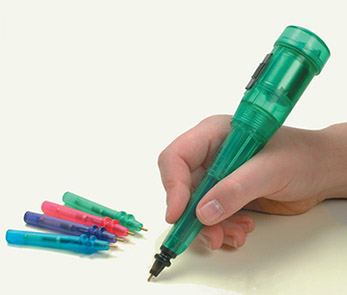
- an extra large tube as a ring stack and rings to stack. The one shown in the photo is made by wedging a swimming noodle into a juice container and has a motorized pen inserted on top to make it vibrate. Vibration helps children to focus on what their hands are doing.
- thick cord and shower curtain rings for stringing instead of offering string and beads. Many toddlers will find this an easier introduction to stringing.
- lacing boards with a few extra big holes and thick cord. I attached the photo of a horse to this lacing board that I used with clients during Hippotherapy (therapy using a horse as a therapeutic tool).
Practice Makes Perfect
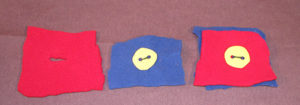
Design activities to require repetition. When a child closes a jacket there is usually only one zipper to connect or a few buttons. Many children benefit from the repetition of closing several button squares. As I describe in my book From Rattles to Writing: A Parent’s Guide to Hand Skills, these are made by sewing a large button or round plastic piece (see photo) to fabric. Then cut a slit into another piece. As your child develops skill, offer button squares with smaller buttons.
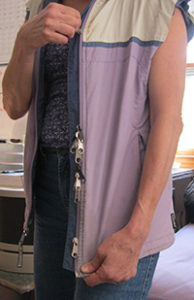
Many children are able to close a zipper once the slider is connected. But connecting the slider onto the zipper is very tricky. In the photograph you see me wearing an old jacket and attaching several zipper sliders. The sliders are sold in zipper repair kits or you can remove nice big ones from broken backpacks and suitcases. I have taught adults with developmental disabilities to zip their own jackets after practicing connecting and pulling up several slider every day.
Let’s Take Apart
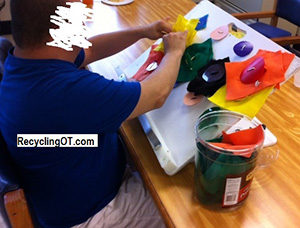
Opening buttons, screw caps, zippers and knots seems to be a lot easier than closing them. One of the strategies I describe in my book From Flapping to Function: A Parent’s Guide to Autism and Hand Skills is to teach children to “ take- apart” before teaching them to “put-together”. In this way they will become familiar and successful with the materials before learning the more challenging motor skills of tying, buttoning, snapping, screwing lids etc. It is much easier to remove the fabric pieces from the “buttoning board” shown below and children will have many opportunities to practice. This board was made by drilling holes into a book stand and tying the “buttons” onto cord that is knotted through the holes.
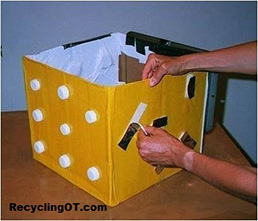
In my book The Recycling Occupational Therapist I describe how to make activities that are perfect for opening and taking apart. The Manipulation Box shown in the photograph has screw covers, Velcro strips, pull lids, and magnets attached to a cookie sheet so that children can remove a variety of objects to drop inside.
Keeping It Fun
Yes, practice is important but we need variation and to add sensory stimulation to keep it fun. That’s why I love
- form boards and ring stacks that make music
- adding a motorized pen inside containers to make insertion tasks vibrate
- using materials such as Velcro and elastic cord that feel good to pull
- toy animals with clothing fasteners to manipulate
- using pretend play toys such as “Feed the Bunny”
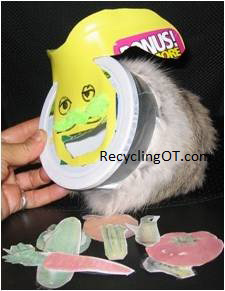
I covered an oatmeal container with fur, attached a face to the lid and photocopied some food items. Now “Feed the Bunny” is more than a plain old shape sorter. This great for working on choice making (i.e. shall we feed bunny a carrot or tomato?), identifying pictures, counting and of course promoting a healthy diet. I hope that you have fun implementing some of these strategies!
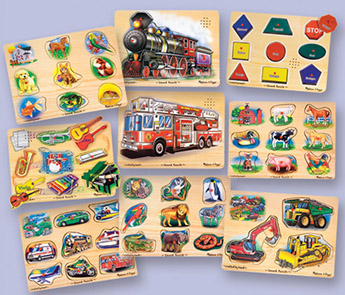
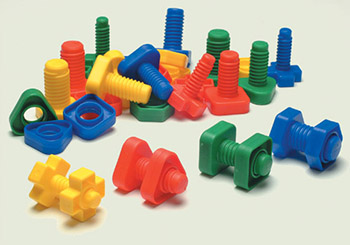
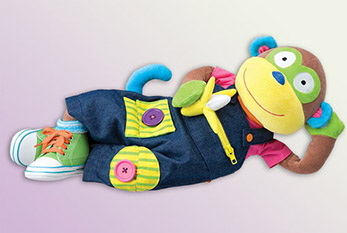
Here are some great Therapro products I recommend that you might use in addition to the activities I’ve discussed:

Guest Blogger: Barbara A. Smith.
Barbara A. Smith has worked with children and adults with developmental disabilities for over 40 years! She is the author of the Recycling Occupational Therapist, From Rattles to Writing: A Parent’s Guide to Hand Skills and From Flapping to Function: A Parent’s Guide to Autism and Hand Skills. Learn more about her work at RecyclingOT.com.