 Movement, whether on a horse, swing or trampoline, provides sensory stimulation that nourishes the brain and in turn promotes attention and learning. Movement can also be used therapeutically to motivate children to engage in hand activities.
As an Occupational Therapist working at Ironstone Therapy in Andover, MA, I am able to use a horse as a treatment tool to work on traditional objectives such as improving bilateral coordination.
Hippotherapy is often very effective because children love bonding with the horse. Instead of in an office, this kind of therapy takes place in a happy environment where simply sitting on top of the animal is the first of many small successes.
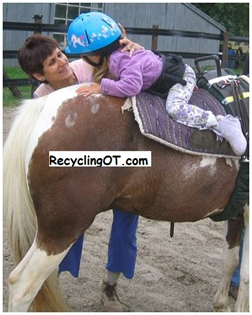
Let’s begin by looking at Amber, a hippotherapy client. When I first met two-year-old Amber she arrived singing “Old McDonald Had a Farm.” She continued to sing while mounting and riding. She never looked at me, and seemed unaware of what her body was doing, and also unaware of the people around her.
Fortunately, Amber loved movement. She didn’t like it when I stopped the horse. I began singing “If You’re Happy and You Know It…Clap Your Hands/Pat the Pony/Blow a Kiss,” etc. At first, I used hand-over-hand assistance to help Amber perform the hand movements. When she ignored me, I stopped the movement. Amber soon learned that by engaging and using her hands, she could avoid stopping.
This example describes how movement can be used as reinforcement. A “reinforcer” is anything that makes a person want to repeat a behavior. Examples of reinforcements can be hugs, stickers, special treats, and even paychecks that motivate one to keep going to work.
Movement can function as a “sensory reinforcement” when it:
- Motivates the child to repeat the desired behaviors (i.e. clapping hands)
- Provides sensory input that organizes the brain
An important aspect of developing hand skills is learning to tolerate touch. Children receive deep pressure stimulation to joints and muscles as the horse gently bounces up and down during the walk.
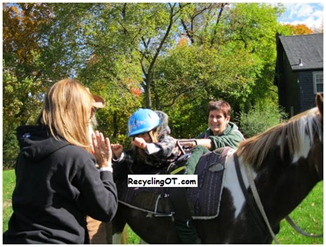 During hippotherapy, children are encouraged to engage in simple hand activities such as giving high five while prone (on the belly).
Children may assume different positions, such as facing backwards while bearing weight on forearms or hands. Bearing weight helps to decrease touch sensitivities (i.e. tactile defensiveness) so that the child is more willing to grasp and manipulate objects.
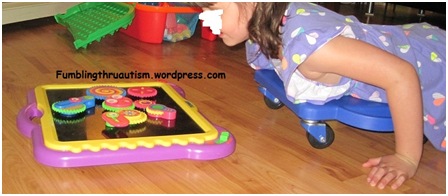
Occupational and physical therapists often position children in “prone” position (on the belly) using swings, therapy balls or a scooter board so that children:
- Develop postural control
- Strengthen trunk, shoulders, neck and eye muscles
- Bear weight on hands to decrease tactile defensiveness
- Receive vestibular (movement that stimulates the inner ears) sensory stimulation that organizes the brain
- And of course, are motivated – because movement is fun!
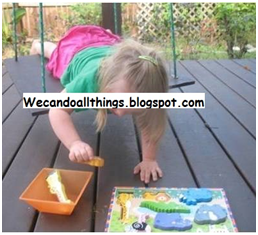 The smart mom at We Can Do All Things explains how her daughter developed postural control by working on fine-motor activities while on the swing. The movement also made puzzles and ring stacks extra fun.
Scooter boards can also be used to develop sequencing and bilateral coordination as children “scoot” to a desired activity. The child might also be asked to scoot back and forth to bring game or puzzle pieces to a board. The clever mom at Fumbling Thru Autism motivates her daughter by integrating movement activities throughout the day.
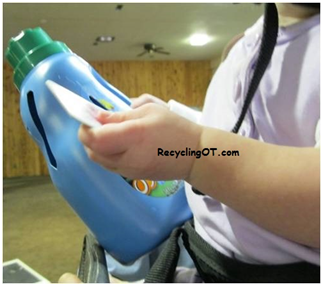
Children can engage in a variety of hand activities while on a horse or other movement apparatus to develop basic skills such as reaching and grasping and more advanced skills such as:
- Stabilizing with one hand while manipulating with the other
- Orienting shapes to fit through openings (developing visual perceptual skills)
- Sequencing several steps
For example, the client shown in this photo is inserting Lotto cards into the slots I cut into a detergent bottle. The slots are cut in vertical, horizontal and diagonal orientations so that she can practice positioning the cards to fit. Some of my more experienced clients can use this activity while kneeling or standing on top of the horse!
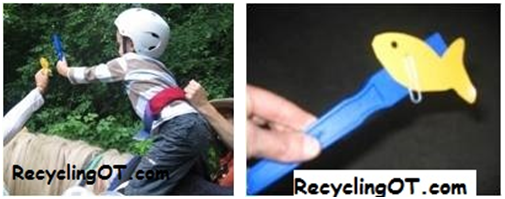
This child is using a magnetic Bingo wand to catch the goldfish while developing visual attention, postural control and sequencing skills as he removes the fish to place in an attached basket. The fish is cut out of a detergent bottle and has a paper clip attached so that it can be used in magnet games. This activity also helps children to coordinate using their hands together as they remove the fish from the Bingo wand.
Most therapists and parents do not have a horse available to use for sensory stimulation and reinforcement. However, the principles are the same when using other movement equipment – or no equipment at all. Young children may be twirled around after putting rings on a stack and older children may enjoy performing jumping jacks as they spell words. Most children of any age or ability level love to move and are motivated to communicate “go” with gesture, pictures or vocalizations. So what are you waiting for? Let’s get moving and developing hand skills!
* * *
Guest Blogger: Barbara Smith, M.S., OTR/L
Barbara Smith, M.S., OTR/L has worked with children and adults with developmental disabilities in a variety of settings over the past 30 years- including early intervention programs, public schools, special education collaboratives, day habilitation programs and community residences. She is the author of The Recycling Occupational Therapist, 2nd edition (RecyclingOT.com, 2012).