Category Archives: Life Skills and Transition Planning

Discover strategies, tools, and supports for life skills development and effective transition planning, including vocational training and daily living preparation for all stages.

I Can Work: Building Pre-Vocational Skills for Young Adults

Our hope for all children is that they become productive, engaged members of their community as adults.  For students with special needs, this goal becomes a challenge because it is dependent on early, interesting, and meaningful training in pre-vocational skills. At Therapro’s Saturday Seminar on March 12th, entitled: I Can Work! Hands-on Ways to Build a Strong Pre-vocational Foundation for All Young Adults, educator and creator of I Can Work!, Angela Mahoney, M.Ed. presented her 5 module course designed to integrate communication skills with hands-on pre-vocational training.  Angela has an extensive background in working on pre-vocational training with special needs students in a variety of settings in New England. Currently she is a Skills for Life Educator at the Middle School level in a self-contained classroom in Connecticut.  She is also providing consultation and training to schools and programs throughout the US in administering and adapting I Can Work! for their particular setting and students.

With her broad experience as a pre-vocational teacher and as a consultant to other schools in developing their pre-voc programs, Angela’s I Can Work! continues to evolve into a practical, exciting course that builds on basic job readiness skills such as how to greet a supervisor, how to dress for work, how to fill out a job application, appropriate job behaviors, etc. Learning those basic skills provides a firm foundation on which to build more advanced skills.  Angela’s program instructs students in 5 different jobs, including clerical, food service, retail, and grocery, which may help them discover a special interest they may not have considered.

Angela was a charismatic and passionate presenter, who engaged in lively problem solving with the audience.  The attendees were very interactive with offering their experiences as professionals and/or parents.  One Mom of a special needs student expressed anxiety that her son would become stuck in a repetitive “job” of folding paper.  Angela was able to encourage the Mom to visualize where her son’s skills could lead him, given a firm foundation in basic job skills. Angela stated that one of her goals with implementing I Can Work! is “to break the mold of preconceived ideas of these students.”  As part of Angela’s program, the skills students have acquired in their pre-vocational training are supported by data collected on a regular basis. When this information is presented at a team meeting, the broad scope of skills the student has acquired is apparent and celebrated.

Attendees had very positive comments about Angela’s seminar:

“Well organized way to approach pre-voc education for a range of student with special needs.  This seminar provides some great ideas for how to incorporate effective, meaningful activities for pre-vocational skills.” Laura K., Teacher

“Mrs. Mahoney was clear, concise & energetic.  She listened and answered questions beautifully.”  Ella, PTA/ Parent

“The format can be generalized to not just these modules/skills (that were presented today), but also to agriculture, computers, engineering, etc.” Jen L. M., Occupational Therapist

“Both our elementary students and 18-21 year old program could benefit to use this program.  I would love to collaborate on how to take these ideas even further.” Anonymous, Transition Counselor

“Fantastic presentation on how to organize a work skills program.  Can implement ideas immediately.” Jennifer P., Occupational Therapist

Thank you, Angie!

Filomena Connor, MS, OTR/L
Pre-Vocational Training: Part 1- Opportunity

By Angela Mahoney

The other day while shopping at a local grocery store, I ran into a former student. I couldn’t believe that this young man I taught in middle school, who like many students faces a unique set of challenges, was now a high school graduate with a job. As soon as we began talking I could see the pride and confidence beaming from him while he bagged my groceries. As I turned to leave, he shared how he remembered learning how to bag groceries in my class. I couldn’t believe it. That moment solidified my purpose for educating professionals and parents about pre-vocational training, and underscored my passion for education.

Pre-vocational planning is a program designed to prepare students for a successful transition to meaningful, paid work in the community. It commonly involves training in the basic work skills required for a typical employment setting. Wherever your child’s path might lead following high school, the strong foundation of these skills provided will help contribute to his or her success. What I am suggesting is early intervention coordinated to promote age-appropriate growth during the critical years of middle school, ages 11-14 — a ‘pre-vocational’ intervention if you will. Let’s build that skill base!

There are many opportunities both at school and at home for vocational tasks to be introduced, discussed, and practiced. The keys to solid growth in vocational skill level are opportunity, consistency and repetition. Consider what your child is currently working on in both environments. Then, ask yourself if you can add additional experiences to build a strong vocational foundation.

OPPORTUNITY:

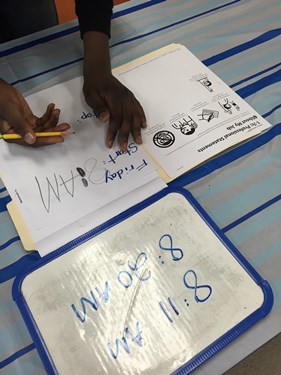
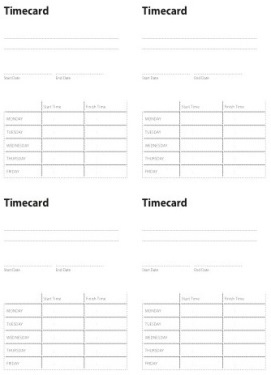
    • Create a small ‘work skills center’ in your home. Have a place for your child to ‘sign in/out’ each time for ‘work’. This builds a sense of responsibility and work readiness.

Pre-Vocational Training timecard examplesPre-Vocational Training time activity

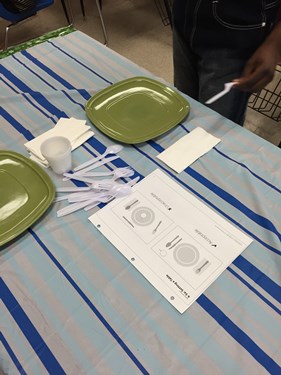
    • A variety of tasks can be introduced and completed in this space. For example, if your child will be working on setting the table, have them sort utensils in this space first to prepare for the job. Other examples of ‘work’ that can be completed in this space are filing by letter or word, collating and stapling papers and buttoning shirts. The ‘work space’ is to be utilized as a routine space for learning vocational tasks that are purposeful and rewarding for your child to complete with independence.

I Can Work table setting Pre-Vocational Training examples

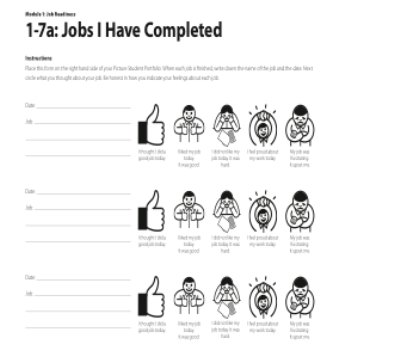
    • Additionally, have your child track the ‘jobs’ completed as well as reflect on how they felt about the job. Reflecting allows for discussions and connections to things your child likes to do as well as tasks they do not like to complete. It can be hand written, a happy face and a sad face, even a thumbs up and thumbs down! Find what way your child responds to best to keep him or her engaged and invested in the tasks.

1prevoc051prevoc06

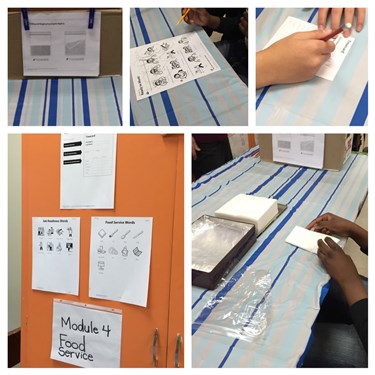
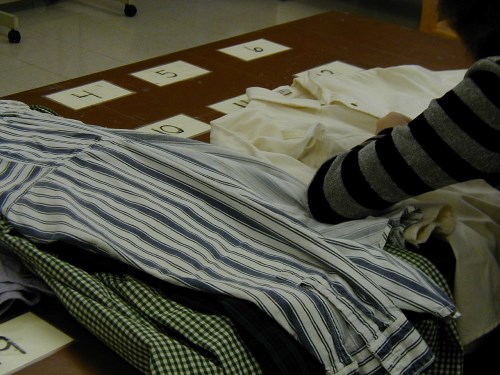
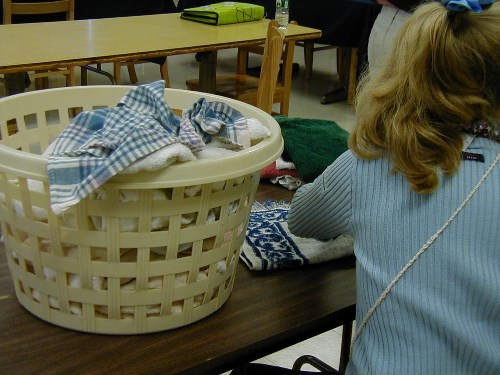
    • Create a way to make chores meaningful and connected to future goals. Knowing how to set a table is related to working in a restaurant. Folding towels is one task that might be required in the hotel industry. Buttoning and folding shirts is connected to working in a retail setting. There are countless ways to tie in hands-on activities at home, while introducing job connections to see if an area of interest stands out. The goal is for your child to learn what work environment and tasks they would be interested in vocationally.

1prevoc071prevoc08

  • Check with your child’s teacher at the middle and high school level for in-house job opportunities such as recycling, mail delivery and cafeteria set up and break down.
  • In middle and high school, inquire about off-campus job experiences in a variety of settings such as grocery stores, offices and hospital. It is important to begin the real life job experiences at the middle school level when possible. Speak with your child’s teacher for more information.

Everyone deserves to be a contributing part to this society and with a strong vocational foundation set at the right time, everyone can.


Angela Mahoney, M.Ed., is currently a special education case manager at Rogers Park Middle School in Danbury, Connecticut. Angela has worked with students of all ages in a variety of settings for the past thirteen years. Her career includes a tenure at a private school where she worked with over seventy-five middle school and high school-aged students on a weekly basis, running an inclusion-based elementary program for students with autism, as well as co-teaching core academic classes as part of a team comprised of fellow middle school educators.

Angela is the author of I Can Work! A Work Skills Curriculum for Special Needs Programs.


Life Skills Program for Deaf Students with Complex Support Needs

Therapro hosted its very first international speaker for the Saturday Seminar Series on February 15. A post professional master’s student at Tufts, occupational therapist Jill Massey, from the United Kingdom, presented her talk entitled: A Life Skills Program for Students, 10-19 years of Age, Who Are Deaf and Low Functioning. On a day that threatened a snowstorm, a brave and focused group of attendees learned how this therapist went about developing a program in a facility that had never had an occupational therapist on its staff and learned of her vision for a life skills approach to the Deaf, low functioning students at her school.

Jill’s seminar provided a brief overview of OT practice in the UK within community based pediatrics. She also discussed understanding and awareness of issues for children/young adults who are Deaf and introduced a Life Skills Program for this population. Jill clarified the difference in the use of the two terms “deaf” and “Deaf” when discussing Deaf culture. The quote she documented from the UN Convention on Rights of Persons with Disabilities says: “Persons with disabilities shall be entitled, on an equal basis with others, to recognition and support of their specific and linguistic identity, including sign language and Deaf culture.”

Jill’s position at Oak Lodge School was a brand new service to the students, with no budget. She had her work cut out for her and has worked tirelessly in conjunction with the school speech and language therapist to educate staff as well as provide evaluation and class-based intervention for the students Her work became focused on real world integration of the students and empowering parents to work with their children to promote independence. Evidenced based studies were shared that indicate that context-based exposure in building life skills is key to success. Her goal is to do international research in this area of practice to demonstrate the efficacy of a program that is directed to student independence in life skills at home and in the community.

Jill taught us Deaf etiquette through a true-false quiz, gave us tips for providing optimal environmental adaptations with Deaf students, and offered practical suggestions on how to communicate effectively with a Deaf person. It was quite an interesting seminar!

Here are a few of the comments received from attendees:

“Presenter is an advocate, trailblazer, and passionate about her work. She is dedicated to research.”

“Even though I don’t work with a lot of deaf students, all the info could be applied to other school life skills.”

“Very informative. I learned a lot, especially about Deaf awareness/culture.”

Thank you, Jill!

Filomena Connor, MS, OTR/L

February 15, 2014