Category Archives: School-Based Practice

Discover school-based therapy resources and intervention strategies tailored to therapists working in educational environments. Support student engagement, learning, and development through targeted tools that align with IEP goals, classroom expectations, and inclusive practices.

25th Annual OT/PT School-Based Conference: Highlights

The Annual Ohio OT/PT School-Based Practice conference celebrated its 25th year on August 7-8 in Columbus! From one year to the next, this conference attracts therapists from Ohio as well as surrounding states. This year the venue was bursting with almost 700 energized attendees. The conference always offers exceptional speakers who present the latest information for both new and seasoned therapists.

We were proud that Therapro author Tere Bowen-Irish, OTR/L presented the Keynote address entitled: “Weaving Visualization and Mindfulness into Your Practice.” She offered a variety of sessions throughout the conference, attracting capacity crowds eager to hear her lively presentations incorporating her Drive Thru Menus. Tere introduced a brand new addition to her product line-up called: Sensory Processing Support Planning Guide.

Other presentations offered show the diversity and breadth of this conference: Athena Oden, PT presented “Ready Bodies, Learning Minds: Cultivating the Complete Child.” Take a look at her website for learning more about her unique approach that provides developmental support for integrating both the sensory systems and motor systems as a basis for academic success. Just a few of the other excellent sessions included: “Integrating Primitive Reflexes to Improve School Function’ by Kim Wiggins, OTR/L, “Developmental Coordination Disorder: Best Practices for Recognition and Management in the School Setting,” by Erin Iverson, PT, DPT, PCS and Patti Sharp, OTD, MS, OTR/L, and “Are We Ready to Meet the Obesity Challenge?” by Cindy Miles, PT, PhD, PCS.

Therapro owner/president Karen Conrad Weihrauch and I enjoyed greeting all the therapists who stopped by the Therapro exhibit. Attendees eagerly tried out some of the latest Therapro products: Safety Grip Scooter Board, Eazyhold universal cuffs, Yoga Spinner Game, Gyrobi fidgets, Stikbot, and Peg Friends: Around the Town.

The Therapro game, Letter Treasure Hunt, was acclaimed by therapists who purchased it at last year’s conference. One therapist excitedly relayed that she loved the game because it was so versatile. She discovered she could use it for students of a variety of ages and abilities. For example, she told us that with one student, she used just the spinner part of the game to help develop fine motor skill.

Fine Motor Olympics a OT/PT School-Based Conference favorite

The new revised edition of Fine Motor Olympics was hard to keep on the shelves! Therapists loved the 64 beautiful color card deck photos of children’s hands performing various fine motor tasks. On the reverse side of the cards there is information on how to perform and adapt the activity as well as identification of the hand functions that are being targeted by the activity. The revised manual includes a quick screening form, a fine motor observation checklist, a record form, plus an in-service training program. All agreed that Fine Motor Olympics is a very practical, important tool to add to the therapy toolbox!


Mary Kay Eastman, PT, MS and Molly Dodge, OTR/L co-chaired this event once again seamlessly. With a dedicated team of hard workers, the two-day conference hummed along and offered attendees a broad selection of relevant, interesting topics. Conference coordinator, Holly Bartholomew of First Class Conferences, once again made sure all ran smoothly throughout the conference. Great job, ladies! Thank you for two exhilarating days. We look forward to seeing you next year!

Filomena Connor, MS, OTR/L

I Can Work! Pre-Vocational Curriculum

Educator, Rebecca Tock teaches at the Elsie Allen High School in Santa Rosa, California. She generously gave us permission to share her glowing testimonial about theI Can Work Curriculum, a 5 module pre-vocational program designed by Therapro author, Angela  (Angie) Mahoney, M.Ed. With Angie’s broad experience as a pre-vocational teacher and as a consultant to other schools in developing their pre-voc programs, her I Can Work! program continues to evolve into a practical, exciting course that builds on basic job readiness skills such as how to greet a supervisor, how to dress for work, how to fill out a job application, appropriate job behaviors, etc. Learning those basic skills provides a firm foundation on which to build more advanced skills. The I Can Work! curriculum instructs students in 5 different jobs: clerical, food service, retail, and grocery.

Rebecca Tock‎

I Can Work

I Can Work! A Work Skills Curriculum

I was introduced to the “I Can Work” curriculum at an educational conference I attended in Spring 2015. Immediately, I knew it was special. It was so different from other vocational curriculums I have used in the past and I thought that this may be the piece that I needed to provide a well rounded pre-vocational education experience in my class. After the presentation, I approached Angela Mahoney, the developer of the curriculum, for some clarifying questions about the program. I was impressed by how user friendly the program appeared to be. Angela was clear, concise and knows her stuff! She was very helpful. What was quite amazing was that it was a total of $49.95. That is unheard of in this profession!


I was able to immediately purchase the curriculum due to its affordability and size. The modules provide comprehensive and clear lesson plans that are easy to use and even easier to incorporate into an existing classroom curriculum. The material presented provides visuals and a guide for the use of real world everyday materials. When working with young adults who have severe disabilities the use of familiar objects is imperative for success. I appreciate the way in which “I Can Work” really uses large graphics and touches upon prior knowledge of the students.

The instructions to set up lessons are easy to follow, and really make this an accessible space for my students. It has definitely enhanced my pre-vocational lessons and given my students more ways to participate in pre-vocational activities.

I love ‘I Can Work!’ It was the best class curricular decision I could have made. I recommend it to any teacher who teaches a pre-vocational class to students/individuals with moderate to severe disabilities.


Ms. Tock teaches students in grades 9-12 who have been identified as having severe special needs.  We would like to direct you to her request for funding ADA accessible tables for her students’ use at mealtimes in school, so they can join their peers. Please visit the site to learn more about her project.

Providing Optimal Services & Supports for Students with Down Syndrome in Educational Settings

Anne Howard

“Meaningful inclusion” is a term that supports the premise that all children should receive an education in the least restrictive environment.  To achieve this goal, social barriers must be hurdled and meaningful instruction must occur.  Anne Howard, PT, PhD tackled this issue in her Therapro Saturday Seminar last week entitled: Providing Optimal Services and Supports for Students with Down Syndrome in Educational Settings.

Dr. Howard’s extensive educational background, beginning as a physical therapist, then becoming an educator, to receiving her doctorate in disability policy, has provided the background for pursuing her interest in those with Down syndrome now as a college professor and consultant to families and school systems.  In addition, Anne serves on the Massachusetts Down Syndrome Congress (MDSC) Education Task Force and contributed to the MDSC Educator’s Manual. This manual provides a comprehensive look at the complex learning profile of students with Down syndrome, as well as provides information around educational considerations that are based upon research-proven best practices.

Anne is also the President of the Board of Directors for the Federation for Children with Special Needs.  With her glowing credentials and experience, Anne proved to be a formidable speaker and expert on Down syndrome.

Attendees at the seminar received a comprehensive review of common learning characteristics and associated physical and health care needs specific to students with Down syndrome.   Dr. Howard provided an interactive seminar, inviting attendees to share their perceptions of students with Down syndrome and asking them to determine what they wanted to learn about students with Down syndrome. She discussed strategies to facilitate independence using visual supports and self-management.  Anne reviewed some basics on Down syndrome with some surprising issues that have come to light.  For example, she noted that children with Down syndrome have a greater prevalence of ASD, with some statistics cited that up to 18% of children with Down syndrome have a co-occurring diagnosis of Autism.

Pencil grips

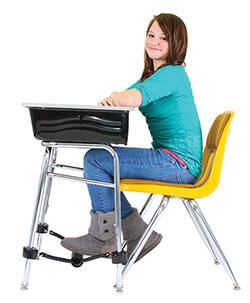
Anne discussed encouraging research that shows that fully inclusive education, special teaching approaches that address areas of weakness, and providing opportunities for success can change the typical profile of a child with Down syndrome, citing studies by Buckley, Bird, and Sacks in Down Syndrome Research and Practice, 2006. A chart with “Characteristics of a typical learning profile” with areas defined as Communication, Socialization, Learning and Memory, and Motor was presented along with strategies to address the targeted areas.  For example, if a student has motor weakness characterized by decreased muscle tone which makes writing difficult, along with having shorter fingers, strategies for learning might include providing adequate postural support, with appropriate seating, motor breaks with tone building activities, and use of adapted materials for handwriting including a slant surface, hand grips, or keyboarding. In addition, she advocated the use of visual supports, which are available for a longer time period for the student, versus using verbal or auditory cues alone. For example, sticky notes, diagrams on the board, photos, calendar, clock /timer, decrease the need for verbal cues. Visual supports are readily available to the student without the need for use of working memory or retrieval of information, which may be difficult for some students.

Finally, Anne provided a Behavior Profile associated with Down syndrome, enumerating strengths, learned behaviors, and then identified strategies that support productive behavior in students with Down syndrome. Students can be taught to self-manage with strategies like self monitoring/self-recoding, self-evaluation, and self-reinforcement.  She suggested that the key is to empower the student by letting him/her know what is expected.  By being proactive, negative behaviors can be averted and targeted behaviors can be reinforced.  She noted that the key to developing acceptable and positive behaviors is to build desired behaviors, versus just responding to negative behavior.

Considering the student with Down syndrome and how to help him/her succeed in an inclusion model involves a number of factors.  Understanding the common characteristics and challenges of this diagnosis is a good starting point.  From there, a wide variety of positive strategies can be implemented to help make the educational process meaningful and fulfilling for the individual student.

Anne has generously provided this link to her PowerPoint slides.

Here are some remarks from attendees:

“I really appreciated Anne’s diverse background. She was able to present the information from a different perspective than I might normally consider.”  Micaela C., Physical Therapist

“Helpful as a student to hear real-world application from professionals in practice who were in attendance.  Also great to see theory learned in the classroom reinforced.”  Sam J., OT student

“Clear, relevant, evidence based info/treatment strategies.”  Mary T., Occupational Therapist

“Dr. Howard provided & presented the basic background info for DS well. She provided useful examples for behavior management for children with DS that I hope to implement with my students.”  Anonymous, PT

Thank you, Anne!

Filomena Connor, MS, OTR/L