Transition Planning Inventory-3 Overview & Review

The Transition Planning Inventory - Third Edition

The Individuals with Disabilities Act (IDEA) of 1990 instituted a transition mandate for students receiving special education services.  IDEA 2004 expanded on this to include planning across all areas including community participation, independent living, and continuing education. The Transition Planning Inventory, now in its 3rd edition, was designed to address these mandates. As described in the TPI-3 Administration and Resource Guide, the primary purpose of the TPI-3 is “to assess the transition needs, strengths, preferences, and interest of students at the secondary level” (Patton & Clark, 2021, 14*)   The domains covered within the TPI-3 are working, learning, & living. 

Information is gathered from:

Core Rating Forms 

  • Three forms (Student, Home, and School) Each form contains 57 statements related to transition planning.
  • Each form is organized according to 11 planning areas; Career Choice & Planning, Employment Knowledge & Skills, Post Secondary Training/ Education, Functional Communication, Self Determination, Independent Living, Personal Money Management, Community Involvement & Usage, Leisure and Recreation, Health, & Social/Interpersonal Relationships.

Preference &  Interest Forms

  • Intended to gather information about a students preference and interest
  • Two versions available; basic (intended to be used early in the transition process) and advanced (intendended to be administered when a student is close to leaving school).
  • An optional Home Preference and Interest Form is also available.

Information is compiled through:

Profile & Further Assessment Recommendation Form

  • All information is summarized on this form consisting of 6 sections; 1.) general information, 2.) likely setting for postsecondary outcomes, 3.) student’s preference, interests, and strengths, 4.) results of other assessments, 5.) student profile, 6.) further assessment and information.

Summary of Performance Data

  • The purpose of this form is to give users a quick and easy way to compile the information required by IDEA into a Summary of Performance (SOP) document.  

Overall, the TPI-3 provides a comprehensive means to gather key information from all major players in order to create and implement a meaningful transition plan.

Quick Facts

Age Range: 14-21

Administration Time:
Student Rating Form:

  • 15-20 minutes to complete independently
  • 25-30 minutes if administered orally and/or with support.

The Home Core Rating:

  • 15-20 minutes to complete independently
  • 25-30 minutes if administered orally and/or with support.
  • The School Rating Form 10-12 minutes

Student Performance & Interest Form:

  • 10 to 15 minutes to complete independently
  • 20-25 minutes if administered orally and/or with guidance.

Profile & Further Assessment Recommendation Form

  • 10-15 minutes

Publication Year: 2021

Authors:
James R. Patton
Gary M. Clark

Administration Type: Individual

Scoring: Inventory rated on a scale from 0 (strongly disagree) to 5 (strongly agree)

*Patton, J. R., & Clark, G. M. (2021). Transition Planning Inventory Administration and Resource Guide (3rd ed.). Pro-Ed.

Modifying Games to Address Therapeutic Goals

Games are a useful therapeutic tool; they are versatile, engaging, and so much fun! WIth a few simple modifications games can address a wide range of therapeutic needs.  A few simple modifications can be used for almost every game:

  1. Add Visuals.  Visuals can be anything from simplified directions to communication aids, like “your turn” and “my turn”. Visuals can help those who struggle with sequencing, memory, or communication participate more independently in game play.  
  2. Change the playing position. Playing games on the floor, at a countertop, or with alternative seating helps to increase participation and access.  Playing a game on the floor allows players to play in alternative positions, like laying on their bellies. This position is great for those with postural instability, and helps increase their focus and endurance.  Another option is to use a therapy ball (add a base for stability), Alert Seat, Ball Chair, or air filled cushion instead of a traditional chair.  These types of alternative seating provides movement input which may allow those with shortened attention spans to participate longer and with more focus.  
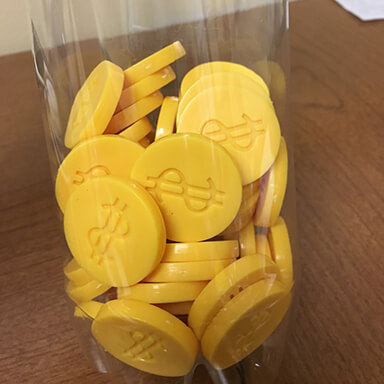
  3. Modify the Manipulatives.  Some game pieces are just too small, too big, or too difficult for students to access.  One quick fix is to swap out the game tokens for something more manageable like a jumbo dice.  Another option, insert game pieces into putty for a bigger gripping surface.  
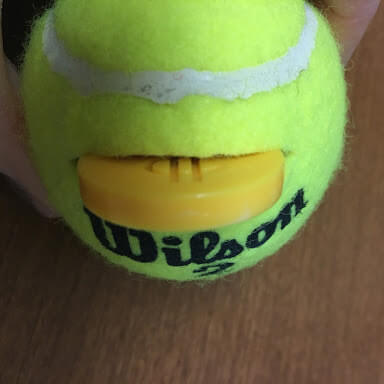
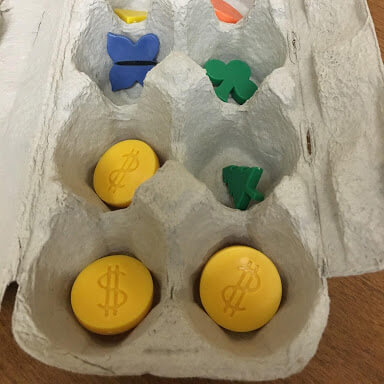
  4. Manipulating the manipulatives to target hand skills. To encourage a pincer grasp, place smaller game pieces into an egg carton (or similar small container); the smaller space allows for only a few fingers to access the piece, encouraging a two or three finger grasp pattern every time the player picks up the game pieces.  To incorporate hand strengthening and bilateral coordination, use a tennis ball with a small slit cut into it.  Players must squeeze the tennis ball with one hand while using the other hand to insert or remove their pieces.  To target fine motor manipulation with insertion, use plastic containers (your recycling bin is a great resource); cut a slit in the lid and work on inserting game manipulatives into the containers.
  5. Change the game rules to address specific therapeutic goals. If your focus is social interactions, team building, or cooperative problem solving, change game play so players play as a group instead of competing against each other. If you are doing individual treatment sessions instead of group sessions, change gameplay to make it a single-person game.  When time is limited or you have participants who struggle with extended attention and focus, add a time rule where gameplay ends after a set amount of minutes.  When the game is too hard or too easy for players, add more complexity or decrease the complexity.   
Example of modifying a game; tube with cover
Example of modifying a game; coins in a clear tube
A tennis ball with a slit and a coin inserted
coins in an egg carton

With a little bit of creativity, most games can be changed, adapted, or modified in order to use them as a therapeutic tool.  Check out Therapro’s handy games guide to see these modifications applied to some of our great games! 

Trunks motor memory game for Working Memory, cognitive and motor skill development - available at Therapro

Recap and Review of Working Memory: A Refresher!

On November 17, Therapro was excited to host yet another successful webinar on the topic of working memory. Dr.  Diane Long, creator of the game Trunks, presented the webinar Working Memory: A Refresher.  Her webinar was full of resources, research, and strategies for this very complex topic.  

Dr. Long started the night off by defining what working memory is thought to be and reviewing brain structures related to the processes associated with working memory.  She did a great job illustrating these concepts by engaging audience members in various memory tasks.  

Next, Dr. Long jumped into the research. Audience members had great things to say about the wide breath of research she covered. Not only did Dr. Long cover the theoretical research, she also reviewed research related to ADHD and working memory.

Some of the best takeaways from the night were the intervention strategies and tips that Dr. Long shared with audience members. Dr. Long covered ADHD specific strategies as well as some very useful strategies to use within a classroom setting. Audience members had great things to say about the way that Dr. Long presented these strategies as they related to developmental appropriateness.  Dr. Long ended the night by reviewing games that are available to help develop working memory, including her own game Trunks! 

Check out the recording of this webinar here.  For more information on Trunks!, check out this great video