Tag Archives: classroom strategies

Classroom strategies encompass OT-informed approaches that support attention, posture, sensory needs, and motor skills to help students succeed academically and socially.

Using RTI-P to Manage Therapy Caseloads

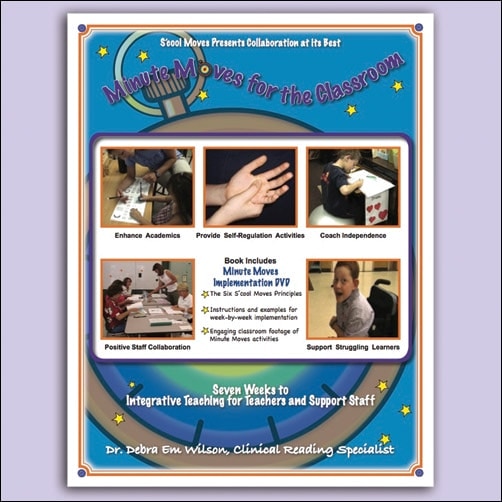
S'Cool Moves

A physical therapist called me from Ohio wanting to know more about the S’Cool Moves products, but what she really needed from me were some insights that I’ve gained from doing what I do for the last twenty years. She was a therapist making the huge shift from clinical practice to educational practice in schools. She told me that she was the ONLY physical therapist for the entire district and was spread really thin. Let’s call our therapist Amber. Amber said that the teachers seemed to want to know what they could do in the classrooms for all the students to improve foundation skills. But how was she going to reach all these teachers and satisfy the IEP goals for her huge caseload?

It was interesting. Do you know where my mind went to help Amber create a framework? It went to sharing about the Response-to-Intervention model (RTI). RTI was designed as an alternative to the discrepancy model used to determine if a child qualified for special education services. With RTI, methods of intervention are validated and data collected prior to referring a child for special education testing. Though some report RTI working well, for others it’s a mixed bag depending on how it is being implemented.

What if we could use RTI personally? Let’s call it the RTI-P model. During our conversation, I found myself explaining to Amber how RTI models work and personalizing the model for her. She got off the call with clarity and new tools to help guide her as she navigates her new position.

Today’s thought is, “How can we use RTI-P to organize our jobs and therapy caseloads?” Think in terms of tiers. RTI has three tiers. The first tier includes interventions and strategies we can use with all students in the classroom. The second tier includes modifications we need to make for small groups of students who are having difficulty with the class-wide strategies. The third tier focuses on individual strategies for the most involved students.

In your caseload, what students do you have that you could support in the classroom setting, Tier 1? Are there opportunities for you to present some strategies during staff meetings or on PD days to support teachers and students in the classroom?

Now think about Tier 2. What students need small group support either in the classroom or within designated smaller group environments?

And finally, Tier 3. What students are very involved and need your one-on-one, hands-on support?

Once you create your own personal framework, then you can figure out what materials or products will help you reach your goals, but first create your RTI-P framework.

For instance, Therapro’s Drive Thru Menus works well with all student in a classroom so this could be considered as an important tool for Tier 1 intervention. For small groups of students who are working on improving visual-motor integration, consider

  • Origami Fun for Beginners – 55 fun-to-do projects! Includes 96 sheets of authentic origami paper in a gorgeous array of colors and designs.
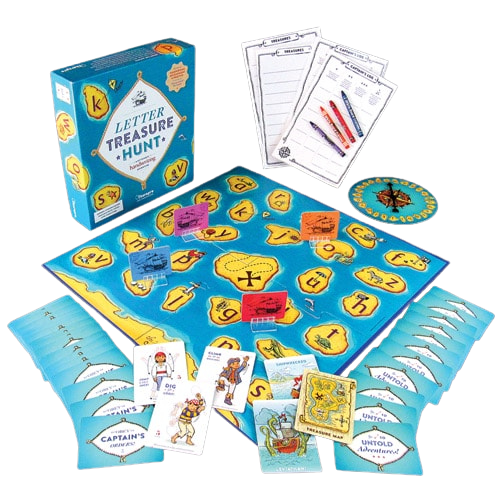
  • Letter Treasure Hunt Game – Handwriting fun!
    1. Sail your ship to an Alphabet Island,
    2. Follow Captain’s orders when you draw a card,
    3. Collect your treasure by writing the letter in the Captain’s log.

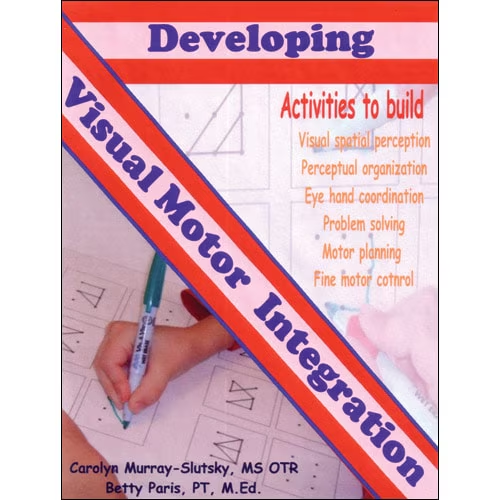
For students needing one-on-on intervention, add Developing Visual Motor Integration and Trace the Eights to your intervention strategies.


Let me know if the RTI-P makes sense to you and how you’ve used it to be more effective in your job and less stressed!

Thanks for all you do for children, Dr. Debra Em Wilson

Guest Blogger: Dr. Debra Em Wilson. I’m excited to join Therapro as a guest blogger. I am a reading specialist and the founder of S’cool Moves. I enjoy collaborating and appreciate this opportunity to connect with the Therapro community.

I Can Work: Building Pre-Vocational Skills for Young Adults

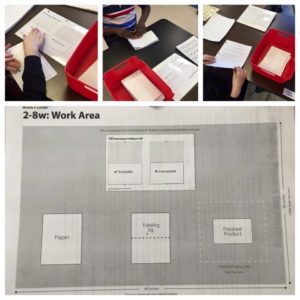
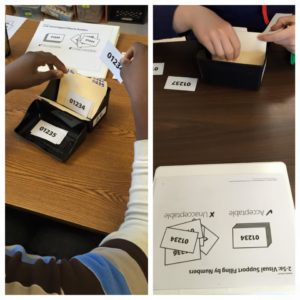
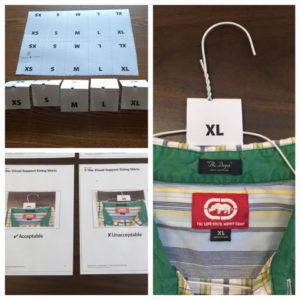
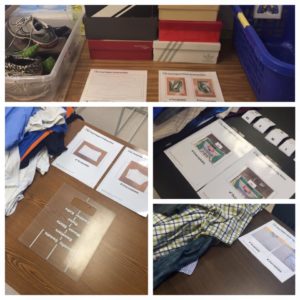
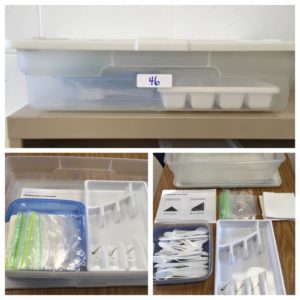
Our hope for all children is that they become productive, engaged members of their community as adults.  For students with special needs, this goal becomes a challenge because it is dependent on early, interesting, and meaningful training in pre-vocational skills. At Therapro’s Saturday Seminar on March 12th, entitled: I Can Work! Hands-on Ways to Build a Strong Pre-vocational Foundation for All Young Adults, educator and creator of I Can Work!, Angela Mahoney, M.Ed. presented her 5 module course designed to integrate communication skills with hands-on pre-vocational training.  Angela has an extensive background in working on pre-vocational training with special needs students in a variety of settings in New England. Currently she is a Skills for Life Educator at the Middle School level in a self-contained classroom in Connecticut.  She is also providing consultation and training to schools and programs throughout the US in administering and adapting I Can Work! for their particular setting and students.

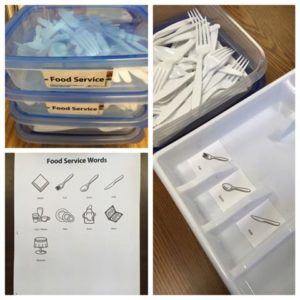
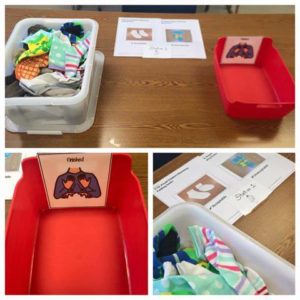
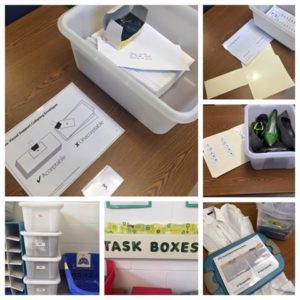
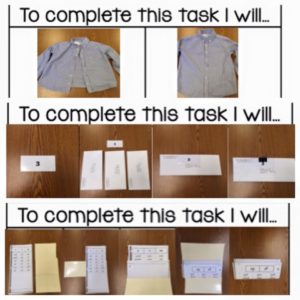
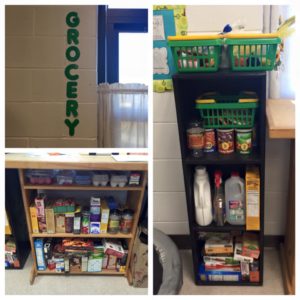
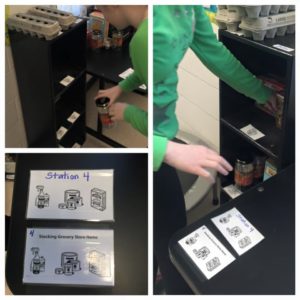
With her broad experience as a pre-vocational teacher and as a consultant to other schools in developing their pre-voc programs, Angela’s I Can Work! continues to evolve into a practical, exciting course that builds on basic job readiness skills such as how to greet a supervisor, how to dress for work, how to fill out a job application, appropriate job behaviors, etc. Learning those basic skills provides a firm foundation on which to build more advanced skills.  Angela’s program instructs students in 5 different jobs, including clerical, food service, retail, and grocery, which may help them discover a special interest they may not have considered.

Angela was a charismatic and passionate presenter, who engaged in lively problem solving with the audience.  The attendees were very interactive with offering their experiences as professionals and/or parents.  One Mom of a special needs student expressed anxiety that her son would become stuck in a repetitive “job” of folding paper.  Angela was able to encourage the Mom to visualize where her son’s skills could lead him, given a firm foundation in basic job skills. Angela stated that one of her goals with implementing I Can Work! is “to break the mold of preconceived ideas of these students.”  As part of Angela’s program, the skills students have acquired in their pre-vocational training are supported by data collected on a regular basis. When this information is presented at a team meeting, the broad scope of skills the student has acquired is apparent and celebrated.

Attendees had very positive comments about Angela’s seminar:

“Well organized way to approach pre-voc education for a range of student with special needs.  This seminar provides some great ideas for how to incorporate effective, meaningful activities for pre-vocational skills.” Laura K., Teacher

“Mrs. Mahoney was clear, concise & energetic.  She listened and answered questions beautifully.”  Ella, PTA/ Parent

“The format can be generalized to not just these modules/skills (that were presented today), but also to agriculture, computers, engineering, etc.” Jen L. M., Occupational Therapist

“Both our elementary students and 18-21 year old program could benefit to use this program.  I would love to collaborate on how to take these ideas even further.” Anonymous, Transition Counselor

“Fantastic presentation on how to organize a work skills program.  Can implement ideas immediately.” Jennifer P., Occupational Therapist

Thank you, Angie!

Filomena Connor, MS, OTR/L

Brains Rule – Perceptual Learning to See Better, Learn Faster, & Work Smarter

Cathy Stern

On February 13th Dr. Cathy Stern, OD, FCOVD, FCSO, FNORA, a developmental and behavioral optometrist, shared her knowledge and passion in a Saturday seminar entitled: Brains Rule – Perceptual Learning to See Better, Learn Faster, and Work Smarter. In her private practice in Canton, MA, she has extensive experience in the diagnosis of developmental and behavioral vision problems and treatment of children and adults with vision therapy and vision rehabilitation.  The Massachusetts Society of Optometrists recently recognized her as a leader in vision therapy.

The majority of the audience was made up of occupational therapists, who absorbed the information Dr. Stern imparted with rapt attention.  Dr. Stern put a new spin on information already familiar to OTs by explaining how perceptual learning occurs and how it helps a student respond to the world around him/her more efficiently. She stated, “Perceptual learning occurs when practice-induced changes enhance the brain’s visual processing speed and accuracy.”  She suggested that if we get referrals for students with decreased attention and behavioral problems, we should take a closer look at the student’s visual processing ability. Dr. Stern noted the staggering statistic that 70-90% of special education students have vision issues, that may or may not be diagnosed.

The principles of perceptual learning dictate that a student learns to recognize features that are relevant and then apply them to new problems.  The student attends to what he/she has learned in the past, which guides him/her when tackling new problems more quickly and more accurately.  Dr. Stern gave examples of professions that require perceptual learning to be successful, i.e. a baseball batter who needs to recognize the type of pitch he’s receiving so he can adapt and swing accurately. A familiar example of perceptual learning is seen in the “Where’s Waldo?” searches.  We know we need to search for red and white stripes, stocking hat, etc. to locate Waldo. Dr. Stern explained that based on our past experience with this game, we know the salient features that make Waldo stand out.  We can decide very quickly what’s important and what is not in the scenes.  So too for a student who needs to zero in on information and not get sidetracked completely by the background (peripheral) information.  We must remember that background information is important to register, such as peripheral vision, which is essential as a “motion detector.”  If we see a student who is having difficulty navigating space, we should consider that he/she is not able to process vision accurately or quickly enough.

Perceptual learning, like motor planning, involves time and space.  With training the brain to improve processing, changes can occur in improved attention, concentration, time planning, and spatial planning.  One tool in Dr. Stern’s toolbox for addressing these issues is a metronome, but there are many tools that can be individualized to a particular student’s needs.

Collaboration between occupational therapists and behavioral/developmental optometrists appears to have great potential in optimizing a student’s classroom success.

Here is a sampling of attendees’ responses to Dr. Stern’s seminar:

“Interesting and exciting!  Good information and clearly the speaker had tremendous knowledge!!”  Anita A., Occupational Therapist

 “This was a whole new way of framing learning issues – combining vision with audition, and timing.  I never thought of learning this way!”   Robin L., Occupational Therapist

 “Excellent information.  Easy to understand.  Very useful seminar.”  Kimberley H., Occupational Therapist

 “This was wonderful information about learning from a different viewpoint.  Dr. Stern was able to integrate knowledge from many disciplines to help us understand vision.”  Michelle B., Occupational Therapist

 “So knowledgeable!  A pleasure to listen to her info, explained in easy to understand terms.  Excellent!”  Anonymous, Occupational Therapist

Dr. Stern’s Saturday Seminar underscored the powerful connection between the brain and how we perceive the world around us—an essential foundation for learning, attention, and functional success. At Therapro, we’re committed to supporting professionals and families with tools that enhance visual perception and cognitive development. Explore our comprehensive Visual Perception & Cognition products to find engaging resources that promote visual learning skills, and visit our Visual Processing Assessments to identify and address specific needs. Empower every learner to see better, learn faster, and work smarter.

Filomena Connor, MS, OTR/L