Tag Archives: classroom strategies

Classroom strategies encompass OT-informed approaches that support attention, posture, sensory needs, and motor skills to help students succeed academically and socially.

Getting Creative with Sweatshirts and Seat Cushions!

 Sensory Processing disorders (SPD) impact how children and adults respond to sensory stimulation such as sound, touch, what they see and movement. One basic principle of occupational therapy for individuals with SPD is to provide controlled, graded and individualized sensory stimulation to promote functional skills such as playing catch or writing one’s name. This means that activities such as tossing bean bags into containers while the child is suspended on a swing can be:

  • Controlled – as the therapist responds to the child’s reactions. For example, the therapist might push the swing faster, slower or in a different direction,
  • Graded- as the therapist chooses the type of swing used, how long the activity lasts, how heavy the bean bags are and how far away the container is positioned, and
  • Individualized – according to the child’s sensory, emotional and motor needs. For example, the child may wear a squeeze vest during the activity, name an animal each time the bean bag is thrown or have a special friend hold the container.

What is a Sensory Diet?

Parents can implement individualized sensory strategies at home in what is called a “Sensory Diet”. This is like a recipe book of activities and adaptations that the therapist designs for parents to carryover at home, school or in the community. It is important to frequently discuss with the therapist how these strategies are working out since children grow and change rapidly along with their sensory needs in different settings.

In my book From Flapping to Function: A Parent’s Guide to Autism and Hand Skills, I describe the 6 different subtypes of SPD and some general strategies to use with children who have each type. These strategies usually impact the following 3 sensory systems:

  1. Tactile – uses sensory receptors in the skin to interpret sensations, such as light and heavy touch.
  2. Proprioception – uses receptors in joints and muscles to tell us where the body is and how it is moving in relation to objects and space.
  3. Vestibular – tells our body how to respond to the pull of gravity and movement of the head. It is also called the balance system.

Now for the fun part…

child sitting on a seat cushion

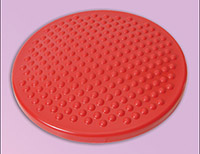
Many children with or without SPD LOVE deep, heavy pressure experiences and movement. This includes children on the autism spectrum or those with other types of developmental disabilities. One very simple strategy is to provide some type of “dynamic seating”. This simply means that the child can bounce, wiggle, rock or move around in some other way while seated. Many teachers incorporate seat cushions and ball chairs in the classroom to help students focus. The Disco Seat is one popular product. An inexpensive alternative is to sit on a deflated ball, as I am doing in the photo. Don’t have one available while eating out or sitting in the movie theater? Consider rolling up a sweatshirt for the child to sit on or curl up inside of to get a full body squeeze.

 
a child using a homemade seat cushion

Speaking of sweatshirts, I have had great success in helping a young lady named Judy to be more focused and less agitated by placing a Disco Seat cushion inside the body of a sweatshirt. The photo shows Judy sitting on the cushion, enjoying some gentle bounces with the sleeves slung over her lap.

 
example of using a sweatshirt to make an innovative seat cushion

The sleeves are heavy because I put bags filled with sand inside of them. Next I sewed the wrist and shoulder ends of the sleeves closed so that the bags wouldn’t fall out. This adaptation can be used in a various of ways. The sweater may be placed over the back of a chair so that the heavy sleeves are draped over the child’s shoulders and body. Placing the cushion inside the sweater is optional.


A young man named Eddy, craves extreme movement and is typically agitated unless in a rocking chair, bungee seat or swing. You can see in the photograph that his chair is adapted to not tip over given all of his body rocking. He LOVED when I attached the sweatshirt with enclosed seat cushion to the back of his chair so that he could slam his back into it while rocking. I know that he enjoyed the deep pressure bouncy sensation because he became calmer, quieter and smiled. The heavy sweatshirt sleeves are draped over his lap. I did my best to capture how I set this up in the following video while maintaining his privacy.

example of an  innovative seat cushion

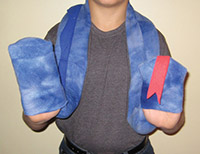
Seat cushions and lap bags that are a lot nicer than the ones I make with a deflated ball, sand and plastic bags are sold by Therapro, Inc. Whether you are reading this blog post as a caregiver, therapist or other type of professional, I hope that adding these simple sensory strategies to your tool box helps the people you love or work with improve their quality of life. This is why I love being an occupational therapist!

 
Disc O'Sit
Disc O’Sit
Weighted Snake Wrap
Weighted Snake Wrap
 
Barbara A. Smith

Guest Blogger:  Barbara A. Smith.

Barbara A. Smith has worked with children and adults with developmental disabilities for over 40 years! She is the author of the Recycling Occupational Therapist, From Rattles to Writing: A Parent’s Guide to Hand Skills and From Flapping to Function: A Parent’s Guide to Autism and Hand Skills. Learn more about her work at RecyclingOT.com.

Massachusetts District Determined Measures

District Determined Measures (DDMs) is a hot topic in Massachusetts’ school districts. DDMs are defined by the Massachusetts Department of Elementary and Secondary Education as:

“measures of student learning, growth, and achievement related to the Massachusetts Curriculum Frameworks, Massachusetts Vocational Technical Education Frameworks, or other relevant frameworks, that are comparable across grade or subject level district-wide. These measures may include, but shall not be limited to: portfolios, approved commercial assessments and district-developed pre and post unit and course assessments, and capstone projects.”

On September 10th, Jan Hollenbeck, OTD, OTR/L tackled the complex and evolving subject in her Saturday seminar entitled: Accepting the Challenge: Developing Meaningful District Determined Measures (DDMS). Jan is an authority on the subject as the Special Education Coordinator responsible for related services, assistive technology, 504, and secondary transition services for Medford Public Schools.

Dr. Hollenbeck shared her experiences with DDMs in an honest and clear way. She provided numerous references and guides to clarify the subject. Because DDMs are designed for teachers, applying them to therapists and other support school personnel is challenging. OTs and PTs are included in the Specialized Instructional Support Personnel (SISP). This group earns individual ratings in two areas: Summative Performance Rating and Student Impact Rating (what’s the therapist’s impact on student learning). We as therapists need to demonstrate that we have impact on student learning, but Jan raised the question of whether DDMs are the right way to do this.

Attendees were all occupational therapists or OT grad students. The seminar generated much discussion among attendees about how OTs fit the model of Massachusetts District Determined Measures and what is happening with DDMs in various school systems where the therapists practice. All enjoyed the opportunity to engage in a lively brainstorming session with colleagues. They were asked to identify their key roles and functions on the school team and designate what data is currently being collected. Quantitative data is required for DDMs. Further in this exercise, therapists generated possible DDMs, decided why they were meaningful, and whether they would be direct or indirect measures of student impact. One interesting idea was to do a survey to ascertain how helpful OT consultation is on a 5 point rating scale, tabulate the results, and use them to arrive at a performance rating.

Jan reminded us that developing DDMs is a “work in progress.” Stay tuned…

Take a look at some remarks from attendees:

“This is the first time I feel like I have a meaningful baseline understanding of the DDM process/expectations.” Anonymous, Occupational Therapist

“Jan presents in an organized & concise manner. She is effective in moving the audience through issues. Considerations presented in a positive manner.” Anonymous, Occupational Therapist

“Very informative – this is a very complicated subject and Jan helped to simplify some of the major points.” Beth M., Occupational Therapist

“I would recommend this seminar to a colleague to get a better understanding of DDMs and how it is still a ‘work in progress.’ Makes you feel less isolated!” Anonymous, Occupational Therapist

Thank you, Jan!
Filomena Connor, MS, OTR/L
September 10, 2016

Task Boxes: A Hands-On Approach to Life Skills

by Angela Mahoney

The importance of pre-vocational planning and opportunity is ever growing, yet when and where to begin can be so overwhelming for both educators and parents! Task boxes are a great way to introduce as well as develop a wide range of hands-on life and vocational activities for a range of diverse learners.

Task boxes are compartments that contain material for a certain activity. The activities are typically short and structured and they offer a nice blend of familiarity and challenge. Any activity that fits in the compartment may be used as part of the young adult’s curriculum both at school and home as well as in a therapy session such as OT, PT and Speech. Task boxes offer much more than organization for the young adult working on the activity:

  • Activities address various skills.
  • They encourage independence, as the young adult takes the task out of the box, completes it, and puts it away with minimal or no guidance.
  • They serve as excellent sequencing activities.
  • The boxes are visual, and the single-unit presentation is easy to understand.
  • They break down activities into small steps, which is an important aspect of applied behavioral analysis (ABA).

Task Boxes for Life SkillsTask Boxes for Life Skills

To create a task box you need to first gather a limited number of materials (10-20) related to the activity as well as a compartment with lid large enough to store materials.

Task_Boxes_for_Life_Skills_3

Next you will need to create a visual guide showing each step of the task in the compartment. This allows the young adult to visually see each step of the variety of task boxes and encourages independence when working.

Task_Boxes_for_Life_Skills_3

After the materials have been placed in the compartment, adhere the steps to the lid, number the box and add it to your task box area for future practice and success with a wide range of skills!

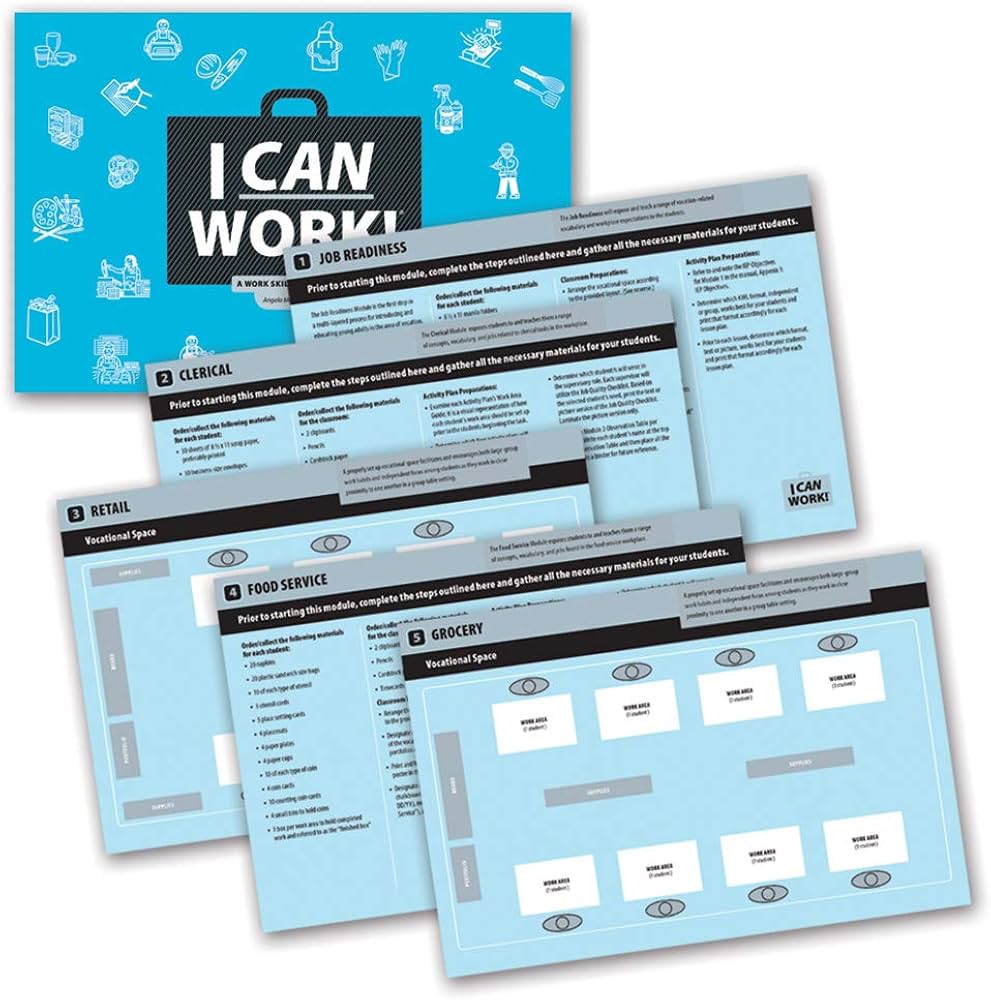
Below are some examples of task box ideas broken down by Module, adapted from the I Can Work! Program.

Clerical: Folding paper in thirds, Addressing envelopes, Filing by numbers or words

Task Boxes for Life SkillsTask Boxes for Life Skills

Retail: Folding t-shirts, Pairing and Sizing shoes, Buttoning Shirt

Task Boxes for Life SkillsTask Boxes for Life Skills

Food Service: Folding napkins, Setting a Table, Assembly of place settings

Task Boxes for Life SkillsTask Boxes for Life Skills

Grocery: Sorting hard and soft groceries, stocking shelves

Task Boxes for Life SkillsTask Boxes for Life Skills

By creating task boxes that apply to life, utilizing vocational materials, young adults are building a stronger foundation and confidence for future success!