

Tag Archives: saturday seminar recaps

Saturday Seminar Recaps provide concise summaries and key insights from Therapro’s Saturday Sreminar professional development sessions designed for therapists, educators, and caregivers at Therapro’s headquarters in Framingham, MA. This tag offers practical takeaways and resources from each seminar to support ongoing learning.

Regulation in the Classroom from an Educator’s Perspective

Victoria Munroe, MA Victoria Munroe, MA arrived at Therapro on Saturday morning, January 16th as a breath of fresh air from Amherst, Massachusetts where she is an innovative 1st grade teacher within an inclusion model.  Her Saturday seminar on January 16th entitled: Regulation in the Classroom from an Educator’s Perspective, was presented to a rapt audience of educators, occupational therapists, and parents.    In addition to being a dedicated teacher, Victoria is a certified Positive Discipline Trainer and Parent Educator, which is an approach to discipline that teaches children positive skills such as “problem solving, relationship building, communication, cooperation, respect, and responsibility.”

The attendees were treated to a virtual tour of Victoria’s classroom where we experienced close-ups of a typical day. Specialized activity areas included classroom sensorimotor stations, areas for regulation driven by Alert Program, Drive Thru Menus, and Zones of Regulation, and spaces for class meetings and lessons. Victoria’s classroom “Peace Corner” holds many sensory materials including a variety of fidgets to help children return to the “Green Zone” of calm and readiness for learning. This classroom provides a nurturing, positive learning environment with built-in supports when a child becomes dysregulated and needs a place to regain control with the goal of remaining in control.

The expectation is for children to transition through activities in Victoria’s classroom, learning successful strategies along the way. Multisensory techniques are utilized to achieve structure throughout the day. These techniques are based on Core values of Victoria’s school, identified by the acronym STAR; Safety, Try My Best, Act Responsibly, and Respect. She demonstrated strategies she uses to help her students with developing executive function skills to help them be better organized and ready for an activity. She suggested something as easy as using photographs as a visual reminder to check if a task has been completed as expected.

A highlight of the morning was getting a roomful of adults standing up and moving to energizing music from GoNoodle.com that encouraged us to “Get Your Body Movin’ and “pull it, push it, dip it” with a catchy beat that you couldn’t ignore.  Victoria uses activities like this for helping her class move, focus, and become alert in order to channel their energy productively.  As a result, her students are engaged and ready to learn!

Here are some of the comments made by attendees who were inspired by Victoria’s presentation:

“Amazing techniques for regulating behavior for all children.  I would love to be a student in Victoria’s class!  Laura E., Teacher

 “It is about a dedicated, experienced 1st grade teacher that is sharing her tools used & implemented with caring and love.”  Anonymous, Occupational Therapist

 “Interactive, inspiring, and pragmatic strategies for student success.”  Sarah S., Occupational Therapist

 “Helpful strategies to help OTs work with teachers.  Good to get teacher’s perspective and how they can use self-regulation strategies in the classroom.”  Stacey F., Occupational Therapist

 “Great job explaining what she does and why.  Very rich detail so it comes alive.”  Anonymous, Teacher

Thank you, Victoria!

Filomena Connor, MS, OTR/L

Fostering Executive Function Skills: Saturday Seminar Recap

Sarah_WardSarah Ward, CCC-SLP of Cognitive Connections in Concord, MA returned to Therapro for Part II of her talk on Fostering Executive Function Skills. This vibrant speaker shared humorous anecdotes and practical strategies to rev our engines.  The 2 hours passed so quickly that she left us wanting more!
Video clips and examples of students struggling with executive function skills were utilized throughout Sarah’s presentation.  In addition to our students and clients, we recognized our own children and ourselves in some of her examples.  She talked about executive functioning for many children as being about “SQ,” meaning “Situational Quotient” rather than about “IQ” – Intellectual Quotient.

Sarah explained the role of working memory and non verbal working future memory, otherwise known as Mimetic Ideational Information Processing, on successful task completion.  She labeled this concept as a “mental dress rehearsal” in executive function skills that occurs on a developmental continuum.  She described children who have difficulty in this area as being a “beat behind” and taught us how we can help them be a “beat ahead.”

In order to move forward with successful task completion, a student needs to have an accurate concept of time. Sarah broke the task plan into three phases: “Get ready/yellow; Do/green, Done/red.” Phase 1 involves task planning, Phase 2 involves task execution, and Phase 3 involves completion. She offered many, many scenarios where she applied the Ready, Do, Done/Get Done Model.  For example: task = doing laundry.  GET READY – photos of washer/dryer, laundry detergent.  DO – Photos of dials of settings on washer/dryer.  DONE/GET DONE – photos of folded laundry in a basket and neat, clean laundry area.  Adding a clock to help estimate time is crucial to success because it makes time visible and tangible.  Check out the Cognitive Connections website and their Pinterest Board for specific clock strategies, i.e. “working clock”. Therapro can help with time materials with Time Timers products.

The goal for students with poor executive function skills is successful management of school assignments, home activities, and community activities with organization and an accurate sense of time. With the research-based tools Sarah has given us, we are ready to tackle executive function skill development in the educational setting and at home.

Once again, Sarah’s audience loved her practical, dynamic, quick-paced presentation.  Take a look at what Sarah’s audience thought of her seminar:

“Great manageable classroom suggestions to set students of all ages up for success!”  Meaghan C., Teacher

“Awesome – Great tips – leaving with a much better understanding of how to help my ADHD child with poor EF skills.”  Karen L., Parent

“Every student on my caseload presents with executive functioning limitations & now I feel like I have somewhere to start helping them!”  Anonymous, Occupational Therapist

“I’m a sophomore in high School and I wish you’d speak to my teachers. This seminar will definitely be helpful in school.”  Brian M., Student

“This seminar explicitly and clearly teaches tools for the whole class and interventions for individual students that feels practical enough to implement immediately & with fidelity.”  Heather A., Teacher

Thank you, Sarah!

Filomena Connor, MS, OTR/L

Yoga as a Therapeutic Practice: Treating the Whole Child

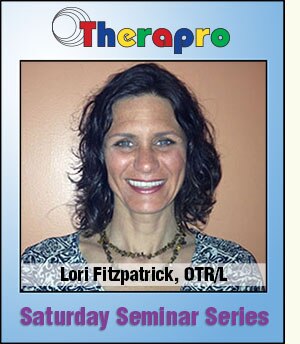
Lori FitzpatrickAt the most recent Therapro Saturday seminar on November 7th, Lori Fitzpatrick, OTR/L and Certified Yoga Instructor, presented: Yoga as a Therapeutic Practice:  Treating the Whole Child. Currently Lori is an occupational therapist in the Plymouth (MA) Public Schools System and also works as a yoga instructor with local social skills programs and special needs programs.

Lori’s review of the history of yoga and the different styles of yoga gave us a basis for understanding how and why yoga can be a wonderful adjunct to school-based practice by therapists as well as an effective practice for teachers to use in the classroom.  The audience included OTs, PTs, Teachers, Grad Students, and Parents who praised the workshop for offering yoga as a medium that can be used by everyone.

It was evident that Lori uses yoga in her school-based practice thoughtfully and in conjunction with more traditional therapeutic modalities. She reviewed the numerous physical and mental benefits of yoga for all children, including those with special needs. Lori explained how yoga creatively addresses many IEP goals including: body awareness, motor planning, bilateral coordination, directionality, memory, attention, etc. Lori recommended using yoga as a complimentary therapy for self-regulation programs such as Zones of Regulation and Social Thinking Programs. She included in her talk a discussion on how yoga benefits the classroom in countless ways. For example, yoga enhances attention and focus, improves listening skills, eases test-anxiety, decreases impulsiveness, improves posture for long periods of sitting, and creates a calm atmosphere and a non competitive environment where all students can experience success.

Audience members openly shared how they used yoga in the school setting. One therapist shared the Yoga Alliance website as a place to examine published research on the efficacy of yoga for children and adolescents. Several studies are highlighted that discuss successful use of yoga in the school environment with a variety of diagnoses.

Lori’s presentation style was interactive and open. She shared many beautiful videos of her group treatment sessions that clearly demonstrated what a gifted instructor/therapist she is in adapting the sessions to each student’s individual needs and strengths. She demonstrated yoga games that can easily be incorporated into the classroom daily routine. Some suggestions included creating “yoga stations” where a student can practice several poses before a scheduled activity or using yoga for “motor breaks.” Lori guided us through teaching children pranayama (breathing). Controlling the way we breathe is very powerful and is beneficial in helping reduce anxiety. Lori’s creative use of props such as LED candles, visualization, bubbles, help engage and focus students.

We all left the seminar with a new respect for an ancient practice that is quite meaningful in today’s school environment and is a powerful and effective modality for therapists and educators. The seminar concluded with all 50 attendees learning the yoga pose – “Breath of Joy.”

Take a look at some glowing reviews from attendees:

“This seminar was great! Lori gave a lot of practical ideas for how to use yoga in schools as a therapist or teacher.”   Amanda B., Occupational Therapist

“ Very informative – everyone can use it. Great suggestions for “tools” to use with kids. I really didn’t know the history of yoga.  I like the concept of “practicing” yoga instead of “doing yoga.” MJH, Teacher

 “Relevant to teaching children about their bodies and how to deal with stress, anxiety, body movements, exercise, breathing, & self awareness.” Laura P., Teacher

 “Enjoyed the practical applications to practice. Wonderful video clips – great ideas.”  Anonymous Occupational Therapist

 “Speaker was well versed on the subject.  Liked the user-friendly presentation and the interactive style of the presenter.”  Maureen M, Occupational Therapist

Thank you, Lori!

Filomena Connor, MS, OTR/L