Tag Archives: saturday seminar recaps

Saturday Seminar Recaps provide concise summaries and key insights from Therapro’s Saturday Sreminar professional development sessions designed for therapists, educators, and caregivers at Therapro’s headquarters in Framingham, MA. This tag offers practical takeaways and resources from each seminar to support ongoing learning.

Apps for School-Based OTs

Margaret (Peggy) Morris, OTD, OTR/L, BCP, Tufts University Pediatrics professor, presented the seminar: Apps for School-Based OTS: BYOD (Bring Your Own Device) at Therapro on October, 24th. Peggy shared her extensive experience in school-based practice and how to use Apps for students and Apps for OTs. Peggy’s presentation style was dynamic and interactive. She elicited creative thinking and problem solving from the attendees. Therapists and student OTs eagerly shared tips and tricks that they have gathered in their experience as well.

The audience was mixed between “digital immigrants” and digital natives” who desire to use or are currently using the internet as a therapeutic tool. Peggy guided the group through accessing iPad functions and accessibility functions on their devices, including Screenshot, Zoom, Digital Safety, etc. A few of Peggy’s favorite Apps for Behavior include: Calm Counter by Touch Autism ($2.99), 123TokenMe from 123appsforme ($9.99), and Breathe, Think, Do with Sesame (free).

She highlighted Dexteria by Binary Labs ($3.99) for Fine Motor and several Cause/Effect Apps such as Fireworks (free), Fluidity by Nebulous design (free), and Koi Pond ($.99). Specifically for therapists, Peggy pointed out Tx Tools by Pediastaff (free) which has a stopwatch, and OneNote by Microsoft Corporation (free), which is a digital notebook for anything you want to organize or remember, such as writing treatment notes, recording them, or snapping a photo. A good tip Peggy provided was that OT Advance publishes an App of the Week and reviews Apps at OT Practice.

Peggy offered invaluable advice for the group on navigating the internet while keeping in mind our responsibility for helping students spend quality time while using screen time. It was interesting to know that The American Academy of Pediatrics (AAP) produced revised research-based screen time guidelines in September of this year. She noted that the www.covd.org (College of Optometrists in Visual Development) recommends visual breaks when using digital devices every 20 minutes for 20 seconds. We tried out the recommendation in the seminar as Peggy set a timer to activate every 20 minutes during her talk to give us an idea about how frequently breaks should occur.

Even though the iPad is a relatively young device that has been in existence for only about 5 years, it is now an integral part of our lives. Peggy noted that as of May of this year, an astounding 80,0000 apps were labeled as “educational”! It is our obligation as therapists to use this technology that is available at our fingertips wisely in our pediatric practice. She recommended reviewing apps through various sites including AOTA where they are grouped into practice areas. The digital age is exciting and evolving almost hourly. We need to jump in and use this tool wisely and responsibly in our OT practice.

Peggy’s seminar was well received, as you can see from the comments below:

“There are many conferences for academic apps, but not OT driven. Helps with evidence-based practice.” Margaret S., Occupational Therapist

“I learned so much. I got so much more knowledge from this meeting than I expected. I highly recommend it to anyone.” Olivia S., Occupational Therapy student

“Peggy was an excellent speaker and had a lot of relevant information to share regarding iPad use and applications.” Anonymous OT

“Great current info & collaborative presentation style.” SMR, Occupational Therapist

Thank you, Peggy!

Filomena Connor, MS, OTR/L
Weaving Mindfulness and Visualization into Your Practice

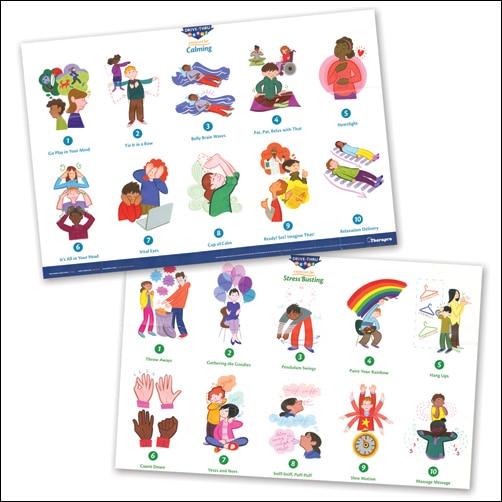
Drive Thru MenusPopular speaker and Therapro author of The Drive Thru Menu Suite of Exercises Tere Bowen-Irish, OTR/L made a return visit to Therapro on Saturday, September 19th to present a seminar on: Weaving Mindfulness and Visualization into Your PracticeTere has spent over 35 years as a practicing occupational therapist in a variety of school settings.  She effectively meshes her expertise in mental health with pediatric practice.

The ultimate goal for the school-based occupational therapist is to help students access the curriculum. Tere discussed that because today’s students appear to be increasingly stressed, angry, and anxious, they may have difficulty achieving academic success. Recognition of every student as “neuro diverse” bears the responsibility of assisting students to increase their resiliency. One way to do this, Tere suggested, is by helping students develop mindfulness. With daily practice of mindfulness, students show decreased stress and improved coping mechanisms when they become dysregulated. A simple task like focusing on breathing is an exercise in centering. For example:  ‘Put your hands on your stomach, inhale through your nose (to the count of 5), exhale through your nose (to the count of 5) 3 times’.

As therapists, we can teach students and their teachers highly effective methods of becoming focused and calm. Tere taught us to use visualization to achieve mindfulness.  Instead of a reactive, impulsive model of “acting, thinking, then stopping”, mindfulness can be achieved with “stopping, thinking, then acting.”

Tere_Bowen-IrishTere is always an engaging and interesting presenter. She used humor and anecdotes liberally to engage her audience. The more than 50 attendees at the seminar eagerly participated in visualization exercises individually and in pairs. The room was alive with energy and laughter!

In a world filled with anxious, stressed-out children, incorporating mindfulness and visualization into their day makes sense.  Mindfulness and visualization strategies can easily become part of the student’s day and can complement self regulation programs which the student may also be using.   A quiet mind and calm self helps with better focus in the classroom, which can directly affect academic success. As Tere taught us, ”Just Breathe….”

Take a look at what attendees had to say about Tere’s seminar:

“She incorporated interactive approaches and was enthusiastic and passionate.  She used wonderful examples for us to apply in school and practice.” Mary E., Occupational Therapist

“Excellent presentation and a lot of great ideas for treatment to address stress, attention and anxiety.” Kelley M., Occupational Therapy student

“I have attended several sessions with Tere.  I always come back from the session with ideas for my kindergarten class.” Ann Marie H., Teacher

“What a wonderful way to address the growing level of students with stress and anxiety.  Took so much away from this seminar.” Nicole R.,  Occupational Therapy student

“Tere is dynamic, keeps things moving, makes it fun.”  Becky S., Teacher/Parent

Thank you, Tere!

Filomena Connor, MS, OTR/L

OT Rubrics for Fine Motor, Visual Motor and Handwriting Skills

Valorie Todd, MA, OTR/LWhen a group of OTs get together to brainstorm, there’s bound to be some exciting “stuff” that is the outcome. Valorie Todd, MA, OTR/L and her school-based practice colleagues in the New York and New Jersey vicinity had a goal in mind. They wanted to devise a way to monitor quarterly progress in performance skills they identified as “OT goals” or “Areas of Need” on the IEP that was based on normative data. Valorie discussed the rubrics her group developed during her Therapro Saturday Seminar Series workshop on August 22, 2015 entitled:  OT Rubrics for Fine Motor, Visual Motor and Handwriting Skills.

This seminar was the kick-off for the Fall Saturday Seminar Series and attracted about 60 attendees who listened closely, commented freely, and shared thoughts. Valorie and her colleagues were determined to conceive a way to assess a student’s performance against predetermined criteria, in which a student is measured against his own performance.

Valorie’s group identified 7 areas for assessment including:

  • Postural Control
  • Sensory Modulation
  • Ocular Motor Skills
  • Object Manipulation: Fine Motor/Hand Skills
  • Controlled Tool Use: Color, Trace, Cut
  • Design Copy: Graphics/Objects, and
  • Handwriting.

In her seminar, Valorie discussed Object Manipulation, Controlled Tool Use, Design Copy, and Handwriting. Fine Motor Rubrics for Kindergarten and Grade 1 were identified.

Valorie offered a thoroughly researched plan on how to assess function and address the skill through worksheets that acknowledged how a student was expected to progress sequentially in each area.  She made clear distinctions in skills expected of a kindergartner versus a first grader.  For example, when assessing “Tracing,” specifically Pencil Control:

kindergartner would receive a score of 4 if he:

  • “Controls lines with min. errors 90-100%”
  • “Stops/turns at corners (angles/arcs)”

A first grader would receive a score of 4 if he

  • “Has good control within/on lines in all directions (90-100%)”
  • “Starts/stops on dots with 1-2 errors”

Valorie’s rubrics were well-defined and can be easily replicated. She was very enthused about sharing her work, including worksheets, and encouraged therapists to use her rubrics and provide her with feedback so that the rubrics can further be developed with input and use over time. As a result, a meaningful assessment of quarterly progress can be obtained and insufficient areas can be addressed systematically and meaningfully before the student is due for the next standardized evaluation.

Attendees comments were very positive and encouraging:

“It was excellent! So much info, well related to school based OTs. This will be helpful in writing goals, tracking progress, presenting at meetings, and for my Teachpoint eval.”  Amanda B., Occupational Therapist

“It helps so much to have these rubrics to support our clinical observations when IEPs are moving toward data driven/measurable goals and objectives. It will help with tracking and also guide thinking when working on skills.”  Anonymous, Occupational Therapist

“Love the practicality of the Rubrics.  Anything we can take away & use is terrific!”  Amanda H., Occupational Therapist

“Looks at detail of task performance and observation of foundational skills which students have or need to build on.”  Anonymous,  Occupational Therapist

“I would recommend this seminar to a colleague because it was well researched and the information was very comprehensive.  The material is very current and I can readily apply this information.”  Anonymous, Occupational Therapist

Thank you, Val!

Filomena Connor, MS, OTR/L