
Tag Archives: saturday seminar recaps

Saturday Seminar Recaps provide concise summaries and key insights from Therapro’s Saturday Sreminar professional development sessions designed for therapists, educators, and caregivers at Therapro’s headquarters in Framingham, MA. This tag offers practical takeaways and resources from each seminar to support ongoing learning.

Early Intervention to Preschool: Key Transition Insights

On a very snowy Saturday morning on Saturday, January 24, 2014, a small, but strong contingent donned their snow gear and ventured out to Therapro to hear Barbara Sanna Collins, OTR/L’s seminar. Barbara presented her talk, Early Intervention Today, School Tomorrow…What You Need to Know to the audience of therapists, teachers, and child specialists. As the Clinical Director of the Massachusetts Brockton Early Childhood Intervention Program, she adeptly led us through the EI process from eligibility, to programming, and then to preparing for the transition to preschool or other appropriate services when the child “graduates” at the age of three years.
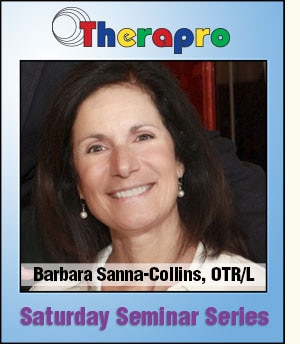
Barbara Sanna Collins presenter of  Early Intervention Today, School Tomorrow…What You Need to Know a Saturday Seminar on the topic of Early Intervention to Preschool: Key Transition Insights

It was astounding to hear that 337,000 children and their families receive early intervention services in the US per year, with 50,000 per year in Massachusetts alone! Barbara updated us on the nitty gritty of how services are paid and how the states differ in their provision of services under Part C of the IDEA federal grant program.

Barbara shared video clips of individual and group treatment sessions in her program that took place at her center as well as at the child’s home. She noted that in the transition to a preschool program, parents who are accustomed to having their hand held through those first 3 years of participation in a program miss this when their child enters the school system – a change from “family focused” services to “child focused” services occurs. The EI team prepares the family and child for this inevitable change in service delivery. At Brockton EI, the team ensures that every child participates in a toddler group before “graduation” so that he/she experiences some typical preschool activities, i.e. transitioning from one activity to another.

Early intervention providers have several unique roles that include the provision of services that help the child with special health care needs reach their highest potential at age three and helping families gain confidence as parents and advocates for their children.

The following testimonials attest to the valuable information Barb presented in her seminar:

“Very informative – A window into the work of EI professionals. Loved the videos of the therapeutic work. Presentation was fantastic!” Marisa G.

“Wonderful presentation. So much good info. Thanks.” Anonymous.

“Very informative and motivating!” Julia H.

“Very informational – I loved the treatment videos!!” Meghan C.

Thank you, Barb!

Filomena Connor, MS, OTR/L
Working Memory: An Overview and Implications

Diane Long, Ed.D, MOTR/L, presented our latest Therapro Saturday Seminar, Working Memory: An Overview and Implications, on November 8, 2014. In addition to her role as Chair of Occupational Therapy and associate professor at Ithaca College, she developed the Therapro publication, TRUNKS®: The Game of Motor-Memory.

Diane met her objectives for the seminar by:

  1. Reviewing a number of theories about the developmental aspects of working memory;
  2. Discussing how working memory contributes to learning, socializing, and task completion; and
  3. Identifying strategies for improving working memory.
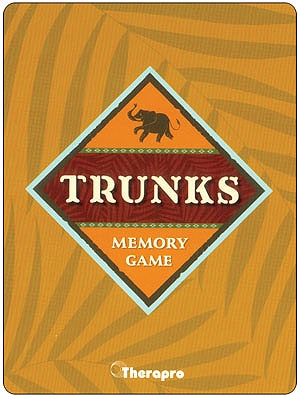
Cover of the game trunks, presented at the Saturday Seminar Working Memory: An Overview and Implications

Her engaging presentation style made reviewing neuro function interesting and applicable. She pointed out that with working memory we form a “mental snapshot” of a task in the prefontal cortex. She noted that working memory is a slowly developing system that does not mature until we are in our 20’s. Its job is to assist in keeping information organized without having to rely on external cues. An important key for us to remember when a child is working on a memory task is to minimize distractions for them, including not talking to them as they work.

Some researchers have found that using games can increase attention and motivation, which can improve visual memory. Diane has proposed that non-computer games (like TRUNKS) will improve working memory skills. She concluded her seminar by actually playing TRUNKS with the audience…”Elephants always remember.”

Seminar attendees had many positive comments about this seminar:

“Material was presented in a fun and interactive way with extreme relevance to therapeutic practice with children.” Molly F.

“Terrific and clear overview of working memory and the impact on learning. The working memory activities helped to apply the concepts.” Denise L.

“Informative but also interspersed with activities to keep up interest and also enhance theories.” Anonymous.

“Interesting topic, well presented, interactive and relevant to my job.” Neha S.

Thank you, Diane!

Filomena Connor, MS, OTR/L

Executive Function Strategies for Students: Seminar Recap

Sarah Ward, MS, CCC-SLP presented the final Saturday Seminar of 2014 on Fostering Executive Function Skills. Sarah is the Co-Director of Cognitive Connections in Concord, MA. She is an expert in the assessment and rehab of traumatic brain injury, particularly in the treatment of executive functioning.

Sarah is a charismatic national and international speaker. A throng of 125 therapists, educators, parents, and paraprofessionals squeezed into the Therapro showroom to hear Sarah share her expertise in developing practical strategies for addressing executive function skills in school-age children and teens. The strategies she shared were readily applicable to anyone in the school and home setting.

Sarah provided many examples of situations where executive function skills are needed in order for a student to execute a plan that results in a successful outcome. Since children have an unrealistic view of time, they need non-verbal working memory, using self-directed talk to execute a task. She illustrated this by presenting various scenarios where a student is asked to perform a task like cleaning his room, getting ready for school or soccer practice, etc. In order to complete the task, he needs a sequential plan. For a student with poor executive functioning, he may have difficulty with making a “mental dress rehearsal” of what he needs to do to in order to accomplish the task, and may get side tracked easily. Sarah recommended a good place to start is for us as the “executive coach” to use a visual word (“see, imagine, visualize, etc.”) and direct the student to put on his “future glasses” to increase awareness. Sarah explained the Get Ready, Do, DONE Model for getting a task completed.

The goal of intervention with a student who has poor executive function skills is to help him become more independent in this area of functioning. Sarah suggested that using therapeutic intervention strategies will improve the following: situational awareness and forethought; task planning, initiation, and transition between tasks; and finally, active self-management of the factors related to time passing. The objective is to help the student learn to manage the organization and time demands of school assignments, home and after-school tasks successfully.

Take a look at a few of the glowing testimonials from attendees about this seminar:

“This was the best, most practical seminar on executive function skills I could have imagined. I came away with lots of strategies that I feel ready to implement at home.” – John G.

“Wow, wow, wow! I loved it! I want to share this info with everyone.” – Jessica E.

“So incredibly practical and helpful – so many amazing tools.” Michele M.

“Sarah provides strategies/practices that can be implemented immediately, across all settings for all ages…and they make sense!” – Kate V.

Thank you, Sarah!

Filomena Connor, MS, OTR/L