Category Archives: Life Skills and Transition Planning

Discover strategies, tools, and supports for life skills development and effective transition planning, including vocational training and daily living preparation for all stages.

Transition Planning Inventory-3 Overview & Review

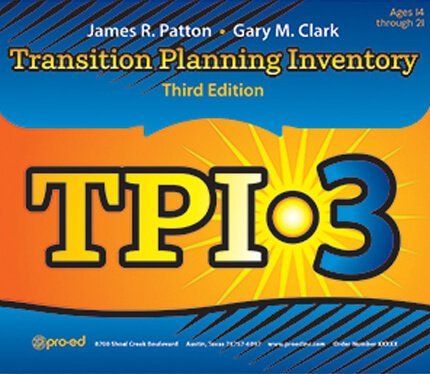
The Transition Planning Inventory - Third Edition

The Individuals with Disabilities Act (IDEA) of 1990 instituted a transition mandate for students receiving special education services.  IDEA 2004 expanded on this to include planning across all areas including community participation, independent living, and continuing education. The Transition Planning Inventory, now in its 3rd edition, was designed to address these mandates. As described in the TPI-3 Administration and Resource Guide, the primary purpose of the TPI-3 is “to assess the transition needs, strengths, preferences, and interest of students at the secondary level” (Patton & Clark, 2021, 14*)   The domains covered within the TPI-3 are working, learning, & living. 

Information is gathered from:

Core Rating Forms 

  • Three forms (Student, Home, and School) Each form contains 57 statements related to transition planning.
  • Each form is organized according to 11 planning areas; Career Choice & Planning, Employment Knowledge & Skills, Post Secondary Training/ Education, Functional Communication, Self Determination, Independent Living, Personal Money Management, Community Involvement & Usage, Leisure and Recreation, Health, & Social/Interpersonal Relationships.

Preference &  Interest Forms

  • Intended to gather information about a students preference and interest
  • Two versions available; basic (intended to be used early in the transition process) and advanced (intendended to be administered when a student is close to leaving school).
  • An optional Home Preference and Interest Form is also available.

Information is compiled through:

Profile & Further Assessment Recommendation Form

  • All information is summarized on this form consisting of 6 sections; 1.) general information, 2.) likely setting for postsecondary outcomes, 3.) student’s preference, interests, and strengths, 4.) results of other assessments, 5.) student profile, 6.) further assessment and information.

Summary of Performance Data

  • The purpose of this form is to give users a quick and easy way to compile the information required by IDEA into a Summary of Performance (SOP) document.  

Overall, the TPI-3 provides a comprehensive means to gather key information from all major players in order to create and implement a meaningful transition plan.

Quick Facts

Age Range: 14-21

Administration Time:
Student Rating Form:

  • 15-20 minutes to complete independently
  • 25-30 minutes if administered orally and/or with support.

The Home Core Rating:

  • 15-20 minutes to complete independently
  • 25-30 minutes if administered orally and/or with support.
  • The School Rating Form 10-12 minutes

Student Performance & Interest Form:

  • 10 to 15 minutes to complete independently
  • 20-25 minutes if administered orally and/or with guidance.

Profile & Further Assessment Recommendation Form

  • 10-15 minutes

Publication Year: 2021

Authors:
James R. Patton
Gary M. Clark

Administration Type: Individual

Scoring: Inventory rated on a scale from 0 (strongly disagree) to 5 (strongly agree)

*Patton, J. R., & Clark, G. M. (2021). Transition Planning Inventory Administration and Resource Guide (3rd ed.). Pro-Ed.
I Can Work! Paving the Path for Vocational Success

At the Fall “Kick-Off” Saturday Seminar Series presentation on August 25th at Therapro, Angela Mahoney, M.Ed. generated an electric environment infused with her passion for helping students and young adults develop the foundation for “career readiness” skills. Angie is an educator and is the author/creator of I Can Work!. Her seminar, I Can Work! Paving the Path for Vocational Success, drew an audience of occupational therapists, parents, and educators, who participated in active dialog with Angie and each other throughout the seminar.

Angie is an ardent educator who continuously strives to modify, expand, and develop I Can Work! Currently she works as a special education middle school case manager in Danbury, Connecticut. For the past 17 years she has worked with students of all ages in a variety of settings, including a private school where she worked with over seventy-five middle school and high school-aged students on a weekly basis, running an inclusion-based elementary program for students with autism, as well as co-teaching core academic classes as part of a team comprised of fellow middle school educators.

Angie stated her goal as an educator is to “help kids find success.” Throughout her seminar, she provided life skills ideas and pre-vocational activities within a structured framework that is applicable to learners of varied abilities. In order to build career skills, Angie discussed the importance of students learning “Vocational Soft Skills” and “Vocational Hard Skills.” Vocational soft skills are interpersonal skills: language skills, social skills, teamwork, communication skills, time management, and more. Angie reported that research indicates that being able to communicate effectively is the most in-demand soft skill. Learning to use soft vocational skills effectively in a pre-vocational environment helps build confidence for when the student is in an actual work environment. For example, learning to maintain a positive attitude and work well with others will be important skills to develop in any chosen career.

“Vocational Hard Skills” are abilities that can be taught and have three characteristics: can be mastered quickly, can be quantified, and can be built over time. The I Can Work! curriculum consists of 5 modules that focus on career readiness: Job Readiness, Clerical, Retail, Food Service, and Grocery. For each module, related vocabulary is taught, tasks are practiced, and visual supports are provided. In addition to exploring career interests, data collection takes place to track learning and success. Opportunities are provided for students to share and reflect on their jobs. Angie advocated the importance for students to have opportunities at home to reinforce pre-vocational skills learned at school with activities like sorting and folding laundry, filing by letter or word, etc.

After hearing the attendees passionately express the need and importance of a solid pre-vocational program for students, it makes good sense that I Can Work! could fulfill this demand. Angie convincingly demonstrated that this curriculum could provide a strong pre-vocational foundation for all, beginning in elementary school and continuing beyond high school years.

Here are some of the many positive comments from seminar attendees:

“This topic is so needed. I would like to ask my school to pay for Angela to come and speak to my district. Also, since she is a sped teacher, my sped teachers can relate!” – Karen B., Occupational Therapist

“Presented in a manner which is easy to follow and incorporate into the school. Data collection sheets are very helpful.” – Pam M., Occupational Therapist

“I would recommend this seminar to increase awareness in schools and SEPACS, maybe local programs.” Aly M. – Teacher, Parent, ABA

“This seminar “honed in” on the need for an available program for pre-vocational and vocational skills beginning from upper elementary through adult.” – Sue R., Occupational Therapist

Thank you, Angie!

Filomena Connor, MS, OTR/L
August 25, 2018

Self-Care with Flair: A Curriculum

Creative authors, Bhanu Raghavan, MS, OTR/L and Ginger McDonald, OTR/L developed a unique curriculum for increasing independence with self-care skills. The program instructs how to teach the skills of dressing, grooming, toilet training, and eating by using a uniform approach with pictures and rhyming while employing visual, verbal, and tactile/kinesthetic cues. Each task is broken down into steps through activity analysis. In June of this year, Bhanu shared her expertise with therapists, caregivers, and children in Guatemala. Here is the account of her experience.

Visit the Self Care with Flair! webpage.

Bhanu Raghavan, MS, OTR/L

Self-Care with Flair! goes international once again…

Teaching basic self-care skills to children can be tedious and is often not prioritized in school or at home, even though these skills are critical for successful transition into the community. Occupational therapists are often consulted for support with this task.  A uniform approach to teaching daily living skills is critical to helping the child generalize the skills to all situations. Learning can be delayed when small differences in method and/or terminology confuse the child or when the number of steps prove to be overwhelming for the child, parent and/or teacher. Occupational therapists, Bhanu Raghavan and Ginger McDonald, authors of Self Care with Flair!, have shared their expertise in teaching self-care skills in a creative, fun way with therapists across the globe. Their methodology involves teaching self-care skills using rhymes to promote mastery and retention within a short period of time. They have based their method on evidence-based research that demonstrates that novel experiences such as rhymes and rhythm trigger the brain to sustain attention. In 2015, they presented at the British Occupational Therapy conference about their effective strategies for teaching self-care skills from their book to a packed audience.

In June 2017, when Bhanu accompanied a team of students, therapists and Professors from Xavier University (Cincinnati, Ohio) to participate in a weeklong volunteer service project in Guatemala at the Missionaries of the Highways, a clinic and residential facility for children with a variety of physical and mental disabilities. Over the course of the week, many questions about teaching self-care skills to children with disabilities arose. Bhanu shared strategies from Self Care with Flair! when she presented an in-service to the staff.  During that week, strategies from Self-Care with Flair! were shared with parents and caregivers as well. Although Spanish is the national language of Guatemala, the illustrations (300+) in the book made teaching/learning quite simple and universal.

Using Self-Care with Flair! Bhanu aided the staff, parents, and caregivers in understanding that the brain learns and retains when visual, auditory and kinesthetic cues are embedded in the teaching/learning process, resulting in success for life.

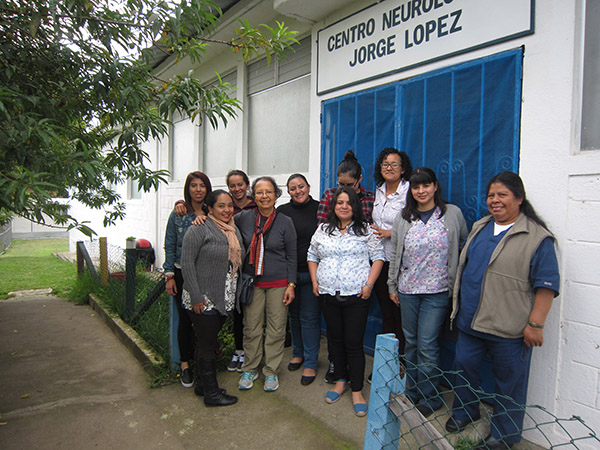
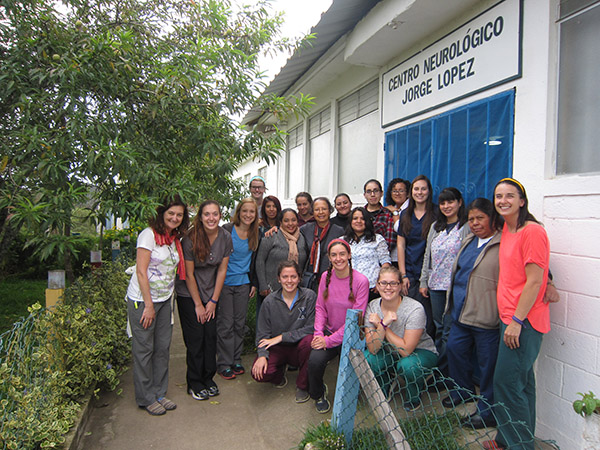
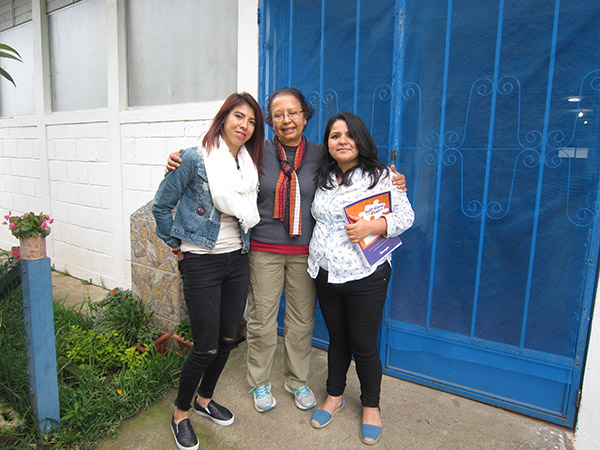
At the end of the week-long service project, the staff of the Missionaries of the Highway acknowledged the ease of use and success of the Self Care with Flair! approach to self-care activities and requested a copy of the book, which was gladly given to them (See photos).  Much to Bhanu’s delight, one of the OTs at the facility volunteered to translate the rhymes in the book into the Spanish language as needs arose!  The week was a joyful learning experience for all!!

Self-Care with Flair!


Bhanu Raghavan, MS, OTR/L

Bhanu RaghavanA graduate of Indiana University and The Ohio State University, Bhanu has over 25 years of experience in pediatrics. She is certified in pediatric NDT and the READY Approach (Bonnie Hanschu) for Sensory Integration Disorders. Frequently, she presents workshops on topics related to self-care independence, sensory processing disorders and fine motor/handwriting skill development to therapists, teachers and parents/caregivers. She works at Centerville City schools, OH. She is a firm believer of the following Confucian principle: “I hear and I forget, I see and I remember, I do and I understand.”