By Barbara Smith, M.S., OTR/L
Many individuals with a sensory processing disorder (SPD) have poor body awareness. This means that they have difficulty perceiving where their arms and legs are in relation to other objects and people. They easily trip, knock things over and lack a sense of personal space. Possible signs of decreased body awareness include:
- sitting or leaning on others curing circle time
- awkward gait
- clumsiness during ball play and other gross motor activities
- poor fine-motor skills.
Children with poor body awareness often have motor planning difficulties. It’s challenging for them to plan and perform skills such as riding a bicycle or cutting out shapes when challenged to perceive:
- how much force to use
- the spatial relationships between oneself and objecs
- the spatial relationships between objects,
Occupational therapists use a variety of strategies to improve body awareness and motor skills. Let’s take a look at a few that involve adapting with weighted materials.
Weighted Materials
 Many children love to snuggle up in heavy and/or tight blankets. Weighted vests, toy animals, collars and other products increase body awareness and also have a calming affect. Gross motor activities (such as wrapping up inside a blanket while rolling across a mat, or rolling across cushions and pillows) combine heavy pressure and vestibular movement stimulation. This helps children interpret how their bodies are moving.
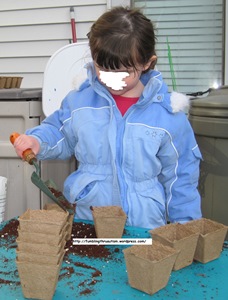
Using heavy materials such as shovels during activities provides proprioceptive sensory input to joints and muscles. The girl shown in the photograph is not only using a heavy shovel but she is also moving around heavy dirt. This is an ideal activity to increase body awareness!
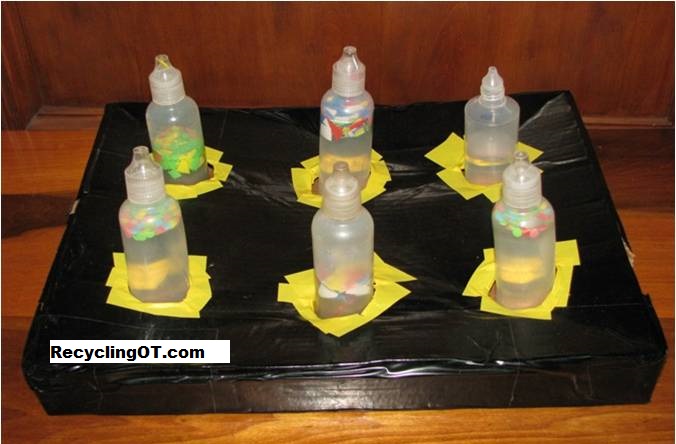
When materials are not naturally heavy, we can adapt them. For example, the “pegs” used in this board (made out of cardboard boxes) are not only extra large because they are made out of bottles, but extra heavy because they are filled with water. The “pegs” provide visual, auditory and proprioceptive cues that helps guide the individual’s hand during placement.
Sensory Socks and Rings
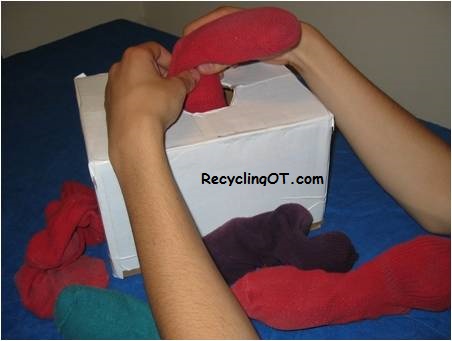 Filling socks or tights with sand creates “Sensory Socks.” (To increase length, you may sew several small socks together. To prevent sand leakage, place the sand in a plastic bag before placing inside the sock.)
Many children with decreased body awareness neglect one side of the body and try to do everything using one hand.
Using large, long, heavy and awkward materials such as “sensory socks” encourages bilateral hand use. Begin by offering a container with a large opening and grade, then graduate to using containers with smaller and smaller openings so that the child needs to manipulate and push with the fingers.
Some children with decreased body awareness will try to insert the sock by dangling the distal end. This activity is a great way to help children problem solve by grasping the socks at the end closest the container opening.
Note: Smaller sensory socks can also be used during tossing activities.
Sew the ends of the socks together to create rings! Explore the variety of heavy objects that can be used to weight these, such as:
- pennies
- marbles
- dried beans/lentils/rice.
Some of my clients enjoy the sensation of putting these rings on and off their arms.
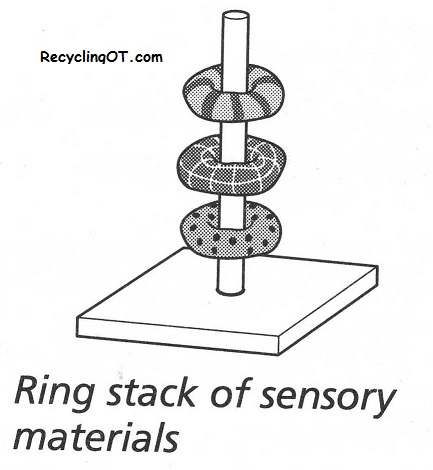
Occupational therapists often recommend weighted products such as the following to promote function during daily living skills:
- spoons, forks or cups
- pencils and pens
- gloves to aid in handwriting
- balls.
In addition, wrist weights can be used during any fine-motor activity to increase body awareness.
Sensory Bags
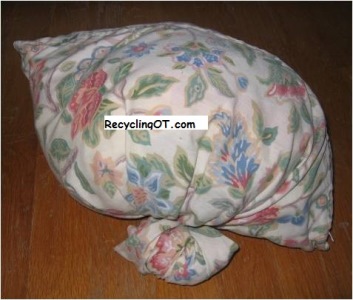 Possible homemade adaptations include adding sand to stacking boxes and tossing/catching a “sensory pillow.” This pillow case filled with foam and small bags of sand is easy to grasp, fun to hug and won’t roll away.
Many children naturally meet their sensory needs during play as they wrestle, have pillow fights and crash into mounds of leaves. Here are a few more fun “weighted” activities to add to a child’s sensory diet:
- placing heavy toys on a blanket or in a wagon to pull
- carrying buckets of water or sand to fill sensory tables
- hiding heavy toys inside the tables to remove and bring to another area.
As you can see, there are many ways to adapt environments and activities with weight. Let’s review why: pushing, pulling, squeezing and lifting heavy objects stimulates the muscles and joints, increasing body awareness. Deep pressure is calming and may improve focus. Improved focus and body awareness help children to plan movements so that they can play and learn to the best of their ability. So now that you know the scoop – let’s get weighting!
* * *
Barbara Smith, M.S., OTR/L has worked with children and adults with developmental disabilities in a variety of settings over the past 30 years- including early intervention programs, public schools, special education collaboratives, day habilitation programs and community residences. She is the author of The Recycling Occupational Therapist, 2nd edition (RecyclingOT.com, 2012).
Check out Barbara’s website for information and resources at: RecyclingOT.com
Illustrations are from the author’s book The Recycling Occupational Therapist.