Tag Archives: physical therapy (PT)

Discover evidence-based physical therapy resources,  equipment, tools, strategies, and professional insights to support physical therapists in enhancing mobility, strength, coordination, and overall functional outcomes across the lifespan and in diverse settings.

Motor Interventions in Autism: Enhancing Participation and Function

Dr. Jennifer Colebourn, MSPT, DPT and Dr. Julie Goff, MSPT, DPT presenters of The Role of Motor Interventions in Autism Spectrum Disorder.

The 2019 Therapro Saturday Seminar Series was launched by school-based physical therapists, Dr. Jennifer Colebourn, MSPT, DPT and Dr. Julie Goff, MSPT, DPT with their presentation: The Role of Motor Interventions in Autism Spectrum Disorder.

Jenn and Julie met at Northeastern University where they were pursuing their doctoral degrees. Jenn’s research focuses on motor interventions for Autism Spectrum Disorders. Her most recent work has been published in the journal, Pediatric Physical Therapy: A. Colebourn, Jennifer & C. Golub-Victor, Ann & Paez, Arsenio. (2017). Developing Overhand Throwing Skills For a Child With Autism: A Collaborative Interdisciplinary Approach In School-Based Therapy. Pediatric Physical Therapy. 29. 262-269. Julie’s research on improving gross motor skills in children with Autism Spectrum Disorders received Northeastern’s RISE award in 2016. In their practice, both therapists focus on a collaborative team approach to improving motor performance in children with ASD.

Attendees were given a comprehensive review of Autism Spectrum Disorder, including the DSM-V (2013) diagnosis as a Neurodevelopmental disorder. We learned that ASD is no longer classified on a “spectrum” but with levels of severity. The term “Asperger” is no longer used, but individuals with the characteristics formerly attributed to Asperger are now considered to be “high functioning Autism.” An alarming statistic they revealed was that currently 1.5 billion children in the US have an autism diagnosis. Jenn and Julie cautioned that diagnosing ASD is complex and in the past 5 years, neuroimaging has provided startling information about the difference in the brain of the child with ASD from a typical child, i.e. “neuro over connectivity” that impacts function.

Jenn and Julie addressed the fact that motor function of children with ASD is affected, usually with simple motor tasks being intact, but with complex tasks and motor planning being impaired. Motor difficulties are now considered a “Core Deficit.” Screening for motor deficits is important for all children with the ASD diagnosis. The PT’s role includes recognizing if a motor impairment interferes with function. Julie and Jenn cited a number of studies that examined how core deficits affect a child’s participation in physical activity across many dimensions. What we might see is a child who prefers simple, sedentary activities and who doesn’t participate in complex social activities such as organized sports. In summary, motor deficits affect a child’s ability to participate in play.

When providing treatment for the child with ASD, Julie and Jenn advocate strongly for a team collaborative approach that includes the child’s family members. They noted that the ABA therapist would be a strong, valuable ally because they can provide behavioral support to motor intervention. They discussed ways to design the environment and treatment sessions in order to help ensure success and motor learning. A few examples they gave were: promote positive transitions, simplify choices, and have a predictable space and schedule. A few materials they recommended include: Body Awareness Fun Deck, Upper Body and Core Strength Fun Deck, Magicatch Set, Rainbow River Stones, Learn to Move, Move to Learn!, and ABC Yoga Cards for Kids.

We are grateful to Jenn and Julie for sharing their passion and expertise for improving motor performance of children who have an ASD diagnosis. With improved motor skills, it is likely that other areas of function will be affected in a positive way as well. With the high incidence of ASD worldwide, Autism will affect us all. The need for continued research is critical to help our understanding and ability to treat children with ASD effectively.

Here are just a few of the attendees’ positive reviews of this seminar:

“Incredibly informative and relevant! Felt so empowered from the seminar. Helped to give me better direction in my practice as well as increased confidence in my recommendations to families & school staff.” – Laine F., Physical Therapist

“The two presenters were so knowledgeable in their area – facts were most interesting.” – Rolene K., Teacher

“Great overview of school PT and best practice for collaboration with all members of the team.” – Micaela M., Physical Therapist

“Presenters were professional presenting evidence based practice to help improve functional skills for students with Autism.” – Alice T., Occupational Therapist

Thank you, Jenn and Julie!

Filomena Connor, MS, OTR/L
January 12, 2018

The Value of Therapy Balls and How Best to Store Them

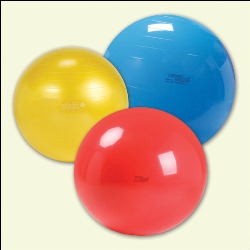
Physio Gymnic Balls, a valuable therapy tool I’ve had the joy of working in four different countries and across a variety of clinical settings. No matter the environment or the age of the client, certain tools remain universally valuable—and therapy balls are one of them. I’ve successfully used therapy balls with individuals recovering from head injuries or strokes, as well as with children with learning challenges and even clients with visual impairments.

I think balls of various sizes, textures, and shapes are a tell-tale sign that you have stepped into an OT room or department. Therapy balls are valuable in meeting so many goals and certainly show how dynamic OT is and how creative we need to be with every treatment plan and session. Let’s face it, balls are fun for most ages. They are colorful and versatile. Being round means that they are dynamic, resulting in the ability to grade therapy sessions by working on an unstable surface.

Therapy balls are valuable for improving:

  • motor control
  • muscle tone
  • trunk control or strengthening core muscles
  • upper limb function for clients with orthopedic or neurological disorders
  • introducing fun games and exercises into therapy
  • eye-hand coordination
  • righting and balance reactions
  • weight shift

Balls can encourage a child to feel excited to come into a treatment room or to prepare a blind child for hippotherapy. Balls can be just as important to an older woman needing to reduce internal scarring from repeated abdominal surgery.

There is one problem with therapy balls: storage. Without due care, your therapy room can quickly become messy, cluttered, and a potential safety hazard. We don’t want our clients tripping over equipment!

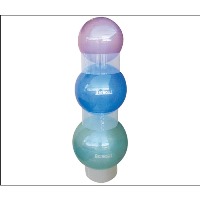
Aeromat Fitness Ball Stacker, a space-saving storage solution designed to neatly organize and stack fitness balls of varying sizes.If you’ve ever worked in an OT department or been involved in developing a therapy department in limited space, then you can appreciate the need to organize physio/Gymnic balls. There are times that facilities will look into securing a suitable shelf, setting up a hammock specifically for therapy balls, or acquiring an array of other wall or ceiling fittings.

But what can do you do if your practice is in rented space that doesn’t permit attaching anything to the walls or ceilings? Or if your OT room is in a building with prefabricated walls and ceilings, reducing the strength and stability of the internal structure?

When I started in private practice, one of the first pieces of equipment I obtained was a large therapy ball with bells inside. Amongst my first private clients was a child who was blind from birth and severely sensory-deprived, hence the bells within the ball. It was wonderful to introduce a ball game in which he could participate because he could hear where the ball was.

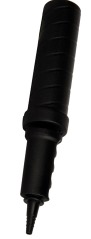
11” Two-Way Hand Pump is a versatile, durable, and efficient tool designed for inflating exercise balls, therapy balls, and other inflatablesThe problem was how to store the therapy ball. I grappled with this dilemma until I discovered the wonderful Ball Stacker. It looks professional and neat and makes a good impression when a parent comes into the therapy room for the first time. Now you can use therapy balls even if you can’t attach brackets, shelves, or hammocks to the wall or ceiling.

Another valuable accessory to the therapy ball, is the Ball Handpump which offers the freedom to alter the pressure in the ball according to the goals of your client.


Guest Blogger: Shoshanah Shear

Shoshanah ShearOccupational Therapist, healing facilitator, certified infant massage instructor, freelance writer, author of “Healing Your Life Through Activity – An Occupational Therapist’s Story” and co-author of “Tuvia Finds His Freedom”.

Move Mindfully Card Deck and Sensory Systems

Therapro is excited to offer the Move Mindfully Card Deck, available at our store. This product helps integrate physical fitness, mindfulness and social emotional skills into practice. The deck not only offers individual poses, but also routines to address a variety of common needs, such as “accident prone” and “lethargic”.

As a Blog Bonus, we are offering a free download of three poses from the card deck to get you started with a simple routine.  Read on to learn more about each pose and how it relates to your Occupational Therapy goals.

Belly Breathing

Belly Breathing

Getting into the Pose:
Belly Breathing is often taught with the Hoberman Sphere. The brightly colored, collapsible tool offers a visual tracking point to feel the diaphragm expand and contract. However, hands can simply be placed at heart and belly when teaching belly breathing as well. To start, we recommend a seated position in a chair, for back support. As a modification, this pose can also be completed laying on the floor. In this position, try a small object or toy placed on the belly for extra visualization of the up and down movement.

Therapy Resource:
Belly breathing is a great way to work on postural stability while maintaining an upright position without a collapsed trunk or slouched shoulders. This pose also taps into interoception and body awareness as breathing is tracked.

Tree Pose

Tree Pose

Getting Into the Pose:
Tree Pose is an introductory balancing pose that all body abilities can enjoy. We start by cueing the heel to touch the ankle. As balancing progresses, the foot can be placed on the calf or thigh. However, make sure to avoid any pressure on the knee joint. The hands press together at midline, palm to palm, providing additional input.

Therapy Resource:
Like belly breathing, this pose works postural stability through core activation in a static hold. It also works on bilateral coordination as hands and feet press towards midline while maintaining balance and focus. The stacking of joints over the anchored foot (ankles, hips, wrists) taps into theproprioceptive system. If you need additional proprioceptive input in this pose, try stamping feet before attempting to hold static. Activate the vestibular system by experimenting with the foot and hand placement.. Also, try small movement, such as swaying, within the pose. Work on vision by providing various focal points experimenting with gaze up, out, down and even eyes closed. If you see the MORO Reflex in this pose, return to Belly Breathing.

Child’s Pose

Child's Pose

Getting Into the Pose:
Child’s pose is often used at the beginning or the end of a session. However, it can be used whenever there is a need to decrease overstimulation. It can be completed on the floor or at a table.

Therapy Resource:
As you cue stacked fists, you are working on bilateral coordination and proprioception as joints are stacked together at midline. On the floor, there is the additional tactile input from the legs and arms on the Earth. Seekers may need to rock, or add extra movement to the pose, while avoiders may have to stay more upright. Offer a vestibular system modification of seating in a chair, hands stacked on forehead and chin slightly tucked.

Guest Blogger: Stephanie Kennelly

About Us-

This blog post is a collaborative effort of Sweet Inside Yoga and 1000 Petals.

Sweet Inside Yoga is a company providing resources for occupational therapy, physical therapy, mental health practitioners, classroom teachers, yoga teachers, professionals, parents, and others in the community to use with individuals who can be found seeking and/or avoiding yoga activities.

1000 Petals is a well-being training and consulting company based on the science and practice of mindfulness and movement. They provide integrative mindfulness and movement solutions in workshops, events, retreats and self-care classes.