
Tag Archives: product spotlight

Featured therapy products highlight tools and resources that improve fine motor, sensory, language, gross motor, self-help, functional skills, and so much more. Learning about featured therapy products helps select effective solutions.

Getting it Write: Wrist Extension in Handwriting

gettingitwriteHere at Therapro we have a BIG focus on handwriting – from Programs, to Practice Worksheets, to Grips and Tools for maintaining proper positioning. Since positioning is the foundation for good handwriting, we recommend emphasizing these skills right from the beginning.

The best position for handwriting is with the wrist in extension. This extension provides the support necessary to get the hand into a tripod position to hold the pencil.

We’ve noticed two trends recently that can hinder proper handwriting development:

  • Children have been learning to write, and using pencils much earlier
  • Children have a tendency to “hunch” their shoulders due to poor muscle tone
  • People don’t put babies on their stomachs anymore, meaning they don’t learn to push up – leading to weaker arm and shoulder muscles

The reason these can be an issue is because they’re using the wrong muscles of the hand – what happens is they get a “death grip” on the pencil from holding it wrong, and keeping the wrist in the wrong position.

If babies don’t gain arm and shoulder strength, this can manifest itself when first grade teachers introduce handwriting. Low muscle tone leads to poor posture and grip, which become evident when the child first learns writing skills.

The way to get out of these bad habits is to put the wrist into extension. Since you don’t want them writing all over your walls (we don’t, at least!), the solution is a slanted surface. Having an incline of at least 20 degrees is the ideal angle for wrist extension and proper handwriting technique. Getting the writing surface more toward vertical will straighten the wrist and provide the support needed to hold a pencil correctly.

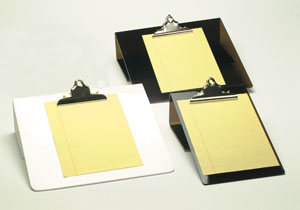
Our Write Slant Boards were first developed for the adult market, but are great to use with kids, and in the classroom. The slant board not only puts the wrist in extension, but it is also good for vision, visual tracking, and strengthening posture.
Exploring Chewy Tubes Oral Motor Tools

The Chewy Tubes Oral Motor Tools family offers a wide range of products designed to support oral motor deChewy Tubes Oral Motor Toolsvelopment and sensory needs in children and adults. These safe, durable, and versatile tools are ideal for improving chewing, biting, and self-regulation skills, making them an essential part of occupational and speech therapy. Whether used for sensory input or as part of a therapeutic intervention, Chewy Tubes help individuals develop the necessary oral motor skills to thrive in daily activities.

Which of the Chewy Tubes oral motor tools is right for your child? With this guide, you’ll be able to pick the perfect resistance and style.

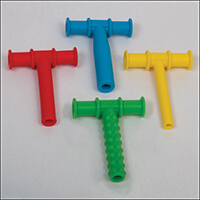
Yellow (smooth)

The Yellow Chewy Tube is used with a smaller jaw, typically infants and children up to 2 years old and individuals who cannot open the jaw very wide. The Yellow Chewy Tube features a narrow stem of 3/8″ OD.

Red (smooth)

The Red Chewy Tube is typically used with toddlers, older children and adults to provide a smooth surface for practicing biting and chewing skills. The Red Chewy Tube features a stem of ½” OD.

Green (knobby)

The Green Knobby Tube offers increased sensory input from the raised bumps along the bitable stem. It provides a slightly firmer bitable surface. The Green Knobby Tube features a stem of 9/16″ OD.

Blue (smooth)

The Blue Chewy Tube is the largest and firmest of the Chewy Tubes. It is intended for adolescents and adults with developmental disabilities, autism or sensory integration disorders. The Blue Chewy Tube features a stem of 5/8″ OD.

Red Super Chew (knobby)

The Red Super Chew offers a solid yet bumpy surface for practicing biting and chewing skills. The closed loop handle is easily grasped by little fingers. The Red Super Chew features a stem of 9/16″ OD.

Green Super Chew (smooth)

The Green Super Chew offers a solid and smooth surface for practicing biting and chewing skills. The closed loop handle is easily grasped by little fingers. The Green Super Chew features a stem of ½” OD.

Ps and Qs

Ps & Qs provide a smooth and solid surface for practicing biting and chewing skills. The Q is wide enough for bilateral chewing activities and the P is especially easy to grasp by small fingers or those with low muscle tone.

Chewy Tube handles have corrugated ridges to assist the grasp – especially useful for those who are visually impaired.

Solving Visual Tracking Problems

Did you know that up to 50% of children in classrooms experience visual challenges—most commonly with eye tracking? These difficulties can significantly impact reading and writing, especially as children begin to learn handwriting.

To address this issue, therapists began highlighting the bottom line of traditional lined paper to show children where their letters should go. Recognizing the need for a more effective and consistent solution, Therapro created Highlighter Paper—a simple yet powerful tool designed to support children with visual tracking and handwriting challenges.

What Makes Highlighter Paper Unique?

Highlighter paper- a resource for solving visual tracking problems

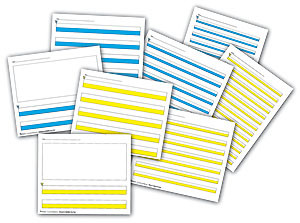
Highlighter Paper features a visually distinct bottom line to help guide letter placement. To support correct letter formation and left-to-right orientation, the paper is indented at the starting point and includes a star icon to clearly indicate where to begin writing.

The paper comes in various formats and line widths to support children at different stages of handwriting development. Some styles also include space to draw a picture, with lines below for writing a description—ideal for creative storytelling or early literacy activities.

Choosing the Right Paper

Highlighter Paper is available in yellow or blue backgrounds and comes in four formats, each designed to support a specific stage of handwriting development:

  • Kindergarten Story Paper: Landscape format with a blank space for drawing and two lines for writing
  • Kindergarten Writing Paper: Landscape format with five writing lines
  • WideLine Writing Paper: Landscape format with seven writing lines
  • NarrowLines Writing Paper: Portrait format with 13 lines for more advanced writers

Not sure which to choose?

For early writers, especially in the first half of first grade, we recommend starting with wider lines. As handwriting skills progress—typically by the second half of first grade—children gain more motor control and can transition to narrower lined paper.

Additional Support: Reading Guide Strips

Therapro also offers Reading Guide Strips—simple tools with a transparent, tinted window to help children visually track lines of text while reading. These can be a helpful addition for children with visual tracking difficulties, especially during early literacy instruction.