Tag Archives: product spotlight

Featured therapy products highlight tools and resources that improve fine motor, sensory, language, gross motor, self-help, functional skills, and so much more. Learning about featured therapy products helps select effective solutions.

Back-to-School Readiness for Classrooms

Throughout the summer, we ensure that our children have all the supplies they need. We worry about their transitions from one grade to another, but as therapists and educators, are we back to school ready? I have created a small list of products that every special educator and therapist should have in their arsenal of education. Most of these items are small and easy to transport from classroom to classroom or school to school.

Here is a list of 15 items you need to start the year off right.

Educational Needs – The products below are perfect for the learning needs of all!

  1. Highlighter Strips are great for visual learners. An ideal tool for those with reading and visual processing difficulties. Brightens any written word. The plastic strips can be placed over any written material and used over and over again.
  2. NOVENOPs! is a hilarious game that teaches sentence structure! A card game for children of ages 6 and up. This game helps develop the player’s ability to understand the basic elements of grammar.
  3. Letter Treasure Hunt is a Pirate adventure with a handwriting twist! A board game with a handwriting component and the pirate theme makes it tons of fun.
  4. Trunks is a game where players move their bodies, make sounds and perform actions from memory!

Handwriting – Slant Boards, Paper & Grips, Oh My! Everything you need for working on handwriting skills, you will find here!

  1. Better Board Slant Boards are made for traveling (from home to school, class to class, etc.) and can easily be stacked and stored in a classroom.
  2. Raised Line Writing Paper is perfect for teaching line orientation, and cueing correct letter and word spacing. Graph spacing is also used for teaching numeracy and basic addition and subtraction.
  3. Pencil Grip Samplers let your students experiment and find their most comfortable writing tools.
  4. Highlighter Paper features a highlighted lower writing area and solid lines. Because the paper is visually simplified letters can be formed and spaced correctly.

Organization – An organized classroom helps with transitioning from class to class or task to task.

  1. Time Timers allow students to understand the passage of time so they can monitor their own activities. Better time awareness also relieves stress and anxiety.
  2. Seat Sacks are a great way for students to quickly gather supplies on a moment’s notice.
  3. Talk Bar is a customizable, versatile communicator that helps students visually display and describe a sequence of events.

Sensory Needs – Don’t forget about your students’ sensory needs; make sure you have all these sensational supplies in your classroom.

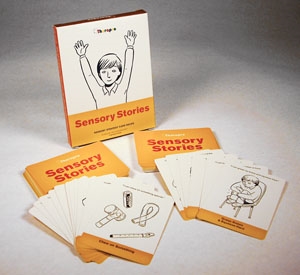
  1. Sensory Stories Cards are visual reminders of the various strategies that children can employ to cope with unpleasant sensations in daily life.
  2. Fidget Kit includes a group of the most popular fidgets.
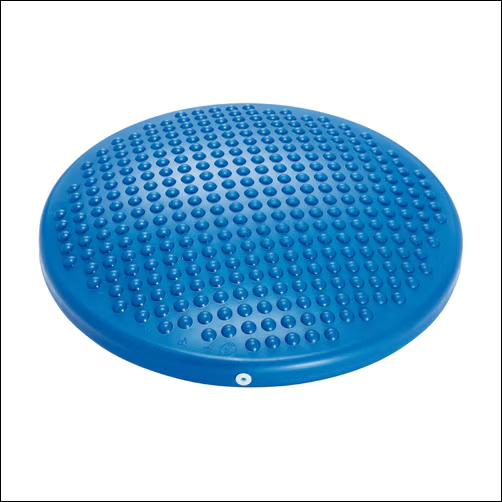
  3. Seating Cushions help promote “active sitting”. Perfect for strengthening the muscles that support the spine and to use when sensory input is needed.
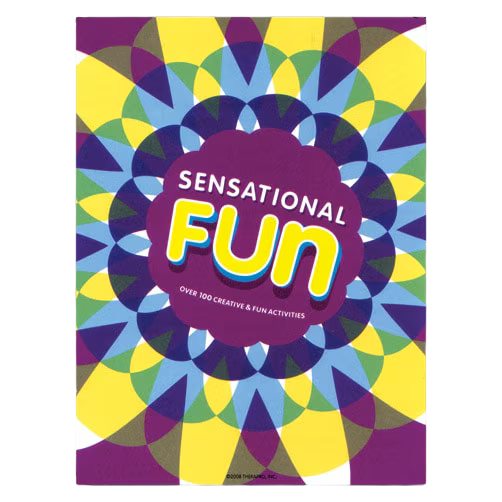
  4. Sensational Fun Cards have over 100 activities for parents and teachers who are looking for some great sensory games using common objects found in the home and school.
Guest Blogger: Diana V. Mendez-Hohmann BA, COTA
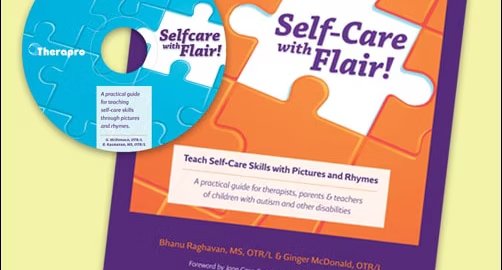
Self Care with Flair

Self Care with Flair!

Self Care with Flair! is an innovative approach designed to support children with disabilities in developing essential self-care skills. Created by Bhanu Raghavan, MS, OTR/L and Ginger McDonald, OTR/L, this method utilizes engaging pictures and rhymes to teach daily living activities, making learning both effective and enjoyable.

A Creative Approach to Teaching Self-Care

Understanding the challenges children face in mastering self-care tasks, Raghavan and McDonald developed a strategy that combines visual aids with rhythmic patterns. This multisensory technique aids in memory retention and skill acquisition, providing a consistent framework for teaching activities such as dressing, grooming, and hygiene.

Benefits for Therapists and Caregivers

The Self-Care Occupational Therapy Guide offers numerous advantages:

  • Consistency: Provides a uniform method for teaching self-care across various settings.
  • Engagement: Utilizes fun and interactive materials to maintain the child’s interest.
  • Collaboration: Facilitates teamwork among therapists, teachers, and parents.
  • Adaptability: Suitable for children with diverse learning needs and abilities.

By incorporating this guide into therapy sessions, professionals can enhance the effectiveness of their interventions, leading to greater independence for the children they support.

I Can Work Module 2: Filing Vocational Task Program

Welcome to I Can Work! The I Can Work! program is a five-module course designed to integrate communication skills with hands-on prevocational training in the areas of job readiness, clerical, retail, food service, and the grocery industry.

The I Can Work! Program was created by Angela Mahoney. I Can Work! serves to introduce and educate young adults with special needs and who are interested in working in their community. This program is geared toward middle school and high school students. Additionally, this program can support recent graduates ages twenty-one through twenty-five who are transitioning from school to the workplace.

Now let’s get filing! In Module 2: Clerical, students are introduced to a variety of tasks related to the clerical field, filing being one of them. In addition to the filing tasks presented in the program, student can practice filing in many other ways to keep the learning of the task fun, interesting and engaging.

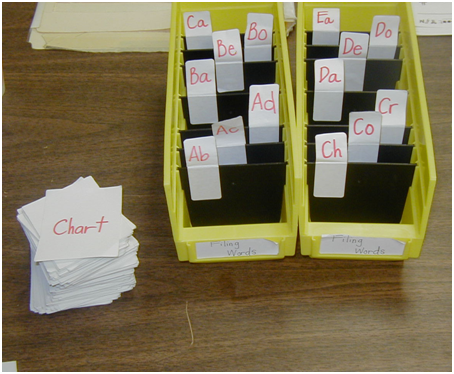
To challenge a student who is showing success with filing by letter, have them file by two letters at a time. I encourage using words that are school and work place related.
Example of a file activity from I Can Work

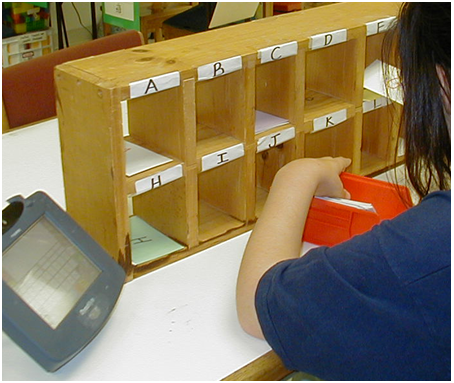
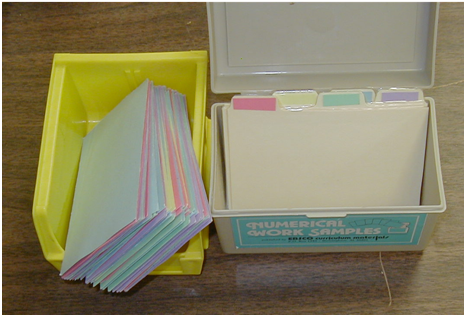
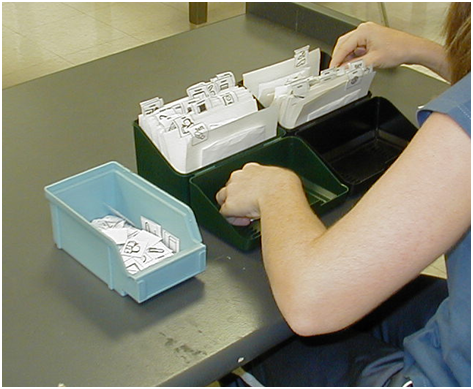
Traditionally when filing, students use a small bin with tabs to organize what is being filed. For certain students, it is more effective and beneficial for them to use a large box grid labeled according to what needs to be filed.
Modified file activity from I Can Work

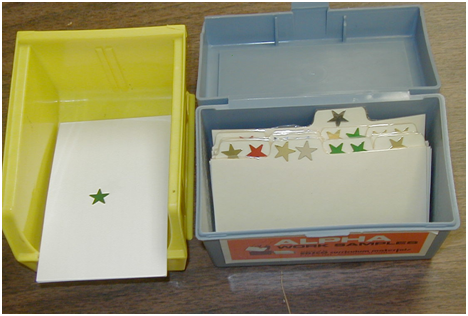
Why not use the resources you have and create cards to file using stickers! Cards can be filed by same picture, pattern or colors to list a few. The options are unlimited and a fun change of pace for the students as well.
filethisandthat3

If you find letters or numbers are challenging for students, use color index cards. Not only does this task build on the skill of filing, but also reinforces color recognition.
filethisandthat4

Many students use picture supports throughout their day to support schedules as well as communication, just to name a few. Why not use those pictures as a filing task? Create dividers for each picture choice and have the student work on filing each picture in the correct section.
filethisandthat5

* * *

Guest Blogger: Angela Mahoney

Angela Mahoney, creator of the I Can Work! Program, currently works as special education case manager at Middle School in Danbury, Connecticut. She has worked with students of all ages in a variety of settings for the past thirteen years. Her career includes a private school where she worked with over seventy-five middle school and high school-aged students on a weekly basis, running an inclusion-based elementary program for students with autism, as well as co-teaching core academic classes as part of a team comprised of fellow middle school educators.
Learn more or purchase the I Can Work! Program here