Tag Archives: webinar recaps

Webinar recaps provide clear summaries and key takeaways from professional development webinars for therapists, educators, and caregivers. This tag offers practical insights and resources to support continued learning and application.

S’Cool Moves Webinar Review

On Tuesday, September 15, 2020 Therapro was happy to host another very successful and well attended webinar, S’Cool Moves, presented by Dr. Debra Em Willson.  Dr. Wilson is a reading specialist and founder of S’Cool Moves.   Webinar attendees left with some great strategies to use for both in person and virtual learning sessions, as one viewer stated:

S’cool Moves has changed the way I practice OT in school. Incorporating Deb’s movements with academics has allowed my students to be so much more engaged and motivated. Her activities can be adapted to every grade level. DF

During the webinar, Dr. Wilson covered her “Top 10 Superrmoves”; that she uses to help students “flip the learning switch”.  Some highlights included: 

  1. Checking In With Myself Tool.  Dr. Wilson shared a visual to use with students to facilitate the “checking in” process and demonstrated a  great example of how to use this visual to help students get out of a “funk”.  
  2. I Can Calm Myself Routine.  Dr. Wilson shared deep pressure activities  students can use for calming and shared a visual that can be individualized for each student.  
  3. Core Out the Door & Minute Moves for Fine Motor. For these super moves, Dr. Wilson demonstrated how she incorporated the Minute Moves activities to a whole class setting, a great resource for therapists doing ‘push in’ services.  
  4. Smiley Jumps, Arrows, & Quadrant Activities. For these super moves, Dr. Wilson demonstrated how she created a simple DIY magnetic board to facilitate using these movement activities in virtual lessons, making the learning session more interactive!

In addition to these great resources, Dr. Wilson shared some great research to support her approaches. As one viewer stated:

I will be taking all of the activities / resources /website, etc, directly to my Title One teachers tomorrow and know they will be interested and use! I have provided many suggestions, activities etc. and even though well received, are not always implemented. Now I can say this comes from a reading specialist. Teachers listen to teachers and I am thrilled as an OT to use anything that will help kids. Deb was wonderful! Generous heart and knowledgeable lady….thank you so much! BW

If you missed the webinar, be sure to check out the recap.
Self Care with Flair

Self Care with Flair: Webinar Recap

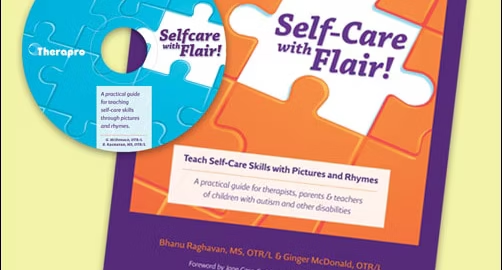
On Tuesday, July 28, Therapro was happy to host another successful webina, Self Care with Flair. Presenters Ginger McDonald, OTR/L and Bhanu Raghavan, MS, OTR/L spoke to viewers about Self Care With Flair and teaching independent living skills. These wonderful ladies have over fifty years of combined experience working with students across a variety of settings. Throughout the presentation they drew from these years of experience to provide illustrations of how a consistent, step by step approach works for teaching self care skills. Viewers left the webinar with helpful takeaways, including: 

Mastery of self care skills is critical for a child’s self esteem. The presenters spoke passionately about the importance of mastering self care skills early on and how this can  improve a child’s self esteem. To exemplify this they discussed toilet training: a skill needed for acceptance in a school setting, community involvement, and employability in later years.  

Use a team approach. The presenters described what they called the partiship triad, where parents or caregivers, teachers, and therapists work together in the teaching of both the self care skill itself and the prerequisite hands skills needed for successful participation. As one viewer noted, “Lots of information for both OT, teachers and parents. Love the team approach and having more information in the book will be an asset for every classroom.” – KF

Use a uniform approach. The presenters discussed the importance of consistency between everyone involved in the teaching process; from grandma, to the therapist, to the classroom teacher. Using consistent language and teaching approaches promotes learning and retention.  In the Self Care With Flair program, the same steps, the same pictures, and the same cues are used, leading to successful learning outcomes. Another useful aspect of Self Care With Flair is that the visuals can be shared with everyone working with the child, ensuring consistency across settings! As one viewer stated, “This is an excellent resource. The work has been done – rhymes, pictures, repetition. It speaks for itself!” – AH

Use rhythms. Rhymes are easy to memorize and make learning the steps of a task so much easier. Rhymes are also a great way to promote consistency across multiple environments and to help with self correction. The presenters pointed to research that supports the use of rhymes for teaching the steps of a task.

Teach Prerequisite Skills. Another important point that was covered in the webinar was the importance of addressing the foundational hand skills needed for success with self care tasks. In the book Self Care With Flair, each prerequisite skill needed for the given self care task is listed with the self care task itself. The final chapter in Self Care With Flair includes activity ideas  to address the essential hand skills needed (finger strengthening, finger to thumb opposition, forearm strengthening, lateral pinch, power grasp, thumb strengthening and wrist extension).  
The presenters also discussed modifications to meet the needs of all users, teaching tips to use when introducing these tasks, and ideas for personalization. Check out the recording of the webinar, and be sure to check out our free resources page for examples from the book!

Oral Motor Treatment Strategies: Part 1

On Tuesday night, Therapro was pleased to host a highly attended webinar presented by Dr. Kate Barlow, focusing on Oral Motor Treatment and Feeding strategies. This blog is part of a multi-post series that explores key points from Dr. Barlow’s webinar. In this entry, we specifically highlight treatment strategies related to feeding.

Dr. Barlow is an Assistant Professor at American International College. She is also the current ambassador for the CDC’s Learn the Signs Act Early program for the state of Massachusetts. She has over 20 years of clinical experience, including public school practice, early intervention, and a pediatric hospital-based outpatient clinic, as well as management. Dr. Barlow’s passion is in global outreach; she founded the International Interprofessional Mentorship Program that currently provides mentorship to over 100 therapists in developing countries in Africa and South America.

Dr. Barlow’s extensive knowledge in this area was evident as she seamlessly broke down this complex topic into manageable bits of information. Dr. Barlow set out with the main objectives of providing viewers with specific intervention strategies for oral motor deficits and relaying the importance of screening all children for feeding difficulties. As one viewer stated:

“This was one of the best courses I’ve taken in a long time. The instructor was knowledgeable with practical assessment and treatment strategies that I can even use in collaboration with SLPs. So many OTs are intimidated to address feeding, especially in the school setting, but I think it is so important!” -LB

Viewers left with some great take-aways that we will recap in this post:

1. Guidelines for making food recommendations. 

2. The importance of enjoying food.

3. All children should be screened for feeding disorders.

Guidelines for Making Food Recommendations. Match food choice with skill level. When Dr. Barlow discussed guidelines for recommending appropriate food choices, she stated simply  “look at the child in front of you and where they are developmentally.” This bit of advice was a great reminder for new and experienced therapists alike; a child’s skill level isn’t necessarily defined by their age. Dr. Barlow highlighted this further by showing that the development of circular rotary chew could occur on a widely varied timeline, anywhere between 18 to 36 months! 

The Importance of Enjoying Food.  Another important takeaway from Dr. Barlow’s webinar was the importance of enjoying food. She spoke passionately about the importance of understanding underlying medical problems when addressing feeding difficulties. Dr. Barlow explained that behavioral problems around eating can often be addressed when the feeding difficulty is appropriately treated. Another point she raised is the importance of a child being included at the family table. She stressed the importance of this inclusion, in whatever capacity the child is capable (even if it meant that they were just sucking on a lollipop), because the mealtime experience is an important cultural ritual.    

All Children Should Be Screened for Feeding Disorders.  A third take away from Dr. Barlow’s webinar was the importance of screening all children for feeding difficulties regardless of why that child is on your caseload.  She highlighted the prevalence of feeding difficulties as a key factor in this; I was struck by how prevalent feeding difficulties are even in typically developing children.  Dr. Barlow cited research indicating feeding difficulties are present in one in four typically developing children. In children with developmental disabilities and cerebral palsy, the prevalence is significantly greater.  With this information, I found myself reflecting on all that I knew about the role of nutrition in supporting optimal behavior for participation.  The concept of screening all children for feeding difficulties truly makes sense when considering the prevalence of feeding difficulties and the role that nutrition plays in a child’s ability to attend and participate in all of their daily activities.  

Pediatric Feeding Disorders: Evaluation and Treatment

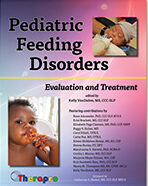
A great resource for information on oral motor and feeding treatment is a book published by Therapro: Pediatric Feeding Disorders Evaluation and Treatment.  It covers topics ranging from the progression of feeding development, to the role of the gastrointestinal system in feeding difficulties, to the evaluation of feeding difficulties, along with a broad range of other feeding topics!  Stay tuned for future blog posts where we continue our review of Dr. Barlow’s webinar, exploring her tips and suggestions for screening pediatric feeding difficulties as well as some of her great treatment strategies!