Category Archives: Inside Therapro

Stay connected with everything happening at Therapro—from product launches and company news to conference highlights, community involvement, and special events we attend or host.

Making Sensory Connections Through Mock Sense-Ability Activities

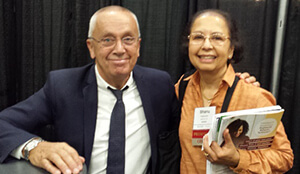
Karen Moore, OTR/L, author of the Sensory Connection Program

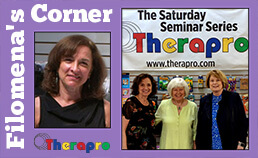
On September 14th, Therapro’s Saturday Seminar Series featured Karen Moore, OTR/L, author of the Sensory Connection Program. Karen’s passion is mental health practice, where she has had extensive experience in acute psychiatric care and in various residential settings with adult and adolescent psychiatric patients. Her career-long commitment to the study and use of sensory modalities for treatment in psychiatric care culminated in the writing of her book, The Sensory Connection Program: Activities for Mental Health Treatment. Her subsequent publications include: The Sensory Connection Program: Self Regulation Workbook and The Sensory Connection Program: Curriculum for Self Regulation. Karen has presented workshops on sensory related treatment to programs and facilities throughout the country, including presentations for “at risk” youths, special needs students, and behavioral programs for adolescent treatment.

Karen’s seminar involved active participation by all the attendees in a simulated Sense-ability Group while sitting in a circle and being challenged motorically, socially, cognitively, and with sensory activities. Karen demonstrated how to adapt the group to target certain behaviors and skills of individuals in the group with the goal of each participant feeling competent and positive. Karen’s style was encouraging, supportive, and at the same time fluid in targeting the needs of each participant. Her anecdotes from her practice were enlightening. Karen described the Sense-ability Group Stages 1-6 along with activities the facilitator might use in each. These stages include the Awareness Stage, Moving and Breathing Stage, Conversing Stage, Active/Interacting Stage, and Learning Stage. Attendees tried out many novelty as well as familiar games in the group such a Hot Potato, to spark interest and energize a sluggish group; ball play with Koosh Ball, parachute games for movement and interaction; Theraband rowing for strengthening and reciprocal movement; Thumball to help express emotion, and many many more! Karen referred all to her website sensoryconnectionprogram.com for full instruction and details for every stage of the Sense-ability Group.

Karen is a Therapro author, and all of her publications are available through the Therapro website. She recommends both the manual and handbook of The Sensory Connection Program: Activities for Mental Health Treatment. These activities can be adapted and interchanged easily for a wide range of purposes, ages, and settings. All of Karen’s books use a person-centered treatment approach that begins with self-awareness and then moves on to self-regulation and eventually to self-care.

In summary, a Sense-ability Group is a highly adaptable, supportive group for those who experience a variety of symptoms that might include, depression, anxiety, psychosis, disorganization, poor self regulation, sensory problems, difficulty with social skills, physical challenges, and much more. The facilitator designs the group to ensure that the participants have a successful, enjoyable experience. Every group is different and is modified by the facilitator depending on the environment, the mood of the group, the participants, etc. Activities might include movement, sensory, physical, cognitive, and social experiences. The goal of the group is that each participant feels competent and improves function.

Thank you, Karen, for sharing your knowledge, expertise, and dedication to mental health treatment by modeling how a Sense-ability group can be a highly effective occupational therapy treatment modality… and lots of FUN!

Take a look at just a few of the glowing comments from those who attended Karen’s seminar:

“It accentuated how incorporating sensory games can enhance engagement, self-regulation & learning all at once.” – Christine C.B., Occupational Therapist

“Awesome ideas for sensory based social skills learning. Great intro & walk through of the materials.” – I.D., Occupational Therapist

“Very hands on and applies to so many different levels of abilities and ages!!” – Beth M., Occupational Therapist

“Hands on. Lots of group ideas. Real life examples. Very comprehensive. Holistic approaches. Many recommended activities & resources.” – Joann W., Occupational Therapist

Thank you, Karen!

Filomena Connor, OT, MS, OTR
September 14, 2019
Rhythm of the Words: Using Songs & Games to Boost Literacy

Cleopatra Knight-Wilkins, OTD, MED, OTR/L presenter for the Saturday Seminar  Rhythm of the Words: Integrating Multicultural Songs & Games with Occupational Therapy to Promote Literacy.

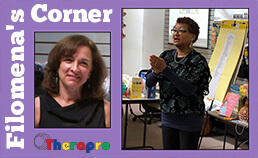
Cleopatra Knight-Wilkins, OTD, MED, OTR/L presented a joyful April Saturday Seminar at Therapro headquarters entitled: Rhythm of the Words: Integrating Multicultural Songs & Games with Occupational Therapy to Promote Literacy. Attendees were up on their feet, moving, clapping and singing for most of the two hour seminar. Dr. Knight-Wilkins led the attendees in activities that engaged their sensory systems. She discussed how the songs and games can be used as part of the therapeutic process as well as how they can be used to target educational goals.

Cleopatra’s rich and extensive experience as an occupational therapist, educator, and performing artist has fueled her passion for integrating musical elements with occupational therapy modalities by using multicultural songs, games, and movement patterns to address the occupation of literacy. Currently, she is in the process of publishing her research-based, multi-media curriculum resource guide entitled Rhythm of the Words: Integrating Multicultural Songs & Games with Occupational Therapy to Improve Literacy. She presented a poster session at the AOTA Annual Conference in New Orleans earlier this month on this topic.

AOTA advocates for the role of occupational therapists in supporting literacy. Research indicates that movement and music improve literacy development. Cleopatra cited a number of interesting studies that demonstrate that isolated handclapping songs result in improved motor and cognitive skills. One particular study that examined training classroom handclapping songs versus participation in music appreciation classes found that training handclapping songs was more efficient in developing literacy skills in 2nd and 3rd grade children than was participation in music appreciation classes.

Attendees formed small and large groups to participate in ‘warm up’ activities, games that involve imitation and chanting, and musical play with graded complexity of movements. Favorites included “Head ‘N Shoulders Baby” played with a partner clapping in various patterns, and “Button You Must Wander,” where a button is passed secretly around a circle while “It” sits in the center of the circle and must guess who has the button. In addition to games and chants, Cleopatra recommended musical CDs such as Make a Sound and Move Around, Simplified Rhythm Stick Activities, and Songames for Sensory Processing. Using Gertie Balls to bounce, catch, and throw to a rhythm, chant, or song can address visual motor, fine motor, and timing skills.

Dr. Knight-Wilkins was an engaging presenter who demonstrated that music, rhythm and movement offer a unique, evidence-based approach to improving language literacy in children of all ages and abilities.

Take a look at some comments from attendees:

“Enjoyed the ‘occupation’ of children reminder! Could implement activities for a whole group and at individual desks.” – Adriana M,, Occupational Therapist

“Something different but very relevant to school-based practice, especially when many schools now have lost funding for music programs.” – Jennifer C., Occupational Therapist

“Cleo was lovely & entertaining. Very knowledgeable. Different perspective on the regular teaching method.” – Anonymous, Occupational Therapist

“Movement to songs was wonderful – I can see how my students would enjoy it. Reminds me that I want to put music/rhythm in my sessions more often.” – Janet L., Occupational Therapist

Thank you, Cleopatra!

Filomena Connor, MS, OTR/L
April 13, 2019

OCALICON 2018: Therapist Highlights & Takeaways

Sometimes OTs only consider conferences aimed at OTs for their CEUs, but there are other (and sometimes cheaper) ways to get your CEUS, and learn something new and different at the same time. In November 2018 we were invited to participate in OCALICON, the annual conference in Columbus OH, sponsored by OCALI (Ohio Center for Autism & Low Incidence).  OCALI is a wonderful organization whose mission is to inspire change and promote access to opportunities for people with disabilities.  OCALICON is directed towards parents, physicians, educators, therapists, administrators and other professionals working with children and young adults with disabilities especially autism.  The conference is a dynamic and inspiring milieu that attracts attendees from all over the United States and even the world. 

We had the pleasure of meeting this year’s keynote speaker- Christopher Gillberg, MD, PhD of the Gillberg Neuropsychiatry Centre at the Sahlgrenska Academy.  Dr. Gillburg holds professorships at universities and hospitals in Sweden, Japan, the United Kingdom and Paris.  His keynote speech was highly compelling.   

Dr. Gillberg’s address was titled AUTISM AND ESSENCE, NEURODIVERSITY AND AUTISM: THE ESSENCE OF ESSENCE ESSENCE is an acronym coined by Dr. Gillberg that stands for Early Symptomatic Syndromes Eliciting Neurodevelopmental Clinical Examination.  The ESSENCE diagnoses include the ADHDs, Language Impairment Disorder, Developmental Coordination Disorder, Intellectual Disability, Autism/ASD, Tic Disorders/OCD, Selective Mutism and Reactive Attachment Disorder. Dr. Gillberg maintains that autism always coexists with one or more of the ESSENSE conditions.  His major point is that pediatric practitioners should screen for these comorbidities early on or they may be missed.  Dr. Gillberg asserted that correct diagnosis followed with early intervention leads to success.  Lack of intervention results in negative outcomes including academic failure, social exclusion, substance use, psychiatric disorders, empathy problems, antisocial lifestyle and criminality later in life.

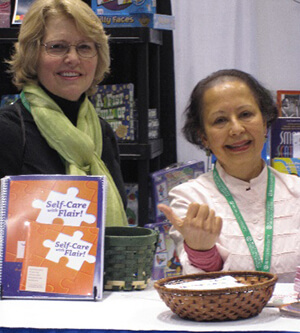
We were pleased to have 150+ people attend our presentation on Self-Care
with Flair!
Our audience consisted of educators, parents, social workers and OT/PT/SLP.  The session was well received. We especially appreciated the parents who shared their children’s self-care challenges & successes with the group.

One of our favorite sessions was called Strategy Smackdown.  This was a total audience participation session, where attendees shared their favorite resources/strategies/evidence. A summary was shared with all participants. OCALICON was a marvelously inclusive, collaborative experience that school-based practitioners could consider for CEUs from a different than the usual perspective.


Guest Blogger: Bhanu Raghavan, MS, OTR/L

Bhanu Raghavan

A graduate of Indiana University and The Ohio State University, Bhanu has over 25 years of experience in pediatrics. She is certified in pediatric NDT and the READY Approach (Bonnie Hanschu) for Sensory Integration Disorders. Frequently, she presents workshops on topics related to self-care independence, sensory processing disorders and fine motor/handwriting skill development to therapists, teachers and parents/caregivers. She works at Centerville City schools, OH. She is a firm believer of the following Confucian principle: “I hear and I forget, I see and I remember, I do and I understand.”

Guest Blogger: Ginger McDonald, OTR/L

Ginger McDonald one of the Therapists who presented at OCALICON 2018

A graduate of the University of Wisconsin, Ginger has practiced Occupational Therapy for over 30 years. She is certified in SCSIT. With an eclectic background of working in hospitals, schools and geriatric settings, Ginger believes in promoting self-care independence at all levels. While working with Bhanu in the Centerville City Schools, they conceived the idea for Self-Care with Flair!