

Tag Archives: product spotlight

Featured therapy products highlight tools and resources that improve fine motor, sensory, language, gross motor, self-help, functional skills, and so much more. Learning about featured therapy products helps select effective solutions.

Product Reviews- Handwriting lined paper designed for fine motor development by Therapro

Product Reviews

We’re thrilled to share recent Therapro product reviews that highlight how our tools are making a difference in classrooms, therapy sessions, and homes. From educators to occupational therapists, customers consistently report how Therapro products support individuals with a variety of learning and developmental needs.

Product Review- Therapro Stage Rite Raised-Line Paper

If you’re looking for a handwriting tool that offers both tactile and visual support, Therapro’s Stage Write Raised-Line Paper delivers. Designed to promote proper letter placement and spacing, this paper features raised lines that provide physical guidance for young writers or individuals with fine motor or visual challenges. Check out this review to see how this effective tool helps students build foundational handwriting skills with greater confidence and control.

“I have (very) low vision and bought this paper to help me take notes when I go to a meeting or such and need to record details. The wide raised dark lines help me write more legibly so that when I get my notes home I have a better chance of being able to decipher what I wrote when put under my CCTV. I am going to try the next smaller stage next time I order as I think I am getting better at writing this way! I am so pleased with my progress. I thought without the money to buy a tablet and with a crummy memory, I was stuck, but I am pleased to have struck upon my creative solution to my problem! I cannot wait to report back at the next meeting at the Support Group I attend for those of us who are adjusting to our new lives.” – Anne M
Raised line paper

More Product Reviews- Wide-Lined Raised Paper

If you’re seeking a handwriting tool that offers both tactile and visual support, Therapro’s Wide-Lined Raised-Line Paper delivers. Designed to promote proper letter placement and spacing, this paper features raised lines that provide physical guidance for young writers or individuals with fine motor or visual challenges. Check out this product review to see how this effective tool helps students build foundational handwriting skills with greater confidence and control.

“Great tool for students who need to feel the lines to stay in them. I am a teacher and use this paper for my special needs students in my classroom. I would definitely recommend it.” – Litter of Pups

Wide Lined paper

Looking for more handwriting solutions? Explore Therapro’s full collection of adapted writing paper designed to support writers of all ages and abilities: Writing and Math Paper. Whether you need raised lines, visual cues, or specialty formats, you’ll find the right tools to meet your students’ needs.
Using Sensory Stories & Sensory Strategy Cards for Regulation

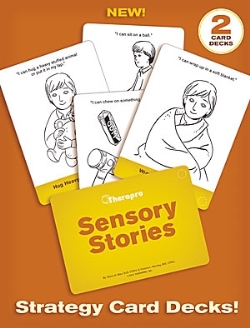
For children with over-responsive sensory modulation, participating in everyday activities can be overwhelming. Victoria Nackley, MS, OTR/L, co-author of Sensory Stories, presented a Therapro seminar on Saturday, October 18th, entitled Using Sensory Stories and Sensory Strategy Cards (45 Strategies to Add to Your Sensory Diet) to Promote Self-Regulation. She engaged the audience of about 60 therapists, teachers, parents, and grandparents in learning how to use sensory stories as a therapeutic tool to help a child engage successfully in typical home, school, and community activities that intrinsically are loaded with sensory experiences. Victoria discussed the fact that 15 research studies currently support the theory that Sensory Stories promote a child’s ability to engage in day-to-day activities.

Sensory Story Cards for regulation Sensory Stories empower a child to cope with day-to-day life activities such as getting dressed, riding the school bus, and going to the store. Victoria and her co-author, Deborah Marr, have developed 30 individual stories that can be customized to each child. She engaged the attendees as a group in a sensory story about brushing their teeth. The calming strategies recommended are simple and quick so that they can easily be incorporated into a task that a child finds difficult to accomplish. For example, calming strategies might involve deep touch pressure, like a self-hug or using a towel to apply deep pressure to the skin.

For a child to feel successful every day builds self-esteem and social acceptance. Sensory Stories are a powerful tool in our toolbox that can help a child learn self-regulation. The following are a few of the many positive comments from those who attended the Sensory Stories seminar:

“Informative practical ideas that can be used right away.” Karen D.

“Exploded my ideas beyond the ‘typical’ applications of the Sensory Story cards.” Elizabeth S.

“Gives a very good presentation not only on Sensory Stories but also the importance of understanding sensory modulation.” Brooke W.

“She provided a great background/review on self-regulation. She gave many great examples and treatment ideas. I’m looking forward to trying them both with my clients and my own son!” Natalie S.

Thank you, Tory!

Filomena Connor, MS, OTR/L

The Peabody Developmental Motor Scales Test

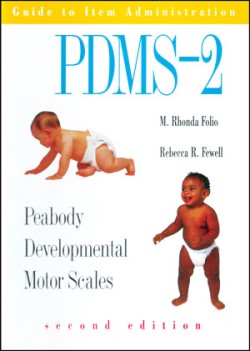
The Peabody Developmental Motor Scales Test-Second Edition (PDMS-2) examines both gross motor and fine motor skills. This test is for children from birth through age 5. The evaluation assesses a child’s development, and also provides training and treatment to improve motor skills. The assessment generally lasts about 45-60 minutes, and provides an in-depth analysis. The Second Edition has been in use since 2000 and is a statistically reliable and valid norm-referenced assessment.

The Peabody Developmental Motor Scales (PDMS-2)When you order the PDMS-2 COMPLETE Kit, you’ll receive an Examiner’s Manual, a Guide to Item Administration, a Picture Book, 25 Profile/Summary Forms, 25 Examiner Record Booklets, the Motor Activities Program Manual and a Peabody Motor Developmental Chart. The PDMS-2 is also offered without the Motor Activities Program Manual (PDMS-2 TEST Kit).

You will also receive the Object Kit and the Shape Cards Kit which both contain sets of test objects to help achieve a standardized administration of the test; the Object Kit includes a black shoelace, six square beads, a wooden pegboard, three wooden pegs, 12 one-inch cubes, a large button strip, a bottle with a cap, a formboard with shapes, a lacing card, a measuring tape, and a roll of masking tape. The Shape Cards Kit includes blackline masters and three shape cards.

The test scores consist of a Gross Motor Quotient, a Fine Motor Quotient, and a Total Quotient. The Gross Motor Quotient is made up of the Reflexes, Stationary, Locomotion, and Object Manipulation subtests. The Fine Motor Quotient includes the Grasping and Visual-Motor Integration subtests. Lastly, the Total Quotient combines both the Gross and Fine Motor subtests.

To reduce scoring and reporting time and errors, the new PDMS-2 Online Scoring and Reporting System has been developed and is purchased separately. It is web-based software that is PC, Mac and iPad compatible. Some of the software Scoring features include:

  • converting PDMS-2 item scores or subtest scores into standard scores, percentile ranks, and age equivalents
  • generating composite quotients
  • comparing PDMS-2 subtest and composite performance to identify significant intra-individual differences

The software Reporting features also include:

  • a printed report of the student’s identifying information and PDMS-2 performance including short-term and long-term treatment goals and objectives
  • score and print reports using as few as one subtest score or only Gross or only Fine Motor scores
  • save or print text or PDF file using two report options:
    • standard clinical report (2 page summary of test scores)
    • detailed clinical report (fully customized 6- to 8- page analysis indicating treatment goals and objectives

Additional features of this web-based software include:

  • pull-down menus to easily navigate among software functions
    fields for storing detailed examiner and testing information
    on-screen subtest and quotient comparisons

A first-time base subscription provides an entire year of unlimited online scoring and report access for up to five users.