Tag Archives: sensory strategies

Sensory strategies are techniques used to help children manage responses to sensory input, such as sounds, textures, or movement. These strategies support self-regulation, attention, and participation in learning environments. They are essential for helping children stay calm, focused, and engaged throughout the day.

Brain Gym: Using the Figure Eight in OT

I came across Educational Kinesiology in the early 1990s when searching for tools or techniques to help heal from a chronic illness. Little did I know that it would become an integral part of much of my OT practice. I began with Brain Gym I and II and loved the fact that the two trainers in South Africa were experienced occupational therapists trained in both SI and NDT.

Brain Gym is wonderful for assisting with goal setting, whole brain learning, stress release, and re-patterning. Although there is a specific process to follow, many of the exercises are both beneficial and transferable into a regular OT session. One that I use a lot is the Lazy 8 – a figure eight that lies on its side like the infinity sign.

What is the Brain Gym figure eight used for?

In Brain Gym terms, the Lazy 8 turns on or activates the eyes while also crossing the mid-line.

It can be used to improve ocular motor function, which assists with reading, and crossing the mid-line improves integration between the two hemispheres of the brain.

The repeated action of the Lazy 8 is also very calming. It can be used in several different formats – using the eyes, drawing the figure of 8 in the appropriate orientation, and in motion, as we shall see shortly.

The Lazy 8 can also be carried out as a motor activity, having the client walk, skip, or run around a figure eight. I love to use two hoops placed side by side on the floor to provide a visual cue. Varying the space between the hoops elongates or enlarges the figure eight. Make it more fun by having the client clap while moving around the figure of eight in time to music.

For added motor integration, combine the cross crawl with the Lazy 8. This often has to be carried out in stages:

  • Having the client carry out their cross crawl while standing until they are sufficiently at ease with the exercise
  • Upgrade to carrying out the cross crawl while walking on a straight line
  • Upgrade further to doing cross crawls while walking a figure eight
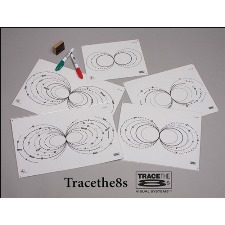
When I first began using components of Brain Gym in my treatment sessions, I would often make up my own worksheets. I am delighted to discover that Therapro has a range of products that bring the figure eight into practice for all occupational therapists. Two examples include:

The development of these tools shows how Brain Gym is becoming accepted as a beneficial modality to use within OT. It also provides an added level of professionalism, which is important for anyone who is skeptical of either how Brain Gym combines with OT or the extent to which OT itself is a recognized profession.
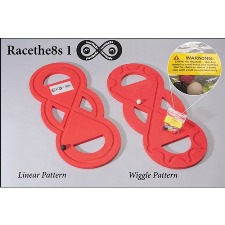
Once clients are familiar with the Lazy 8 through either Trace the 8s or Race the 8s, introducing the Alphabet 8 helps improve their motor memory. The Alphabet 8 incorporates lower-case letters with the Lazy 8 and is wonderful as a pre-writing activity to enhance work to meet writing goals. It’s designed for English letters but, with some creativity and practice, cursive letters for Hebrew can also be used. Note, I am not sufficiently familiar with other alphabets to know how well they can be used in the Alphabet 8.

I mentioned earlier the benefit of improving a sense of calm. The rhythmic movement of drawing or moving in the Brain Gym figure eight pattern is a wonderful addition to your toolbox for assisting clients in need of stress management and improving relaxation.


Guest Blogger: Shoshanah Shear
Occupational Therapist, healing facilitator, certified infant massage instructor, freelance writer, author of “Healing Your Life Through Activity – An Occupational Therapist’s Story” and co-author of “Tuvia Finds His Freedom”.
Move Mindfully Card Deck and Sensory Systems

Therapro is excited to offer the Move Mindfully Card Deck, available at our store. This product helps integrate physical fitness, mindfulness and social emotional skills into practice. The deck not only offers individual poses, but also routines to address a variety of common needs, such as “accident prone” and “lethargic”.

As a Blog Bonus, we are offering a free download of three poses from the card deck to get you started with a simple routine.  Read on to learn more about each pose and how it relates to your Occupational Therapy goals.

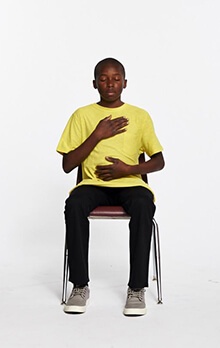
Belly Breathing

Belly Breathing

Getting into the Pose:
Belly Breathing is often taught with the Hoberman Sphere. The brightly colored, collapsible tool offers a visual tracking point to feel the diaphragm expand and contract. However, hands can simply be placed at heart and belly when teaching belly breathing as well. To start, we recommend a seated position in a chair, for back support. As a modification, this pose can also be completed laying on the floor. In this position, try a small object or toy placed on the belly for extra visualization of the up and down movement.

Therapy Resource:
Belly breathing is a great way to work on postural stability while maintaining an upright position without a collapsed trunk or slouched shoulders. This pose also taps into interoception and body awareness as breathing is tracked.

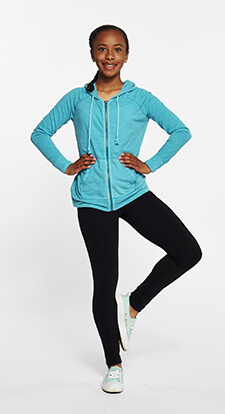
Tree Pose

Tree Pose

Getting Into the Pose:
Tree Pose is an introductory balancing pose that all body abilities can enjoy. We start by cueing the heel to touch the ankle. As balancing progresses, the foot can be placed on the calf or thigh. However, make sure to avoid any pressure on the knee joint. The hands press together at midline, palm to palm, providing additional input.

Therapy Resource:
Like belly breathing, this pose works postural stability through core activation in a static hold. It also works on bilateral coordination as hands and feet press towards midline while maintaining balance and focus. The stacking of joints over the anchored foot (ankles, hips, wrists) taps into theproprioceptive system. If you need additional proprioceptive input in this pose, try stamping feet before attempting to hold static. Activate the vestibular system by experimenting with the foot and hand placement.. Also, try small movement, such as swaying, within the pose. Work on vision by providing various focal points experimenting with gaze up, out, down and even eyes closed. If you see the MORO Reflex in this pose, return to Belly Breathing.

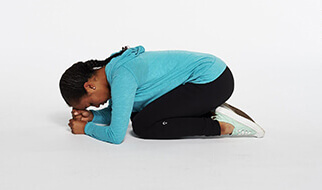
Child’s Pose

Child's Pose

Getting Into the Pose:
Child’s pose is often used at the beginning or the end of a session. However, it can be used whenever there is a need to decrease overstimulation. It can be completed on the floor or at a table.

Therapy Resource:
As you cue stacked fists, you are working on bilateral coordination and proprioception as joints are stacked together at midline. On the floor, there is the additional tactile input from the legs and arms on the Earth. Seekers may need to rock, or add extra movement to the pose, while avoiders may have to stay more upright. Offer a vestibular system modification of seating in a chair, hands stacked on forehead and chin slightly tucked.

Guest Blogger: Stephanie Kennelly

About Us-

This blog post is a collaborative effort of Sweet Inside Yoga and 1000 Petals.

Sweet Inside Yoga is a company providing resources for occupational therapy, physical therapy, mental health practitioners, classroom teachers, yoga teachers, professionals, parents, and others in the community to use with individuals who can be found seeking and/or avoiding yoga activities.

1000 Petals is a well-being training and consulting company based on the science and practice of mindfulness and movement. They provide integrative mindfulness and movement solutions in workshops, events, retreats and self-care classes.

The Impact of Personalized Tool Kits on Adolescents with Mental Illness

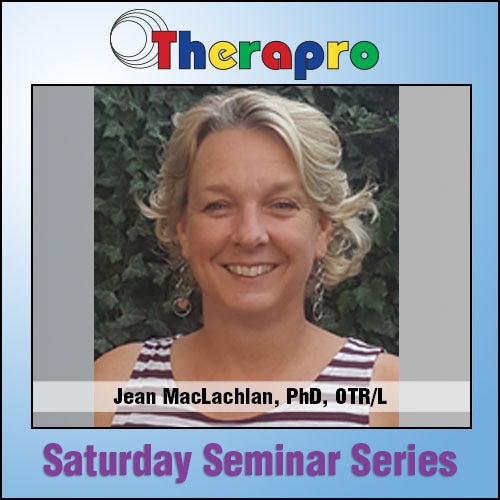
Dr. Jean MacLachlan presenting on the use of personalized sensory tool kits for adolescents with mental illness during Therapro's Saturday Seminar.Jean MacLachlan, PhD, OTR/L’s November 4th 2014 Saturday Seminar was entitled: The Impact of Personalized Tool Kits on Adolescents with Mental Illness: How to Assess, Develop and Integrate into Daily Routines. A specialist in mental health and sensory processing, Dr. MacLachlan teaches at Salem State University, conducts research, and consults throughout the US. Her focus has been on the integration of sensory-based interventions into “non-traditional settings.”

Jean’s thoughtful and thought-provoking seminar revealed some surprising documentation about adolescent mental health including the statistic that about 20% of children and adolescents in the US have been diagnosed with a mental health disorder that impairs their lives (NIMH, 2010; Perou, 2013). Jean provided a summary of supportive literature that indicates that a sensory-based approach to treatment promotes positive behaviors. Jean’s research using individualized sensory tool kits yielded statistically significant results in 6 areas, 3 of which affected all study participants including an increase in self perception of sense of occupational competence; an increase in daily number of hours in the classroom; and a decrease in the number of PRN medications.

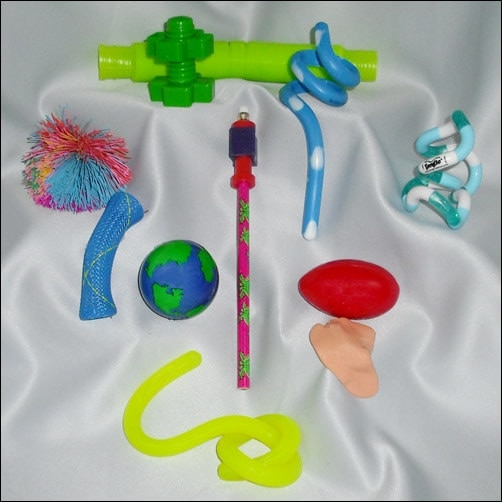
Assortment of sensory tools from Therapro's Fidget Kit including Squeezies, Boinks Fidgets, and Tangles used in adolescent mental health therapyJean offered a rich array of ideas for creating individualized sensory tool kits that target all sensory areas, depending on the adolescent’s needs. She added cautions regarding some client-specific personal issues including: allergies to certain materials, olfactory experiences that may elicit negative memories in trauma victims, visual responses that may trigger seizures, and vibratory stimulation for hypersexualized adolescents. She advocated building the use of sensory toolkits into a client’s routine to help improve function, which means devising a way that the client has access to his/her toolkit whenever it is needed, i.e. during transition times that might cause an outburst, like going from school to a job. Some Therapro materials that she recommended included:

In addition to personalized tool kits for adolescents, Jean discussed some interesting examples of sensory-based coping skills groups. One example she gave involved playing “Sensory Hopscotch,” where the client throws a beanbag on a sensory square and then identifies the tool in their sensory tool kit they use in that sensory category and why they use it.

With our understanding of sensory processing, occupational therapists can have an important role in providing sensory-based treatment for young people diagnosed with mental illness. Jean provided us with a dynamic seminar, including interactive times for participants to share thoughts and problem-solve about tools that may be useful and accessible in their particular setting. Many offered helpful ideas on how to acquire those tools through creative funding. This seminar fulfilled all expectations for attendees who learned how to create and use personalized sensory tool kits with the adolescent population in individual and group settings.

Take a look at just a few of the positive remarks attendees made about this seminar:

“Excellent material, engaging presentation. Thank you!!” – Katherine C., Occupational Therapist

“Great ideas; really liked the built in discussion time.” – Maura M., Teacher

“Lots of ideas, suggestions. Opportunities to collaborate. And free!!” – Anonymous, Occupational Therapist

“Specific and functional activities! Direct and to the point!” – Susan J., Physical Therapist Assistant

“Well organized, informative, and applicable to my work.” – Anonymous, Occupational Therapist

Thank you, Jean!

Filomena Connor, MS, OTR/L