Tag Archives: sensory strategies

Sensory strategies are techniques used to help children manage responses to sensory input, such as sounds, textures, or movement. These strategies support self-regulation, attention, and participation in learning environments. They are essential for helping children stay calm, focused, and engaged throughout the day.

Therapro’s Free Activity of the Month: Sock Snowman

Looking for a cozy, winter-themed craft that doubles as fine motor practice? Therapro’s Sock Snowman Activity Idea guides you step-by-step through creating adorable snowmen from recycled socks.

The Snock Snowman Activity is from the Pre-Writing Curriculum Enrichment Series, written and illustrated by Peggy Hundley Spitz, OTR. The books are split into 5 sections, and each section is packed with seasonal activities to enhance your classroom or therapy session. The sections are as follows: Trace & Draw, Crafts and Costumes, Cooking, Stories to Color and Read, and Games.

This month’s activity comes from the Crafts and Costumes section of Winter Activities: Snowflakes Snowflakes Everywhere.

Materials:

  • 1 White tube sock
  • Rubber band
  • Polyester stuffing
  • Fabric paints
  • Felt Strips, 1” x 12” or Ribbon
  • Colorful yarn scraps
  • Scissors

Directions:

  1. Fill sock with polyester stuffing. Leave 2” at the top unstuffed.
  2. Wrap rubber band around the top of the sock to close the end.
  3. Tie a felt strip or ribbon firmly around the sock where the neck and the scarf of the snowman should be. This will divide the sock into “head” and “body”.
  4. Tie some colorful scraps of yarn around the rubber band,
  5. Use fabric paints to add features and buttons to your snowman.
  6. Allow paint to dry completely.
  7. Enjoy!

Activities:

  1. Explore and encourage tactile awareness by discussing the variety of textures- stuffing, sock, felt, paint, yarn and rubber band.
  2. Add uncooked beans or uncooked rice instead of polyester stuffing to make a weighted snowman.
  3. Add lavender scented sachet to the inside of the snowman for a relaxing friend.
  4. Encourage each child to make their snowman unique and name them.
  5. Use light colored socks such as light blue or pink and shorter socks, see how different they look.

Make it a sensory activity:

After you complete your snowmen enjoy our recipe for Winter Fruit Salad. The recipe is in the cooking section of Winter Activities: Snowflakes Snowflakes Everywhere.

Winter Fruit Salad

Food Needed:

  • 1 red delicious apple, cored and sliced
  • 1 granny smith apple, cored and sliced
  • 1 winter pear, cored and sliced
  • 1 8oz can mandarin orange slices
  • ½ cup seedless grapes
  • 1 cup shredded coconut
  • Miniature marshmallows
  • 8-10 maraschino cherries

Equipment Needed:

  • Large Bowl
  • Plastic knives
  • Mixing spoon
  • Can opener
  • Serving bowls

Directions:

  1. Wash & dry hands.
  2. Cut apple and pear slices into cubes. Place in a large bowl.
  3. Wash grapes. Add to bowl.
  4. Open can of orange slices and drain. Add to bowl.
  5. Add some marshmallows and ½ cup of shredded coconut. Stir in until all the fruit is covered with coconut.
  6. Spoon into serving bowls. Sprinkle with more coconut and top with a cherry.
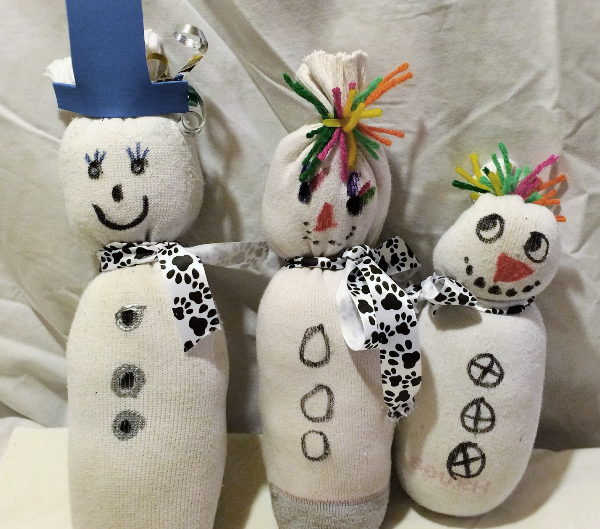
Three examples of the Sock Snowman from the Snowman Activity Idea

Using Sensory Stories & Sensory Strategy Cards for Regulation

For children with over-responsive sensory modulation, participating in everyday activities can be overwhelming. Victoria Nackley, MS, OTR/L, co-author of Sensory Stories, presented a Therapro seminar on Saturday, October 18th, entitled Using Sensory Stories and Sensory Strategy Cards (45 Strategies to Add to Your Sensory Diet) to Promote Self-Regulation. She engaged the audience of about 60 therapists, teachers, parents, and grandparents in learning how to use sensory stories as a therapeutic tool to help a child engage successfully in typical home, school, and community activities that intrinsically are loaded with sensory experiences. Victoria discussed the fact that 15 research studies currently support the theory that Sensory Stories promote a child’s ability to engage in day-to-day activities.

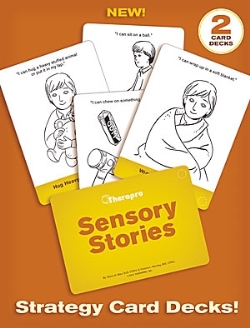
Sensory Story Cards for regulation Sensory Stories empower a child to cope with day-to-day life activities such as getting dressed, riding the school bus, and going to the store. Victoria and her co-author, Deborah Marr, have developed 30 individual stories that can be customized to each child. She engaged the attendees as a group in a sensory story about brushing their teeth. The calming strategies recommended are simple and quick so that they can easily be incorporated into a task that a child finds difficult to accomplish. For example, calming strategies might involve deep touch pressure, like a self-hug or using a towel to apply deep pressure to the skin.

For a child to feel successful every day builds self-esteem and social acceptance. Sensory Stories are a powerful tool in our toolbox that can help a child learn self-regulation. The following are a few of the many positive comments from those who attended the Sensory Stories seminar:

“Informative practical ideas that can be used right away.” Karen D.

“Exploded my ideas beyond the ‘typical’ applications of the Sensory Story cards.” Elizabeth S.

“Gives a very good presentation not only on Sensory Stories but also the importance of understanding sensory modulation.” Brooke W.

“She provided a great background/review on self-regulation. She gave many great examples and treatment ideas. I’m looking forward to trying them both with my clients and my own son!” Natalie S.

Thank you, Tory!

Filomena Connor, MS, OTR/L

Praxis Disorders and Intervention Strategies: Seminar Recap

A new season of Therapro’s Saturday Seminar Series is off and running—and it started strong! On Saturday, August 23rd, Teresa May-Benson, ScD, OTR/L, an esteemed occupational therapist, educator, author, and researcher, presented an in-depth session titled “Praxis Disorders and Intervention.”

Dr. May-Benson currently serves as the Executive Director of the SPIRAL Foundation (Sensory Processing Institute for Research and Learning), a nonprofit dedicated to advancing knowledge in the field of sensory integration and praxis. Her presentation offered attendees a compelling and informative overview of this complex area of practice. The seminar felt like a “fall tune-up,” preparing therapists and educators to reengage with the foundational concepts of praxis just as the academic year gets underway.

During the seminar, Dr. May-Benson clearly and succinctly reviewed the primary components of praxis, describing it as a multifaceted process involving a sequence of sub-processes—each engaging various parts of the brain. She explained how praxis dysfunction impacts ideation, motor planning, sequencing, and execution, and emphasized the importance of identifying these breakdowns in order to provide effective intervention.

In addition to outlining clinical signs and observable behaviors associated with praxis challenges, she presented a toolbox of intervention strategies designed to be immediately applicable across home, school, and clinical environments. A major emphasis was placed on child-directed activity, which she identified as a critical component of successful intervention. According to Dr. May-Benson, when children are not invested in the therapeutic activity, the session loses meaning—and with it, motivation and therapeutic effectiveness. Her approach reinforced the importance of aligning goals and activities with a child’s interests to promote engagement and motor planning success.

The seminar drew a diverse group of attendees, including occupational therapists, educators, parents, and even a grandparent. The feedback was overwhelmingly positive. Participants appreciated the balance of theory and practical strategies, as well as Dr. May-Benson’s ability to make such a nuanced topic accessible and actionable.

Therapro was proud to host this outstanding presentation and extends its sincere thanks to Dr. May-Benson for sharing her time and expertise. Her passion for the field of occupational therapy and deep understanding of praxis intervention left a lasting impression on all in attendance.

Check out  these reviews:

“Very informative. A lot of information presented in thoughtful manner.”

“Good information and gave me a better understanding of praxis disorders”

“Information was broken down in a very clear & helpful way.”

“Great information – helpful to get fuller picture of components of praxis & great ideas for interventions.”

Thank you, Teresa!

Filomena Connor, MS, OTR/L

August 23, 2014