Category Archives: Games

Explore a wide range of therapeutic games that support learning, development, and engagement across multiple skill areas. From language and motor coordination to executive functioning and social-emotional learning, these games offer purposeful fun for home, school, and clinic settings.

Keeping Skills Sharp All Summer Long

Summer activities are filled with opportunities for the continued development of skills learned during the previous academic year. Summer activities also provide numerous opportunities to develop and build skills that will be needed for the upcoming school year. 

Play Ball! The visual tracking and coordination needed to accurately catch and throw a ball is linked to academic skills like copying from the board and handwriting.  Help develop these vital skill areas with simple ball games.  For beginners try using Magicatch or a Gertie Ball; these types of balls are easier to catch and help to build confidence while ball skills are developing. Build strength and increase body awareness using a weighted ball for a backyard bowling game! Add a sensory element with Porcupine Balls, Koosh Balls, or Slush Balls

Draw! Drawing offers many opportunities to develop visual perceptual skills and fine motor control, essential elements needed for handwriting.  Step by step drawing books, like How To Draw are great ways to work on these skills along with working on direction following. In the summertime you can get extra creative with drawing mediums and canvases. Sidewalk chalk or drawing pictures in the sand are great options for warmer days. On rainy days, there are many options for indoor art projects!  Tape drawing paper to the wall or the under sides of  a table to help develop shoulder strength and stability.   Try drawing pictures in shaving cream or whipped cream for a fun sensory experience.  

Solve a Puzzle! Dot to Dot Books, Hidden Picture Activities, and mazes  are great rainy-day or long car ride boredom busters! They also offer opportunities to build visual perceptual skills and fine motor control that are essential for neat and legible handwriting.  

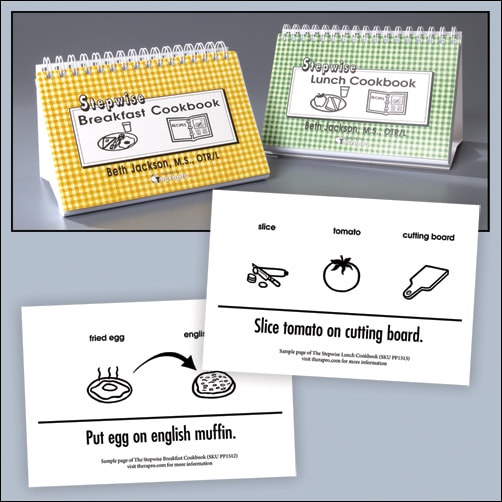
Cooking & Crafts! Students in older grades will be expected to follow schedules and take on large, multi-step projects. Crafts and cooking activities are great ways to prepare for these challenging expectations.  These activities offer opportunities for learning how to  follow sequential steps, manage time,  and problem solve.  Try the free Make & Eat Activities from Sensational Fun

Play a Game!  With so many game options available there is no limit to the skills you can work on! Target executive function skills with the game Rush Hour, work on handwriting skills with Letter Treasure Hunt, or work on grammar skills with the game NOVENOPS!
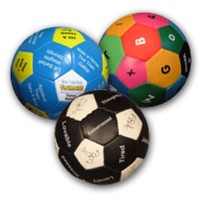

Keep skills sharp and prepare for the upcoming school year with summer fun! 

Modifying Games to Address Therapeutic Goals

Games are a useful therapeutic tool; they are versatile, engaging, and so much fun! WIth a few simple modifications games can address a wide range of therapeutic needs.  A few simple modifications can be used for almost every game:

  1. Add Visuals.  Visuals can be anything from simplified directions to communication aids, like “your turn” and “my turn”. Visuals can help those who struggle with sequencing, memory, or communication participate more independently in game play.  
  2. Change the playing position. Playing games on the floor, at a countertop, or with alternative seating helps to increase participation and access.  Playing a game on the floor allows players to play in alternative positions, like laying on their bellies. This position is great for those with postural instability, and helps increase their focus and endurance.  Another option is to use a therapy ball (add a base for stability), Alert Seat, Ball Chair, or air filled cushion instead of a traditional chair.  These types of alternative seating provides movement input which may allow those with shortened attention spans to participate longer and with more focus.  
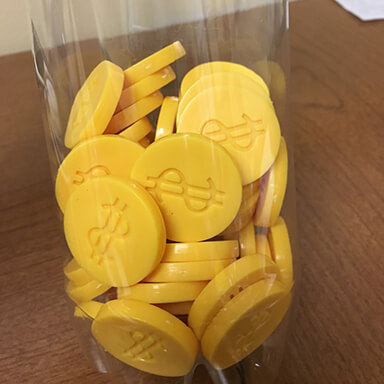
  3. Modify the Manipulatives.  Some game pieces are just too small, too big, or too difficult for students to access.  One quick fix is to swap out the game tokens for something more manageable like a jumbo dice.  Another option, insert game pieces into putty for a bigger gripping surface.  
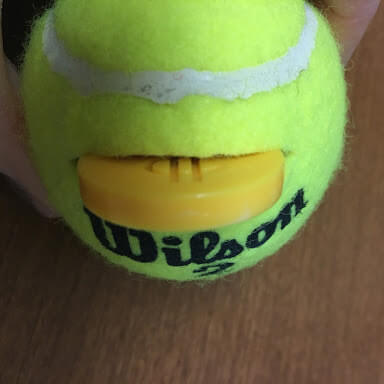
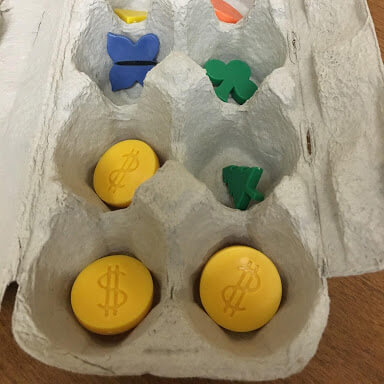
  4. Manipulating the manipulatives to target hand skills. To encourage a pincer grasp, place smaller game pieces into an egg carton (or similar small container); the smaller space allows for only a few fingers to access the piece, encouraging a two or three finger grasp pattern every time the player picks up the game pieces.  To incorporate hand strengthening and bilateral coordination, use a tennis ball with a small slit cut into it.  Players must squeeze the tennis ball with one hand while using the other hand to insert or remove their pieces.  To target fine motor manipulation with insertion, use plastic containers (your recycling bin is a great resource); cut a slit in the lid and work on inserting game manipulatives into the containers.
  5. Change the game rules to address specific therapeutic goals. If your focus is social interactions, team building, or cooperative problem solving, change game play so players play as a group instead of competing against each other. If you are doing individual treatment sessions instead of group sessions, change gameplay to make it a single-person game.  When time is limited or you have participants who struggle with extended attention and focus, add a time rule where gameplay ends after a set amount of minutes.  When the game is too hard or too easy for players, add more complexity or decrease the complexity.   
Example of modifying a game; tube with cover
Example of modifying a game; coins in a clear tube
A tennis ball with a slit and a coin inserted
coins in an egg carton

With a little bit of creativity, most games can be changed, adapted, or modified in order to use them as a therapeutic tool.  Check out Therapro’s handy games guide to see these modifications applied to some of our great games! 

Game Adaptations for All Ages: Enhancing Therapy with Play

Allyson Locke, MS, OTR/L presenter for the seminar Games, Games, Games: Unique Adaptations of Games for All Ages and All Abilities.

On March 16th, therapists and teachers formed teams to learn new games and how to adapt them for those with whom they work from preschool age and up. Allyson Locke, MS, OTR/L presented the seminar Games, Games, Games: Unique Adaptations of Games for All Ages and All Abilities. She discussed how the games can be used as part of the therapy process as well as how they can be used to target educational goals.

Allyson’s expertise with adapting games comes from her extensive and diverse background in both sensory integration and school-based practice. She currently works in a Massachusetts school for children and young adults who have significant medical, mental health, and cognitive needs.

Allyson chose 5 Therapro games to discuss in her presentation, followed by hands-on game time. The games included NOVENOPS, Letter Treasure Hunt, and Obstacles. Attendees rotated every 15 minutes from one game to another. They reconvened as a group to discuss possible modifications of the games in order to meet a student’s needs. Letter Treasure Hunt, created by author and occupational therapist, Jenny Clark, has many adaptations for playing built into the game. It also includes suggestions for variations of playing the game within the game directions. The game includes a Captain’s Log for writing acquired treasures, for which a variety of pencil grips can be trialed. Allyson discussed a variety of multisensory activities for writing letters, i.e. Wikki Stix, Squiggle Writer, scented markers. Children can play in teams or individually to target cooperative and social skills. There are endless variations to try! During the game, players draw a Captain’s Orders card that features a motor activity they must perform.

Allyson provided a peek at a number of other games that will be discussed in Therapro’s first-ever webinar: Games, Games, Games: Unique Adaptations of Games for All Ages and All Abilities, Part 2. Be sure to keep an eye out for an announcement for this webinar in the Therapro’s e-newsletter (Theragram), and on the Therapro website.

All of the game adaptations presented were unique, motivating, and applicable to many environments. As therapists and educators, we are trained to develop strategies that ensure that children learn and succeed in achieving goals. Making learning fun is what motivates students of all ages!

Attendees enjoyed this interactive seminar! Here’s what they had to say:

“I liked exploring various games for different skill/age levels.” – Laurie K., Occupational Therapist

“It was fun to move around and try things.” – Rolene K., Teacher

“I enjoyed exploring the games while brainstorming & discussing how to adapt/grade each game to meet the needs of various students/clients.” – Shannon A., Occupational Therapist

“Surprised me that it would apply to my preschool class. Very good. Lots of fun.” – Anonymous, Teacher

“Great intro to available OT focused games!” – Inibral D., Occupational Therapist

Thank you, Allyson!

Filomena Connor, MS, OTR/L
March 16, 2019