Learn about tools and strategies for providing therapy in community environments such as recreation centers, job sites, and public spaces. Focus on building independence, social participation, and generalization of skills beyond clinical or educational settings.
Hippotherapy is a specialized treatment area used by occupational therapists, physical therapists, and speech and language pathologists. It involves utilizing the sensory-motor aspects of horses to achieve therapeutic goals such as improving sensory processing to tolerate touch and motor plan sequential movements. Although the horse functions as a therapy tool, it is obviously much more exciting than a swing or therapy ball, offering opportunities to develop an emotional bond, communication and social skills.
Let’s look at the basics of hippotherapy
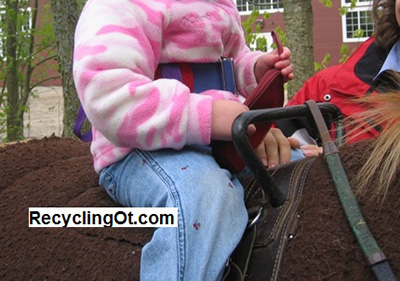
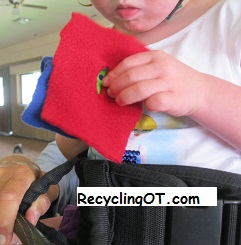
Although the healing power of horses has been recognized for thousands of years (Hippocrates mentions it in ancient Greek writings), hippotherapy only developed in Europe in the 1960s and soon after in the United states as an adjunct to physical therapy. Therapeutic goals might have included improving the rider’s strength, postural control, balance and coordination. Hippotherapy’s versatility as a treatment tool gradually expanded as SLPs used it to improve communication skills. Occupational therapists recognized the power of sensory stimulation in promoting engagement and functional hand skills, such as manipulating fasteners. For example, this rider enjoys opening the zipper on my glasses case and then handing me the sun glasses. She loves to help out and make both the horse and me happy!
Hippotherapy is a type of Animal Assisted Therapy
Please note that “therapeutic riding” (TR) is a different type of animal assisted therapy (AAT) that is offered by certified therapeutic riding instructors who teach riding skills to people with disabilities. A TR instructor may or may not be an OT, PT or SLP. However, hippotherapy is ONLY performed by a licensed OT, PT or SLP practitioner. Training and certification requirements vary at facilities and many require that the therapist have certification in both TR and hippotherapy. As an OT, my goal is not to teach my client how to ride a horse, although frequently that is the result and many children transition from hippotherapy to do TR and eventually earn medals at the Special Olympics.
Why are horses special therapeutic friends?
Well, many animals are special in their ability to connect with people nonverbally and provide unconditional love. Cats and dogs also provide great heavy pressure and tactile sensory stimulation as they lie on laps and cuddle. However, a child with cerebral palsy may improve range of motion by straddling a horse and the repetitive, smooth vestibular movement can gradually reduce muscle tone. A horse’s gait is similar to the human gait in terms of timing. Clients who have never walked or have an abnormal gait can kinesthetically experience what normal pelvic movement feels like.
I have primarily worked with very young children who received services through their early intervention programs. Many had developmental disabilities, including Down syndrome and autism spectrum disorders. My goals often focused on decreasing sensory defensiveness while increasing engagement, postural control and hand skills. Of course, this involves using a variety of reaching, grasping and manipulation hand activities.
Hippotherapy Provides controlled and graded Sensory Simulation
Simply being on a horse provides sensory stimulation. Actually, as soon as a client enters the hippotherapy facility, they are impacted by happy sounds, smells and scenery. Bouncing on the horse while walking and bouncing even more when trotting provides heavy duty proprioceptive and vestibular sensory input. I control and grade the sensory input with choices such as whether to:
walk slow, fast and for how long before stopping
walk in straight, curved lines or in circles
walk uphill, downhill or only on flat surfaces
the child faces forward, sideways, and backwards or rides in a different position such as in quadruped or kneeling.
Using Sensory-Based Materials
Hipppotherapy horses are selected for many specific attributes including tolerance for riders who may hit, kick or scream. I also use a variety of sensory materials that must first be introduced when there is no rider so that the horse becomes desensitized to materials such as:
rings placed on top of a vibrating ring stack (see photo)
toys and sound puzzles that make funny sounds or vibrate
clothespins clipped onto or removed from the mane (this does not hurt the horse)
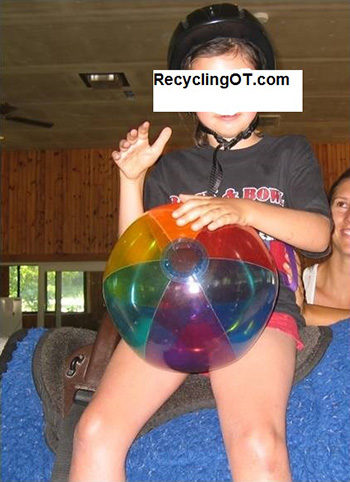
ball play, playing catch with toys like a Gertie Ball
The little girl in the photo is facing backwards while her hands bear weight on top of a vibrating cushion like a Senseez Vibrating Pillow. This helps to decrease her tactile defensiveness before asking her to engage in more complex fine motor tasks.
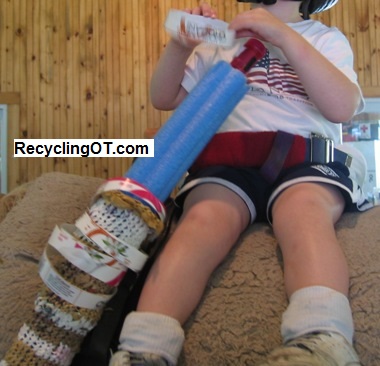
This vibrating ring stack is made by inserting a motorized pen, like a Squiggle Wiggle Writer Pen inside a swimming noodle.
Adapting activities to vibrate is one of the many sensory strategies described in my book From Flapping to Function: A Parent’s Guide to Autism and Hand Skills.
Hand Activities to Develop Postural Control
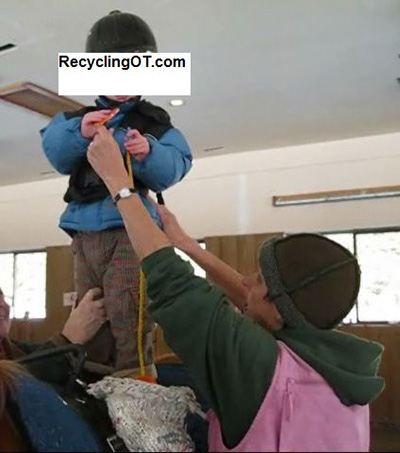
Clients may work on postural control while reach to touch body parts on the horse or therapist. I like to offer sensory materials to pull or squeeze such as Panic Pete (AKA Martian Popping Thing) while the client maintains a quadruped or kneeling position. The child in the photo squats to take rings out of the bag and stands up while stringing them. He typically has difficulty visually attending but it is difficult NOT to focus and be in the moment when standing on top of a large animal!
The girl in the photo reaches for rings positioned in front of her before rotating her body to place them over a ring stack. This “ring stack” is actually a cat toy and the mouse on top of a spring squeaks when moved. The sensory aspects of this activity help her to visually attend while developing postural control.
Hand Activities that Develop Cognitive and Manipulation Skills
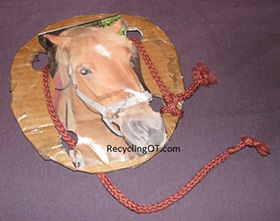
In my book – From Rattles to Writing: A Parent’s Guide to Hand Skills I describe many simple adaptations that make it easier for children with and without disabilities to develop manipulation skills. For example, lacing boards can be cut out of cardboard and made to have just a few, big holes and thick cord that are easier than string to control.
During a typical Hippotherapy session, I spend time walking and trotting, followed by stopping to complete a simple hand activity such as this lacing board. When finished I encourage the child to say or sign “go” to continue movement. Most children are eager to resume movement.
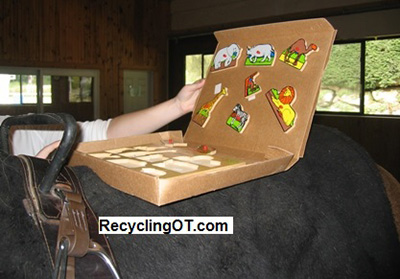
A horse’s rear end is wide and functions as a convenient work surface. I adapted this puzzle by attaching the pieces with Velcro to the box cover. I encourage the child to use one hand to stabilize the box lid while pulling them off. Of course, this activity also teaches children to identify animals and imitate sounds. The Pizza Party is another activity that would be fun to use in this position.
Creating Functional Hand Skills Objectives
It’s a good idea to create OT objectives to improve functional skills such as opening and closing buttons because:
occupational therapy is all about increasing independence
this skill is measurable
insurance companies prefer work on functional, achievable daily living skills rather than abstract goals such as improving coordination
Therefore, I provide activities such as:
opening and closing extra large fasteners
opening bags and other containers (like my sunglasses case)
putting the helmet and gait belt on and off
unbuckling and putting away the reins, neck strap or other equipment
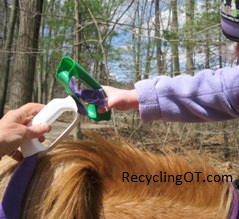
The first video shows how I made and use the “Sensory Pull Toy” (that I designed) during Hippotherapy to develop:
reaching, balance and postural control
hand strength
visual attention
eye-hand coordination
color identification
This toy is made out of detergent bottles and a strip of fabric. It’s simple to use – the child pulls the handle while in various positions. It can also be used during non horse activities to work on many skills. Please check out my book The Recycling Occupational Therapist for many other easy to make therapeutic activities.
The second video shows a few of the exciting ways therapists can use hippotherapy to develop hand skills. It is truly amazing how motivated children are to focus and engage in challenging hand activities because they love being cowboys and cowgirls!
Guest Blogger: Barbara A. Smith.
Barbara A. Smith has worked with children and adults with developmental disabilities for over 40 years! She is the author of the Recycling Occupational Therapist, From Rattles to Writing: A Parent’s Guide to Hand Skills and From Flapping to Function: A Parent’s Guide to Autism and Hand Skills. Learn more about her work at RecyclingOT.com.
Ironically, the reasons why we go to these venues are the reasons people with Autism do not like them! Here are a few challenges that may be faced in public entertainment venues:
Sensory: People with Autism often struggle with sensory input and how to deal with it.
Many of these venues may smell strange (or someone may be wearing perfume) and cause a negative reaction for some people. This can be so subtle that the person with autism may not even know that it is causing him/her to act out of control.
Sudden and loud chaotic noises can cause confusion for them in addition to all the chatter and background music in the room.
Sitting too close to other people can cause unwanted light touch that we know can be very irritating. Speaking of touch, a theatre setting may have textured chairs that are uncomfortable
And not to mention all the visual stimuli that occurs – all the bright lights, some moving and others flashing can put a nervous system into overload.
Social Skills: These venues involve social environments which is an area of real challenge for people with Autism
They may be highly anxious in knowing how to interact with the rest of the group.
As a result they may seem aloof or, on the other hand, blunt.
In an attempt to communicate, they may not be able to read the body language or facial expressions of the other person and then their behavior may appear to be inappropriate.
People with Autism take things very literally which may cause misunderstandings with others at the venue.
Routine and Anxiety: Routine is very important for people with Autism
Going somewhere new outside of routine can cause a lot of anxiety.
Even if a person with Autism is used to going to a venue each week, even the absence of a staff member, different layout, etc. could cause anxiety.
Unexpected events are anxiety producing for them.
Other diagnoses that might experience similar challenges:
We as occupational therapists working with people with developmental disabilities are trained to assess their ability to process sensory information as part of their evaluation.
We are finding that many people with no known diagnoses also have challenges with entertainment venues. Recently, I have been privileged to attend professional baseball games in Baltimore, Philadelphia and San Diego. That venue has changed since I went to baseball games as a child – now there is loud music, flashing lights, huge TV screens and people getting up and stepping on your toes which all make me wonder why I am there. It is challenging for me!
Suggested Solutions
Preparation, Preparation, Preparation:
Social Story: A social story can be a written or visual guide describing various social interactions, situations, behaviors, skills or concepts and were introduced and described by Gray and Garand (1993). They are designed to improve the social skills of people with autism spectrum disorders (ASD). Social stories are used to educate and as praise. Social stories model appropriate social interaction by describing a situation with relevant social cues, other’s perspectives, and a suggested appropriate response. About one half of the time, the stories are used to acknowledge and praise successful completion of an accomplishment. These have been used successfully in preparation for entertainment venues. For further information, Therapro, Inc. offers the Newly Revised Book on Social Stories here.
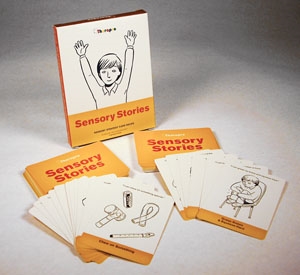
Sensory Stories: Sensory Stories, published by Therapro, are similar to Social Stories but with the specific approach to teaching children with autism and over-responsive sensory modulation issues to successfully engage in social activities within the home, school, and community. Sensory Stories comprise 30 individual stories about daily activities. These Sensory Stories instruct the child to use calming sensory strategies in order to deal with the unpleasant sensory aspects of that particular situation. When read on a regular basis, Sensory Stories assist the child in developing effective routines to manage the sensory experiences surrounding typical daily activities. The authors have conducted several studies to demonstrate their effectiveness. They can be viewed on the Therapro website.
The Venue Itself
Call ahead and see if the facility has a visual tour for an iPad of the venue. A 360 degree tour to show as much of the rooms, location of bathrooms, etc. would be helpful for knowing the physical layout.
Find out what the venue rules are, how services operates so everyone knows what to expect of the routine
Ask if there could be dedicated time that can be with just families with autism
Would there be a quiet area or small area available for families and individuals who might experience stress during the venue? Here at the Therapro Showroom, we have a sensory area for individuals including a bean bag chair and a basketful of sensory tools. This helps when the parent or caregiver want to look around the showroom. Also, our showroom does not have all products out as that could be overwhelming to individuals. Instead, we ask the parent to make a list of interested products and we go into the warehouse to pick them. Shoppers can sit comfortably at a table and make their decisions as to what they want – no rush.
Helpful Tools During the Venue Visit
Fidgets: During stressful times, fidgets help reduce agitation. Therapro’s selection of fidgets have increased through the years as each nervous system finds a fidget helpful and others offensive. Please see our website for numerous fidgets. Our very popular Fidget Kit includes a variety of fidgets so a person can determine which ones they like or dislike. We have many quiet fidgets that can be used unnoticed!
Additional Tools:
Sensory Strategy Cards: These are small cards with such strategies as “I can grasp my elbows and squeeze hard”, “I can put a heavy backpack or fanny pack in my lap”, “I can do an elbow-check to make sure no one is too close.” They are visual reminders of the various strategies that children can use. They can be tucked in a shirt or pants pocket for a quick reference to a preferred strategy or put on a belt loop or backpack.
On a very snowy Saturday morning on Saturday, January 24, 2014, a small, but strong contingent donned their snow gear and ventured out to Therapro to hear Barbara Sanna Collins, OTR/L’s seminar. Barbara presented her talk, Early Intervention Today, School Tomorrow…What You Need to Know to the audience of therapists, teachers, and child specialists. As the Clinical Director of the Massachusetts Brockton Early Childhood Intervention Program, she adeptly led us through the EI process from eligibility, to programming, and then to preparing for the transition to preschool or other appropriate services when the child “graduates” at the age of three years.
It was astounding to hear that 337,000 children and their families receive early intervention services in the US per year, with 50,000 per year in Massachusetts alone! Barbara updated us on the nitty gritty of how services are paid and how the states differ in their provision of services under Part C of the IDEA federal grant program.
Barbara shared video clips of individual and group treatment sessions in her program that took place at her center as well as at the child’s home. She noted that in the transition to a preschool program, parents who are accustomed to having their hand held through those first 3 years of participation in a program miss this when their child enters the school system – a change from “family focused” services to “child focused” services occurs. The EI team prepares the family and child for this inevitable change in service delivery. At Brockton EI, the team ensures that every child participates in a toddler group before “graduation” so that he/she experiences some typical preschool activities, i.e. transitioning from one activity to another.
Early intervention providers have several unique roles that include the provision of services that help the child with special health care needs reach their highest potential at age three and helping families gain confidence as parents and advocates for their children.
The following testimonials attest to the valuable information Barb presented in her seminar:
“Very informative – A window into the work of EI professionals. Loved the videos of the therapeutic work. Presentation was fantastic!” Marisa G.
“Wonderful presentation. So much good info. Thanks.” Anonymous.
“Very informative and motivating!” Julia H.
“Very informational – I loved the treatment videos!!” Meghan C.