Investigate evidence-based sensory integration strategies and therapeutic tools designed to help individuals of all ages regulate sensory input, enhance emotional regulation, and improve behavior, attention, and participation across a variety of environments.
A captive audience representing a broad range of disciplines attended Therapro’s September Saturday Seminar featuring Lise Gerard Faulise, MS, OTR/L, BCP. Lise is the founder of Rehab New England, a private sensory integration-oriented practice in Rhode Island, and co-founder of the Wolf School in East Providence, Rhode Island, designed for K-8 children with learning differences. Her presentation, Ready, Set, Learn: Tools to Build Self Regulation, provided a clear view of how self regulation develops from in utero and beyond, how dysregulation might occur, and how treatment can affect function.
Lise’s discussion of foundational skills that impact somatosensory experiences of a child before, during, and after birth was comprehensive. She led us through the developmental process where sensory and motor development are intimately linked, and showed how they help develop cognitive skills efficiently from the “bottom up.” She referred to the “Pyramid of Learning,” developed by Occupational Therapists MarySue Williams and Sherry Shellenberger, authors of the Alert Program – How Does Your Engine Run?, which teaches children how to identify and change self regulation using the analogy of an engine.
When there is a problem with self regulation, where the child either seeks or avoids sensory input, we may see behavioral changes in the child, which should raise red flags and further questions. Lise recommended the book, Is It Sensory or Is It Behavior? to help us examine if the behavior is intentional or whether it is a by-product. She suggested observing the timing of the behavior and whether it is limited to specific environments. For a child who experiences sensory modulation issues, Lise suggested providing the child with a large dose of sensory input activities so that behaviors don’t escalate and/or the child doesn’t feel threatened. For a child who experiences sensory overload, she suggested a quiet area or space at home and in the classroom that has things available that comfort the child, like a Cozy Caterpillar Sock, and comfortable clothing like Compression Clothing. She noted that oral or hand fidgets can help with self regulation as well. In addition, Lise identified somatosensory activities that involve deep tactile pressure, heavy work, rhythmical movement, music, breathing, and mindfulness as research-supported activities that are calming. Treatment materials to use may include scooter boards, Deluxe Peanut Balls, Rainy Day Playground: 2 in 1 Rotary Platform Swing, Heavy Work Bands, to name a few. When a child is self-regulated he/she is ready to tackle higher-level function.
We were engaged fully in Lise’s seminar and wanted to hear more as the two hours of her presentation evaporated. Her skills as a clinician, researcher, and lecturer in the area of sensory processing disorders were evident from her solid and inspiring presentation.
Attendees offered these positive remarks:
“What a pleasure! Great presenter and excellent information.” – Beth B., Occupational Therapist
“So much information that I can really use in my classroom. Clarified a lot! Could have been 2-3 classes!” – R. B., Teacher
“All educators should be equipped with tools to help children with self-regulation.” – Anonymous, Teacher
“Very informative and relatable to all disciplines.” – Amanda S., Behavior Analyst (ABA)
“Great seminar – loved the specific examples, backed by evidence-based practice.” – Marianne T., Occupational Therapist
Hippotherapy is a specialized treatment area used by occupational therapists, physical therapists, and speech and language pathologists. It involves utilizing the sensory-motor aspects of horses to achieve therapeutic goals such as improving sensory processing to tolerate touch and motor plan sequential movements. Although the horse functions as a therapy tool, it is obviously much more exciting than a swing or therapy ball, offering opportunities to develop an emotional bond, communication and social skills.
Let’s look at the basics of hippotherapy
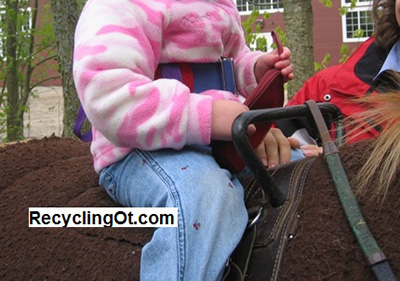
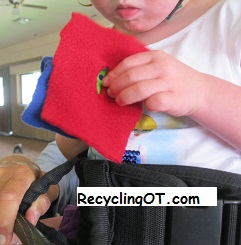
Although the healing power of horses has been recognized for thousands of years (Hippocrates mentions it in ancient Greek writings), hippotherapy only developed in Europe in the 1960s and soon after in the United states as an adjunct to physical therapy. Therapeutic goals might have included improving the rider’s strength, postural control, balance and coordination. Hippotherapy’s versatility as a treatment tool gradually expanded as SLPs used it to improve communication skills. Occupational therapists recognized the power of sensory stimulation in promoting engagement and functional hand skills, such as manipulating fasteners. For example, this rider enjoys opening the zipper on my glasses case and then handing me the sun glasses. She loves to help out and make both the horse and me happy!
Hippotherapy is a type of Animal Assisted Therapy
Please note that “therapeutic riding” (TR) is a different type of animal assisted therapy (AAT) that is offered by certified therapeutic riding instructors who teach riding skills to people with disabilities. A TR instructor may or may not be an OT, PT or SLP. However, hippotherapy is ONLY performed by a licensed OT, PT or SLP practitioner. Training and certification requirements vary at facilities and many require that the therapist have certification in both TR and hippotherapy. As an OT, my goal is not to teach my client how to ride a horse, although frequently that is the result and many children transition from hippotherapy to do TR and eventually earn medals at the Special Olympics.
Why are horses special therapeutic friends?
Well, many animals are special in their ability to connect with people nonverbally and provide unconditional love. Cats and dogs also provide great heavy pressure and tactile sensory stimulation as they lie on laps and cuddle. However, a child with cerebral palsy may improve range of motion by straddling a horse and the repetitive, smooth vestibular movement can gradually reduce muscle tone. A horse’s gait is similar to the human gait in terms of timing. Clients who have never walked or have an abnormal gait can kinesthetically experience what normal pelvic movement feels like.
I have primarily worked with very young children who received services through their early intervention programs. Many had developmental disabilities, including Down syndrome and autism spectrum disorders. My goals often focused on decreasing sensory defensiveness while increasing engagement, postural control and hand skills. Of course, this involves using a variety of reaching, grasping and manipulation hand activities.
Hippotherapy Provides controlled and graded Sensory Simulation
Simply being on a horse provides sensory stimulation. Actually, as soon as a client enters the hippotherapy facility, they are impacted by happy sounds, smells and scenery. Bouncing on the horse while walking and bouncing even more when trotting provides heavy duty proprioceptive and vestibular sensory input. I control and grade the sensory input with choices such as whether to:
walk slow, fast and for how long before stopping
walk in straight, curved lines or in circles
walk uphill, downhill or only on flat surfaces
the child faces forward, sideways, and backwards or rides in a different position such as in quadruped or kneeling.
Using Sensory-Based Materials
Hipppotherapy horses are selected for many specific attributes including tolerance for riders who may hit, kick or scream. I also use a variety of sensory materials that must first be introduced when there is no rider so that the horse becomes desensitized to materials such as:
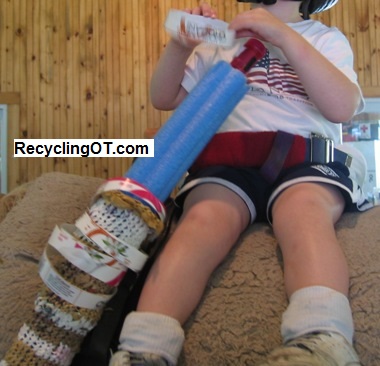
rings placed on top of a vibrating ring stack (see photo)
toys and sound puzzles that make funny sounds or vibrate
clothespins clipped onto or removed from the mane (this does not hurt the horse)
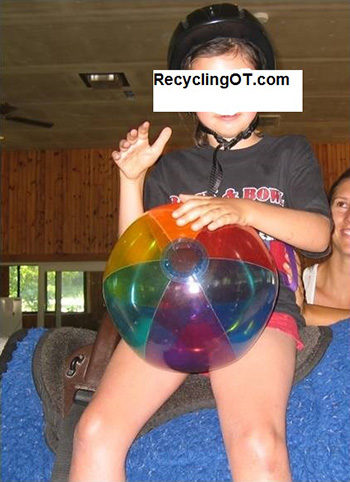
ball play, playing catch with toys like a Gertie Ball
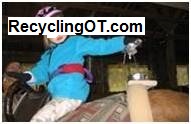
The little girl in the photo is facing backwards while her hands bear weight on top of a vibrating cushion like a Senseez Vibrating Pillow. This helps to decrease her tactile defensiveness before asking her to engage in more complex fine motor tasks.
This vibrating ring stack is made by inserting a motorized pen, like a Squiggle Wiggle Writer Pen inside a swimming noodle.
Adapting activities to vibrate is one of the many sensory strategies described in my book From Flapping to Function: A Parent’s Guide to Autism and Hand Skills.
Hand Activities to Develop Postural Control
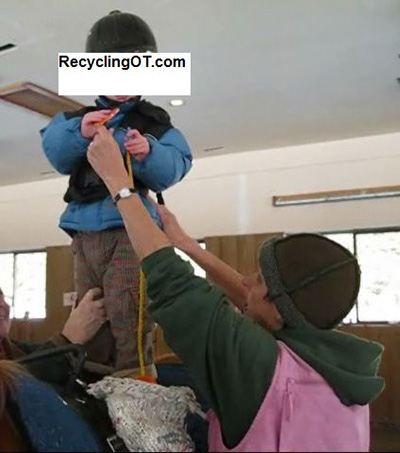
Clients may work on postural control while reach to touch body parts on the horse or therapist. I like to offer sensory materials to pull or squeeze such as Panic Pete (AKA Martian Popping Thing) while the client maintains a quadruped or kneeling position. The child in the photo squats to take rings out of the bag and stands up while stringing them. He typically has difficulty visually attending but it is difficult NOT to focus and be in the moment when standing on top of a large animal!
The girl in the photo reaches for rings positioned in front of her before rotating her body to place them over a ring stack. This “ring stack” is actually a cat toy and the mouse on top of a spring squeaks when moved. The sensory aspects of this activity help her to visually attend while developing postural control.
Hand Activities that Develop Cognitive and Manipulation Skills
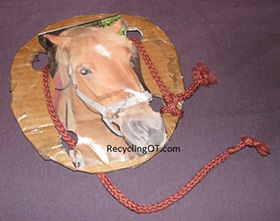
In my book – From Rattles to Writing: A Parent’s Guide to Hand Skills I describe many simple adaptations that make it easier for children with and without disabilities to develop manipulation skills. For example, lacing boards can be cut out of cardboard and made to have just a few, big holes and thick cord that are easier than string to control.
During a typical Hippotherapy session, I spend time walking and trotting, followed by stopping to complete a simple hand activity such as this lacing board. When finished I encourage the child to say or sign “go” to continue movement. Most children are eager to resume movement.
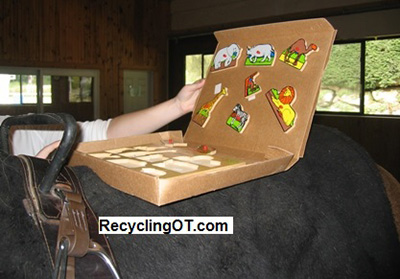
A horse’s rear end is wide and functions as a convenient work surface. I adapted this puzzle by attaching the pieces with Velcro to the box cover. I encourage the child to use one hand to stabilize the box lid while pulling them off. Of course, this activity also teaches children to identify animals and imitate sounds. The Pizza Party is another activity that would be fun to use in this position.
Creating Functional Hand Skills Objectives
It’s a good idea to create OT objectives to improve functional skills such as opening and closing buttons because:
occupational therapy is all about increasing independence
this skill is measurable
insurance companies prefer work on functional, achievable daily living skills rather than abstract goals such as improving coordination
Therefore, I provide activities such as:
opening and closing extra large fasteners
opening bags and other containers (like my sunglasses case)
putting the helmet and gait belt on and off
unbuckling and putting away the reins, neck strap or other equipment
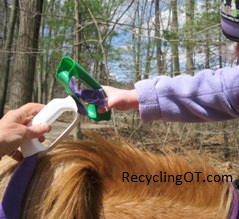
The first video shows how I made and use the “Sensory Pull Toy” (that I designed) during Hippotherapy to develop:
reaching, balance and postural control
hand strength
visual attention
eye-hand coordination
color identification
This toy is made out of detergent bottles and a strip of fabric. It’s simple to use – the child pulls the handle while in various positions. It can also be used during non horse activities to work on many skills. Please check out my book The Recycling Occupational Therapist for many other easy to make therapeutic activities.
The second video shows a few of the exciting ways therapists can use hippotherapy to develop hand skills. It is truly amazing how motivated children are to focus and engage in challenging hand activities because they love being cowboys and cowgirls!
Guest Blogger: Barbara A. Smith.
Barbara A. Smith has worked with children and adults with developmental disabilities for over 40 years! She is the author of the Recycling Occupational Therapist, From Rattles to Writing: A Parent’s Guide to Hand Skills and From Flapping to Function: A Parent’s Guide to Autism and Hand Skills. Learn more about her work at RecyclingOT.com.
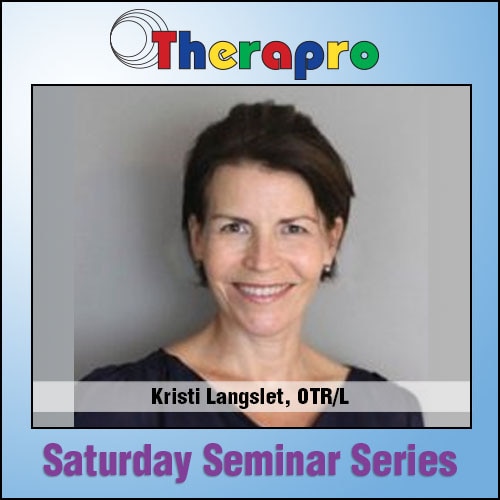
Kristi Langslet, OTR/L ended the 2017 Spring Saturday Seminar Series with her enlightening presentation: Weighted Blankets and More for Use in Your Sensory Room or Sensory Carts! She discussed benefits and applications of weighted, compression and fidget products in Sensory Rooms and Sensory Carts.
General confusion and misconceptions abound regarding the use of therapeutic weighted materials, which Kristi dispelled with her seminar. She is an experienced therapist, having worked in a variety of primarily pediatric settings. Kristi began designing and making products for her clients to meet specific needs related to sensory processing. With her sister, Heidi, she developed and launched her therapeutic products company Sommerfly, in 2005, with the goal of “Calm, Sleep and Focus for All.”
Kristi’s review of research findings regarding sensory rooms and weighted blankets was thorough. The research reviewed came primarily from studies in adult psychiatric settings, but was still applicable to broader settings and age groups. Sensory rooms have been validated as safe, effective, anxiety and distress reducers, with weighted blankets being particularly useful for decreasing anxiety. She emphasized the recommendation for the best way to use a weighted blanket is for the child to apply it on himself/herself. Research cited from Tina Champagne, MEd, OTR/L indicates that weighted blankets should weigh more than 10% of the wearer’s body weight to be most effective – with 15-25% of a person’s weight as the guideline for use. She cited studies that indicate the rise in pediatric admissions for behavioral health problems. This fact points to the need for treatment strategies that are accessible, powerful, sensory-based, and research supported.
Sensory rooms are defined as a voluntary, self-managed place to decrease stress; they empower people to care for themselves. In these rooms you might find a Sit Tight Weighted Lap Pad, a Relaxer Blanket, and a variety of other calming sensory materials such as a white noise machine, lava lamp, chewing gum,exercise bands, yoga position cards, noise cancelling headphones, etc., depending on the child’s age and needs. Kristi referred to Karen Moore’s Sensory Connection books as a having a wealth of information for developing sensory rooms and carts.
In her discussion of compression garments and muscle work, Kristi reminded us that compression garments have a similar effect as deep pressure applied to the skin and heavy work on joints/muscles. Both compression garments and weighted products provide similar touch pressure sensation, with a rapid response time, but heavy muscle work response time varies. The guideline for weighted vests provided was 3-5% of the wearer’s weight is optimal with wearing times of between 15-30 minutes at a time throughout the day; accommodation occurs with longer wearing times.
Kristi reported that since the hands and mouth have a high density of touch and proprioceptive receptors, the perception of sensation in these areas is greater than in other body areas. This may explain why we naturally fidget with hands and mouth with activities like nail biting, smoking, doodling, hair twirling, etc. Hand fidget research evidence shows that distraction reduced anxiety and pain after surgery. She advocated the use of a fidget as a “tool” versus a “toy” with examples like a Wristful Fidget or a Fidgety.
In our stress-filled society, the popularity and use of mindfulness techniques has alerted us to the value of being calm and centered. Sensory strategies we employ personally give us a sense of well being and regulation. Kristi asked us to imagine what effect they might have on a child who is “at risk.” As occupational therapists, we understand the value of and can use self-regulation practices to help people function optimally. After Kristi’s presentation, we understood the application of weighted products and fidgets more thoroughly, particularly with the pertinent research cited by her. When caregivers are given tools designed to help with self-regulation, coupled with other cognitive-behavioral strategies, we can look forward to seeing the effects with our students/patients as they reengage in life occupations.
Take a look at some of the glowing comments attendees provided:
“Great to have research to back up findings. Simple facts and Ideas to pass on to school colleagues and administration.” – Fredda T., Occupational Therapist
“I tend to be relatively skeptical about these issues, but I found Kristi extremely knowledgeable and approachable, and her presentation very informative. Lots to think about!” – Maura K., Teacher
“I liked the trauma informed approach, evidence based and practical suggestions. Really appreciated the update on weight guidelines.” – Kim B., Occupational Therapist
“Great intro course for new therapist and/or parents, teachers, related fields. Most useful for experienced OTs was the research/weight & wearing prescription/demo of products. Organized, straightforward presenter. Warm, open, compassionate, available for questions and pertinent case studies. Thank you!!” – Bernadette W., Occupational Therapist
“Great answers to questions, great products, great suggestions. I like the non toy look for fidgets.” – Anonymous, Occupational Therapist