Category Archives: Social Emotional Learning

Explore strategies, tools, and resources that promote social emotional learning (SEL) for children and adolescents. This category covers emotional regulation, self-awareness, relationship skills, and responsible decision-making to support success in school, home, and community settings.

Advanced Treatment Strategies for Youth with Complex Behavior

Speaker John Pagano, PhD, OTR/L who present Advanced Treatment Strategies for Youth with Complex Behavioral Challenges

On November 16, John Pagano, PhD, OTR/L presented his Therapro Saturday Seminar, Advanced Treatment Strategies for Youth with Complex Behavioral Challenges, to a captivated audience. The energy in the room was palpable throughout the two hour talk. Dr. Pagano ‘s passion was evident as he discussed assessing and treating children and adolescents who have complex behavioral disorders. He shared clinical examples and anecdotes to highlight his talk, peppered with humor. Leading the audience through many experiential activities provided them with examples of practical tools to use with individuals and groups.

John is an occupational therapist who practices at an adolescent psychiatric hospital and school. He is a certified instructor of Positive Behavioral Support and Movement Based Learning Strategies. His years of experience include working in various settings including adolescent juvenile detention, psychiatric hospital, adolescent group home, and in special needs, regular education and preschool classrooms. He is the author of the recently published book, FAB: Functionally Alert Behavior Strategies: Integrated Behavioral, Developmental, Sensory, Mindfulness & Massage Treatment.

John discussed the importance of setting functional behavioral goals when providing OT, PT, and Speech/Language therapies for students with complex behavioral disorders. He frequently reiterated the value of a team approach, including ABA specialists, to working with this population.

FAB Strategies® are Dr. Pagano’s evidence-based, practical strategies that use “clinical reasoning based on current clinical research and neurology to develop the individualized strategies needed to address complex behavioral challenges.” John reviewed Sensory Processing Disorders, how they interact, and how to treat them using sensory based interventions. In his discussion of Sensory Modulation Disorders, John stated that his research and experience have shown that the olfactory sense is a powerful teaching tool for those with ASD and for those who have experienced trauma. He has found that pairing a scent is very effective for achieving the desired Quiet Alert state of arousal. He advocated using materials like Scented Dough and scented markers as treatment materials.

John disclosed that research supports that mindfulness strategies are an effective and powerful treatment methodology for improving special needs students’ behavior and executive functioning. John led the group in breathing and movement activities that he uses with his students that also increase body awareness. John taught the group a number of quick, easy, and practical strategies to circumvent problem behaviors. For example, his FAB Turtle Strategy involves 4 steps: 1) Notice environmental & body triggers – STOP 2) Go to the sensory coping area 3) Do your individual coping strategy 4) Later problem solve with help. Fidgets like Loopeez, Boinks, Panic Pete, and Theraband were mentioned as some of John’s favorites for calming.

Dr. Pagano is a dynamic presenter who generously shared resources and evidence-based, practical treatment strategies for working with children and adolescents who have complex behavioral challenges. He integrates all that he has learned in his years of experience with current research so adeptly!! Attendees left this seminar with ideas they could put to use immediately in their practice.

Take a look at some of the overwhelmingly positive comments from those who attended John’s seminar:

“I left full of simple/functional strategies to try with my students, all ages. John is simply AMAZING!!!” – Christie H, Speech/Language Pathologist

“John is an excellent speaker who was very helpful, evidence based, and offered suggestions for treatment.” – Renee S., Physical Therapist

“Offered many resources & activities that can be used immediately in my practice & therapy.” – Rose O, Occupational Therapist

“John’s sense of humor made this important topic fun. Many teachers & therapists are struggling in the classroom. These are strategies that can be implemented Monday. In addition, his strategies come from evidence based research of strategies/techniques that help our students make progress.” – Jennifer H, Occupational Therapist

Thank you, John!

Filomena Connor, OT, MS, OTR
November 16, 2019
Move Mindfully Card Deck and Sensory Systems

Therapro is excited to offer the Move Mindfully Card Deck, available at our store. This product helps integrate physical fitness, mindfulness and social emotional skills into practice. The deck not only offers individual poses, but also routines to address a variety of common needs, such as “accident prone” and “lethargic”.

As a Blog Bonus, we are offering a free download of three poses from the card deck to get you started with a simple routine.  Read on to learn more about each pose and how it relates to your Occupational Therapy goals.

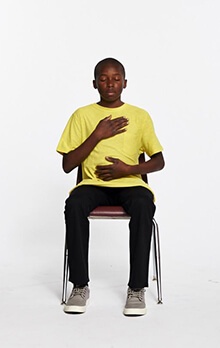
Belly Breathing

Belly Breathing

Getting into the Pose:
Belly Breathing is often taught with the Hoberman Sphere. The brightly colored, collapsible tool offers a visual tracking point to feel the diaphragm expand and contract. However, hands can simply be placed at heart and belly when teaching belly breathing as well. To start, we recommend a seated position in a chair, for back support. As a modification, this pose can also be completed laying on the floor. In this position, try a small object or toy placed on the belly for extra visualization of the up and down movement.

Therapy Resource:
Belly breathing is a great way to work on postural stability while maintaining an upright position without a collapsed trunk or slouched shoulders. This pose also taps into interoception and body awareness as breathing is tracked.

Tree Pose

Tree Pose

Getting Into the Pose:
Tree Pose is an introductory balancing pose that all body abilities can enjoy. We start by cueing the heel to touch the ankle. As balancing progresses, the foot can be placed on the calf or thigh. However, make sure to avoid any pressure on the knee joint. The hands press together at midline, palm to palm, providing additional input.

Therapy Resource:
Like belly breathing, this pose works postural stability through core activation in a static hold. It also works on bilateral coordination as hands and feet press towards midline while maintaining balance and focus. The stacking of joints over the anchored foot (ankles, hips, wrists) taps into theproprioceptive system. If you need additional proprioceptive input in this pose, try stamping feet before attempting to hold static. Activate the vestibular system by experimenting with the foot and hand placement.. Also, try small movement, such as swaying, within the pose. Work on vision by providing various focal points experimenting with gaze up, out, down and even eyes closed. If you see the MORO Reflex in this pose, return to Belly Breathing.

Child’s Pose

Child's Pose

Getting Into the Pose:
Child’s pose is often used at the beginning or the end of a session. However, it can be used whenever there is a need to decrease overstimulation. It can be completed on the floor or at a table.

Therapy Resource:
As you cue stacked fists, you are working on bilateral coordination and proprioception as joints are stacked together at midline. On the floor, there is the additional tactile input from the legs and arms on the Earth. Seekers may need to rock, or add extra movement to the pose, while avoiders may have to stay more upright. Offer a vestibular system modification of seating in a chair, hands stacked on forehead and chin slightly tucked.

Guest Blogger: Stephanie Kennelly

About Us-

This blog post is a collaborative effort of Sweet Inside Yoga and 1000 Petals.

Sweet Inside Yoga is a company providing resources for occupational therapy, physical therapy, mental health practitioners, classroom teachers, yoga teachers, professionals, parents, and others in the community to use with individuals who can be found seeking and/or avoiding yoga activities.

1000 Petals is a well-being training and consulting company based on the science and practice of mindfulness and movement. They provide integrative mindfulness and movement solutions in workshops, events, retreats and self-care classes.