Sensory Processing disorders (SPD) impact how children and adults respond to sensory stimulation such as sound, touch, what they see and movement. One basic principle of occupational therapy for individuals with SPD is to provide controlled, graded and individualized sensory stimulation to promote functional skills such as playing catch or writing one’s name. This means that activities such as tossing bean bags into containers while the child is suspended on a swing can be:
- Controlled – as the therapist responds to the child’s reactions. For example, the therapist might push the swing faster, slower or in a different direction,
- Graded- as the therapist chooses the type of swing used, how long the activity lasts, how heavy the bean bags are and how far away the container is positioned, and
- Individualized – according to the child’s sensory, emotional and motor needs. For example, the child may wear a squeeze vest during the activity, name an animal each time the bean bag is thrown or have a special friend hold the container.
What is a Sensory Diet?
Parents can implement individualized sensory strategies at home in what is called a “Sensory Diet”. This is like a recipe book of activities and adaptations that the therapist designs for parents to carryover at home, school or in the community. It is important to frequently discuss with the therapist how these strategies are working out since children grow and change rapidly along with their sensory needs in different settings.
In my book From Flapping to Function: A Parent’s Guide to Autism and Hand Skills, I describe the 6 different subtypes of SPD and some general strategies to use with children who have each type. These strategies usually impact the following 3 sensory systems:
- Tactile – uses sensory receptors in the skin to interpret sensations, such as light and heavy touch.
- Proprioception – uses receptors in joints and muscles to tell us where the body is and how it is moving in relation to objects and space.
- Vestibular – tells our body how to respond to the pull of gravity and movement of the head. It is also called the balance system.
Now for the fun part…
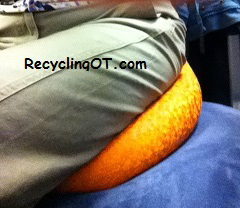
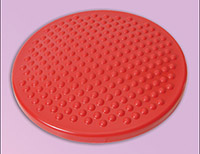
Many children with or without SPD LOVE deep, heavy pressure experiences and movement. This includes children on the autism spectrum or those with other types of developmental disabilities. One very simple strategy is to provide some type of “dynamic seating”. This simply means that the child can bounce, wiggle, rock or move around in some other way while seated. Many teachers incorporate seat cushions and ball chairs in the classroom to help students focus. The Disco Seat is one popular product. An inexpensive alternative is to sit on a deflated ball, as I am doing in the photo. Don’t have one available while eating out or sitting in the movie theater? Consider rolling up a sweatshirt for the child to sit on or curl up inside of to get a full body squeeze.
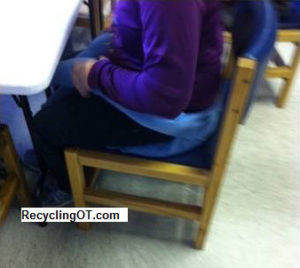
Speaking of sweatshirts, I have had great success in helping a young lady named Judy to be more focused and less agitated by placing a Disco Seat cushion inside the body of a sweatshirt. The photo shows Judy sitting on the cushion, enjoying some gentle bounces with the sleeves slung over her lap.
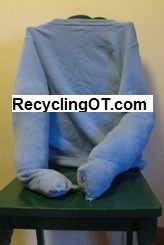
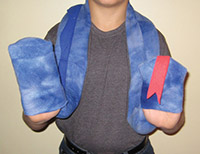
The sleeves are heavy because I put bags filled with sand inside of them. Next I sewed the wrist and shoulder ends of the sleeves closed so that the bags wouldn’t fall out. This adaptation can be used in a various of ways. The sweater may be placed over the back of a chair so that the heavy sleeves are draped over the child’s shoulders and body. Placing the cushion inside the sweater is optional.
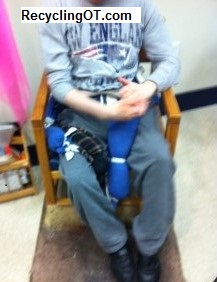
A young man named Eddy, craves extreme movement and is typically agitated unless in a rocking chair, bungee seat or swing. You can see in the photograph that his chair is adapted to not tip over given all of his body rocking. He LOVED when I attached the sweatshirt with enclosed seat cushion to the back of his chair so that he could slam his back into it while rocking. I know that he enjoyed the deep pressure bouncy sensation because he became calmer, quieter and smiled. The heavy sweatshirt sleeves are draped over his lap. I did my best to capture how I set this up in the following video while maintaining his privacy.
Seat cushions and lap bags that are a lot nicer than the ones I make with a deflated ball, sand and plastic bags are sold by Therapro, Inc. Whether you are reading this blog post as a caregiver, therapist or other type of professional, I hope that adding these simple sensory strategies to your tool box helps the people you love or work with improve their quality of life. This is why I love being an occupational therapist!

Guest Blogger: Barbara A. Smith.
Barbara A. Smith has worked with children and adults with developmental disabilities for over 40 years! She is the author of the Recycling Occupational Therapist, From Rattles to Writing: A Parent’s Guide to Hand Skills and From Flapping to Function: A Parent’s Guide to Autism and Hand Skills. Learn more about her work at RecyclingOT.com.