The Value of Therapy Balls and How Best to Store Them

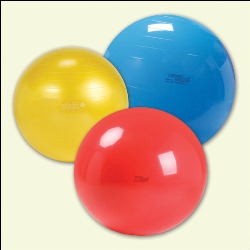
Physio Gymnic Balls, a valuable therapy tool I’ve had the joy of working in four different countries and across a variety of clinical settings. No matter the environment or the age of the client, certain tools remain universally valuable—and therapy balls are one of them. I’ve successfully used therapy balls with individuals recovering from head injuries or strokes, as well as with children with learning challenges and even clients with visual impairments.

I think balls of various sizes, textures, and shapes are a tell-tale sign that you have stepped into an OT room or department. Therapy balls are valuable in meeting so many goals and certainly show how dynamic OT is and how creative we need to be with every treatment plan and session. Let’s face it, balls are fun for most ages. They are colorful and versatile. Being round means that they are dynamic, resulting in the ability to grade therapy sessions by working on an unstable surface.

Therapy balls are valuable for improving:

  • motor control
  • muscle tone
  • trunk control or strengthening core muscles
  • upper limb function for clients with orthopedic or neurological disorders
  • introducing fun games and exercises into therapy
  • eye-hand coordination
  • righting and balance reactions
  • weight shift

Balls can encourage a child to feel excited to come into a treatment room or to prepare a blind child for hippotherapy. Balls can be just as important to an older woman needing to reduce internal scarring from repeated abdominal surgery.

There is one problem with therapy balls: storage. Without due care, your therapy room can quickly become messy, cluttered, and a potential safety hazard. We don’t want our clients tripping over equipment!
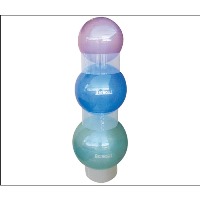
Aeromat Fitness Ball Stacker, a space-saving storage solution designed to neatly organize and stack fitness balls of varying sizes.If you’ve ever worked in an OT department or been involved in developing a therapy department in limited space, then you can appreciate the need to organize physio/Gymnic balls. There are times that facilities will look into securing a suitable shelf, setting up a hammock specifically for therapy balls, or acquiring an array of other wall or ceiling fittings.

But what can do you do if your practice is in rented space that doesn’t permit attaching anything to the walls or ceilings? Or if your OT room is in a building with prefabricated walls and ceilings, reducing the strength and stability of the internal structure?

When I started in private practice, one of the first pieces of equipment I obtained was a large therapy ball with bells inside. Amongst my first private clients was a child who was blind from birth and severely sensory-deprived, hence the bells within the ball. It was wonderful to introduce a ball game in which he could participate because he could hear where the ball was.
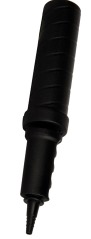
11” Two-Way Hand Pump is a versatile, durable, and efficient tool designed for inflating exercise balls, therapy balls, and other inflatablesThe problem was how to store the therapy ball. I grappled with this dilemma until I discovered the wonderful Ball Stacker. It looks professional and neat and makes a good impression when a parent comes into the therapy room for the first time. Now you can use therapy balls even if you can’t attach brackets, shelves, or hammocks to the wall or ceiling.

Another valuable accessory to the therapy ball, is the Ball Handpump which offers the freedom to alter the pressure in the ball according to the goals of your client.


Guest Blogger: Shoshanah Shear

Shoshanah ShearOccupational Therapist, healing facilitator, certified infant massage instructor, freelance writer, author of “Healing Your Life Through Activity – An Occupational Therapist’s Story” and co-author of “Tuvia Finds His Freedom”.
Improving Student Hand Function: Activity Analysis Strategies

Marcia Bridgeman, MHA, OTR/L, presented at the seminar entitled, Analyzing Activities for Improving Student Hand Function!,

The March Saturday seminar at Therapro was presented by Marcia Bridgeman, MHA, OTR/L, fine motor expert and author of the revised Fine Motor Olympics (2016). In her seminar entitled, Analyzing Activities for Improving Student Hand Function!, she methodically reviewed hand development from birth to elementary school age, and then discussed how the development translated into functional hand use.

Marcia has extensive experience in school-based practice and currently provides both consultation and direct service through her private practice in several Massachusetts school systems. She specializes in providing services to students from preschool through age 22.

Fine Motor Olympics has been revised to include a new Manual and 64 beautiful color photo cards of children’s hands performing fine motor tasks with instructions for the activity on the reverse side of the cards. A Guide to Hand Function, Quick Screening Form, Fine Motor Observation Checklist, Record Form, and In-Service Training Program are included in the Manual.

Within her comprehensive review of motor development and hand function from newborn to age 6, Marcia discussed functional fine motor skills expected at the corresponding developmental stages. For example, around the age of 8 months, development of the arches of the hand begins, essential for providing stability, mobility, and opposition of the hand. She matched simple therapeutic activities to this developmental level, including cupping the hand to shake dice, rolling up paper, fastening a zip lock bag, and cutting with a knife, to name a few!

Seminar attendees enjoyed breaking into groups at 8 stations where they tried out and analyzed original fine motor activities that Marcia created using inexpensive materials such as paper towel rolls, yarn, drinking straws, etc. The activities included activities like creating a spider web in a plastic basket and moving the spider in the web, using a variety of tongs to hunt tiny dinosaurs, balancing marbles on golf tees, and threading straws into paper towel rolls punched with holes. The groups engaged in activity analysis and shared their comments with the rest of the attendees. In addition to the new activities Marcia introduced today, she highlighted a number of fine motor Therapro products she loved, including, Boinks, Get a Grip Pegboard, Helping Hands Fine Motor Tool Set, and What’Zit Animals. She discussed conventional uses for the materials and also adapted the materials creatively and adeptly to help develop muscles of the hand. Some activities incorporated use of intrinsic muscles in translation activities, for example: moving a small single object fingers to the palm (1.5 – 2 years) and from palm to fingers (2.0 – 2.4 years).

Marcia sparked attendees to share their own creative fine motor activity ideas with the group. Everyone walked away with a toolbox filled to the brim with fresh, low-cost, and fun activities to try out next week.

We can’t think of a more enjoyable way to spend a sunny, brisk New England Spring morning than analyzing fine motor activities and sharing thoughts on how to help develop better hand function in the classroom setting! Marcia’s skill at analyzing functional hand use is unsurpassed. She offered many innovative, easy-to-make fine motor activities that support fine motor skill development.

Here’s a sample of the many positive observations that attendees shared about this seminar:

“Excellent easily implemented activities. Energetic presentation. Great product. Kudos all around.” – Beth B., Occupational Therapist

“As a Pre-K teacher, I learned a lot and will be able to look for certain signs in my 4-5 year olds and activities to help.” – Jackie K., Teacher

“Loved hearing about the development of the arches. Great refresher to help me
better analyze the activities I choose for my students.”
– Jennifer N., Occupational Therapist

“It’s directly relatable in my practice!” – Jennifer C , Occupational Therapist

“Marcia was a warm, open, creative, and generous presenter who succinctly
outlined foundations of hand function. We all left with user-friendly,
inexpensive ideas we can implement immediately. Wonderful!”
– Bernadette W., Occupational Therapist

Thank you, Marcia!

Filomena Connor, MS, OTR/L
March 24, 2018

Brain Gym: Using the Figure Eight in OT

I came across Educational Kinesiology in the early 1990s when searching for tools or techniques to help heal from a chronic illness. Little did I know that it would become an integral part of much of my OT practice. I began with Brain Gym I and II and loved the fact that the two trainers in South Africa were experienced occupational therapists trained in both SI and NDT.

Brain Gym is wonderful for assisting with goal setting, whole brain learning, stress release, and re-patterning. Although there is a specific process to follow, many of the exercises are both beneficial and transferable into a regular OT session. One that I use a lot is the Lazy 8 – a figure eight that lies on its side like the infinity sign.

What is the Brain Gym figure eight used for?

In Brain Gym terms, the Lazy 8 turns on or activates the eyes while also crossing the mid-line.

It can be used to improve ocular motor function, which assists with reading, and crossing the mid-line improves integration between the two hemispheres of the brain.

The repeated action of the Lazy 8 is also very calming. It can be used in several different formats – using the eyes, drawing the figure of 8 in the appropriate orientation, and in motion, as we shall see shortly.

The Lazy 8 can also be carried out as a motor activity, having the client walk, skip, or run around a figure eight. I love to use two hoops placed side by side on the floor to provide a visual cue. Varying the space between the hoops elongates or enlarges the figure eight. Make it more fun by having the client clap while moving around the figure of eight in time to music.

For added motor integration, combine the cross crawl with the Lazy 8. This often has to be carried out in stages:

  • Having the client carry out their cross crawl while standing until they are sufficiently at ease with the exercise
  • Upgrade to carrying out the cross crawl while walking on a straight line
  • Upgrade further to doing cross crawls while walking a figure eight

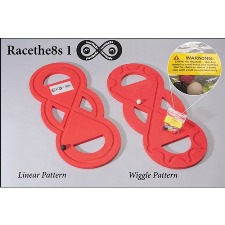
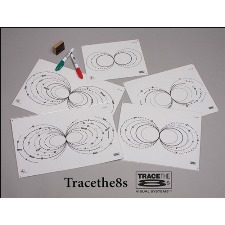
When I first began using components of Brain Gym in my treatment sessions, I would often make up my own worksheets. I am delighted to discover that Therapro has a range of products that bring the figure eight into practice for all occupational therapists. Two examples include:

The development of these tools shows how Brain Gym is becoming accepted as a beneficial modality to use within OT. It also provides an added level of professionalism, which is important for anyone who is skeptical of either how Brain Gym combines with OT or the extent to which OT itself is a recognized profession.

Once clients are familiar with the Lazy 8 through either Trace the 8s or Race the 8s, introducing the Alphabet 8 helps improve their motor memory. The Alphabet 8 incorporates lower-case letters with the Lazy 8 and is wonderful as a pre-writing activity to enhance work to meet writing goals. It’s designed for English letters but, with some creativity and practice, cursive letters for Hebrew can also be used. Note, I am not sufficiently familiar with other alphabets to know how well they can be used in the Alphabet 8.

I mentioned earlier the benefit of improving a sense of calm. The rhythmic movement of drawing or moving in the Brain Gym figure eight pattern is a wonderful addition to your toolbox for assisting clients in need of stress management and improving relaxation.


Guest Blogger: Shoshanah Shear

Occupational Therapist, healing facilitator, certified infant massage instructor, freelance writer, author of “Healing Your Life Through Activity – An Occupational Therapist’s Story” and co-author of “Tuvia Finds His Freedom”.