Creative Uses for Slant Boards and Positioning Cushions

Handwriting and writing position are often discussed in a school setting but what about our other clients? Let us consider a patient who is in the hospital. Enabling a patient to engage in drawing, art, a pre-writing task, or writing itself following an illness or injury is invaluable. However, it can be a challenge to provide the necessary angle for a writing surface when working at the bedside. Some hospital-based OT departments have a table surface that adjusts in height as well as the angle of the writing surface, but slant boards and positioning cushions are not always available.
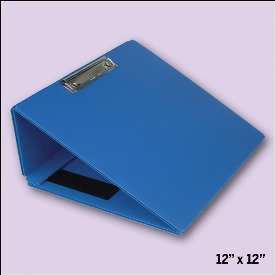
Slant Boards used for Positioning

The various slanted writing surfaces available through Therapro offer the solution. I particularly love the Collapsible Writing Surface. It opens the door to varying both the activity used in treatment as well as the location for the session.

Imagine for a moment a patient in an orthopedic ward following an MVA. The patient has multiple fractures with exoskeleton / P.O.P. and is depressed and uncooperative with all staff members. After persuading the doctor to refer to OT, a brief history reveals that the patient is an artist and the thought of not being able to draw is what depresses them enough to interfere with function on all levels.

As an OT, we can build up the grips of a pencil or paint brush. Another option to easing use of writing implement is through Triangular Pencils. Triangular writing implements can also enable a patient of this nature to return to drawing by easing the demands of the small muscles in the hand. Although strengthening these muscles will be important, the first step might be to encourage return to meaningful activity, hence the need for an easier means of holding the writing or drawing implement.

Using the portable, collapsible slanted writing surface or easel, one can now take the patient out of the ward (whether on a trolley or in a wheelchair) and into either the OT department or, better still, the garden. A change of environment does wonders for the patient psychologically, not to mention the hope offered by enabling an artist to return to what they love best – drawing, painting or creating. Many artists gain inspiration from nature, hence being able to get into the garden can literally be a breath of fresh air that instills a desire to regain function.

Through this brief example, we can see that writing and being involved in creative pursuits is a necessary skill and activity for various age groups and types of clients, not only for children at school. The tools and equipment that are beneficial in the classroom can be equally important in a hospital or other setting.

The write slant boards or Better Board Slant Boards are also of benefit to:

  • a woman who is expecting and is placed on bedrest.
  • the elderly who has limited space due to downsizing and increasing need to take care of their backs. The fact that the slant boards are light and collapsable makes handling and storage easy for an older person.
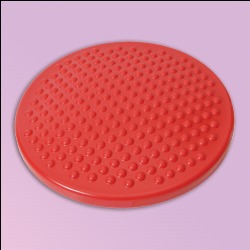
The Movin’ Sit Air Cushion used for Positioning

Still related to positioning, two cushions that I have used quite often in my practice are the Disc‘O’Sit and the Movin’ Sit Air Cushion. I love the fact that they are portable and adjustable in terms of air pressure. This makes it possible to take these cushions to a treatment or evaluation in a home or workplace.

One group of clients I have found to benefit from these cushions is a pregnant woman who is experiencing lower back pain. Pregnancy related lower back pain is a common complaint which can be alleviated with appropriate exercise and positioning.


Guest Blogger: Shoshanah Shear
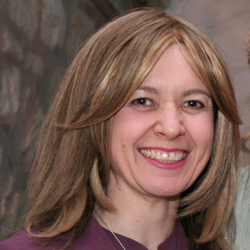
Guest Blogger Shoshanah Shear

Occupational Therapist, healing facilitator, certified infant massage instructor, freelance writer, author of “Healing Your Life Through Activity – An Occupational Therapist’s Story” and co-author of “Tuvia Finds His Freedom”.
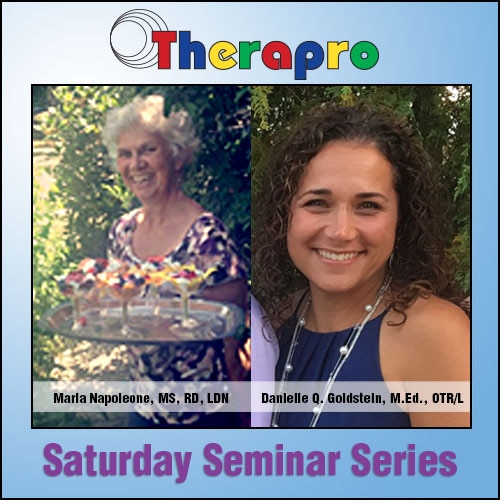
From Farm to Table: A Comprehensive Group Model of Nutrition and Feeding

nutritionist, Maria Napoleone, MS, RD, LDN and Occupational Therapist, Danielle Goldstein, M.Ed, OTR/L,The February 17, 2018 Saturday Seminar at Therapro was an innovative presentation from nutritionist, Maria Napoleone, MS, RD, LDN and Occupational Therapist, Danielle Goldstein, M.Ed, OTR/L, entitled: Farm to Table: A Comprehensive Group Model of Nutrition and Feeding. The women have developed a feeding group collaboratively at BAMSI Early Intervention Program, in Brockton, MA. Maria has notable pediatric experience as a nutritionist working in varied settings including the Boston Medical Center Growth and Nutrition Clinic, Pediatric Feeding Clinic and Pediatric Surgery Department at UMass Medical Center, WIC, early intervention, and as a Peace Corps volunteer. Danielle’s broad pediatric experience includes practice in acute care, outpatient services, feeding team, school-based therapy, early intervention, and private practice.
Danielle and Maria described Farm to Table as a comprehensive model to improve feeding outcomes with nutrition at its foundation. Their toddler feeding group at BAMSI involves using a multi-sensory approach in a structured group setting in which peer role models play a critical role in the development of eating skills. The seminar covered many topics including tips on how to structure a feeding group in various settings, how to implement key strategies, how to empower parents carryover and use the strategies learned through the group, how to improve the quality of foods consumed, how to improve mealtime behavior, and much more!

Farm to Table developed over a number of years as the model for the BAMSI feeding group that provided the toddlers with hands-on food exploration and multisensory experiences in a nurturing, supportive setting. The Sequential Oral Sensory (S.O.S) Approach, a trans-disciplinary program for assessing and treating children with feeding challenges and weight/growth problems, serves as the approach the BAMSI team uses in their feeding group. S.O.S. integrates posture, sensory, motor, behavioral/learning, medical, and nutritional factors to evaluate and manage children with feeding and growth difficulties. Creating a garden as part of the group experience gives the children other sensory and food-related experiences that helps them understand how food grows and what it looks like when it is cooked and on your plate. The garden has produced a wide variety of vegetables and herbs that the group has used to prepare snacks and meals including spaghetti sauce, zucchini muffins, and pesto. Growing food adds a critical component to the group in light of the fact that Maria noted that “70-90% of children who receive EI services have one or more nutritional risk indicators.”

Several of the many helpful resources recommended by Danielle and Maria include: www.choosemyplate.govwww.feedingmatters.orgwww.ellynsatterinstitute.org, and www.farmtopreschool.org.

Maria and Danielle presented an exciting model that addresses jointly the importance of developing a solid nutritional foundation for children as well as the need to support children with feeding challenges through a multi-sensory approach to feeding. They have documented great success with their Farm to Table feeding group. The rich experiences the children gain take them from learning about how plants are grown, cared for, and harvested, to how the plants are prepared, cooked, and eaten, in a structured group with peers and adult role models. This team approach takes children who experience feeding challenges on a nurturing, supportive, fun journey toward improved nutrition and enjoyment of food!

Take a look at a few of the many positive comments from attendees about Danielle and Maria’s seminar:

“Very informational on ways to improve feeding with children not just by using food but also through movement, circle time, structured activities. Really like the idea of group and using peer modeling.” – Julia N., Occupational Therapist

“It was interesting and well presented. I will use many of these strategies for my class. (I am in First Grade and work with Special Needs).” – Annmarie M., Teacher

“Great process from beginning to end of creating this group program.” – Micaela C., Physical Therapist

“The emphasis on the process was important in understanding that every student works at their own pace and that any type of food trial – whether it be touch, smell, or taste is success!” – Beth M., Occupational Therapist

Thank you, Maria and Danielle!

Filomena Connor, MS, OTR/L
February 17, 2018

Move Mindfully Card Deck and Sensory Systems

Therapro is excited to offer the Move Mindfully Card Deck, available at our store. This product helps integrate physical fitness, mindfulness and social emotional skills into practice. The deck not only offers individual poses, but also routines to address a variety of common needs, such as “accident prone” and “lethargic”.

As a Blog Bonus, we are offering a free download of three poses from the card deck to get you started with a simple routine.  Read on to learn more about each pose and how it relates to your Occupational Therapy goals.

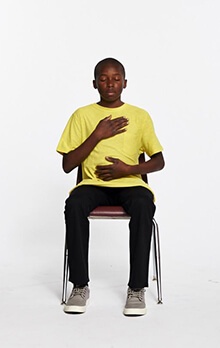
Belly Breathing

Belly Breathing

Getting into the Pose:
Belly Breathing is often taught with the Hoberman Sphere. The brightly colored, collapsible tool offers a visual tracking point to feel the diaphragm expand and contract. However, hands can simply be placed at heart and belly when teaching belly breathing as well. To start, we recommend a seated position in a chair, for back support. As a modification, this pose can also be completed laying on the floor. In this position, try a small object or toy placed on the belly for extra visualization of the up and down movement.

Therapy Resource:
Belly breathing is a great way to work on postural stability while maintaining an upright position without a collapsed trunk or slouched shoulders. This pose also taps into interoception and body awareness as breathing is tracked.

Tree Pose

Tree Pose

Getting Into the Pose:
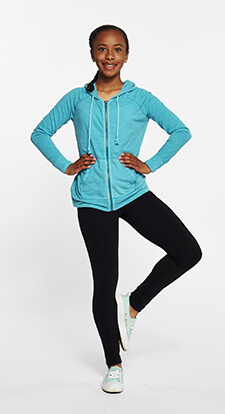
Tree Pose is an introductory balancing pose that all body abilities can enjoy. We start by cueing the heel to touch the ankle. As balancing progresses, the foot can be placed on the calf or thigh. However, make sure to avoid any pressure on the knee joint. The hands press together at midline, palm to palm, providing additional input.

Therapy Resource:
Like belly breathing, this pose works postural stability through core activation in a static hold. It also works on bilateral coordination as hands and feet press towards midline while maintaining balance and focus. The stacking of joints over the anchored foot (ankles, hips, wrists) taps into theproprioceptive system. If you need additional proprioceptive input in this pose, try stamping feet before attempting to hold static. Activate the vestibular system by experimenting with the foot and hand placement.. Also, try small movement, such as swaying, within the pose. Work on vision by providing various focal points experimenting with gaze up, out, down and even eyes closed. If you see the MORO Reflex in this pose, return to Belly Breathing.

Child’s Pose

Child's Pose

Getting Into the Pose:
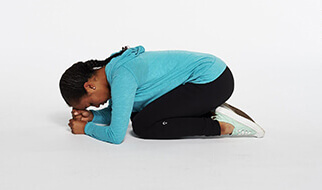
Child’s pose is often used at the beginning or the end of a session. However, it can be used whenever there is a need to decrease overstimulation. It can be completed on the floor or at a table.

Therapy Resource:
As you cue stacked fists, you are working on bilateral coordination and proprioception as joints are stacked together at midline. On the floor, there is the additional tactile input from the legs and arms on the Earth. Seekers may need to rock, or add extra movement to the pose, while avoiders may have to stay more upright. Offer a vestibular system modification of seating in a chair, hands stacked on forehead and chin slightly tucked.

Guest Blogger: Stephanie Kennelly

About Us-

This blog post is a collaborative effort of Sweet Inside Yoga and 1000 Petals.

Sweet Inside Yoga is a company providing resources for occupational therapy, physical therapy, mental health practitioners, classroom teachers, yoga teachers, professionals, parents, and others in the community to use with individuals who can be found seeking and/or avoiding yoga activities.

1000 Petals is a well-being training and consulting company based on the science and practice of mindfulness and movement. They provide integrative mindfulness and movement solutions in workshops, events, retreats and self-care classes.