Classroom strategies encompass OT-informed approaches that support attention, posture, sensory needs, and motor skills to help students succeed academically and socially.
Sometimes called tactile paper, Raised Line Paper is used to help individuals stay between the lines when writing. The raised line paper has raised top and bottom lines to provide tactile, proprioceptive and visual feedback to the writer. There are a variety of types of paper to choose from!
There are so many options to help more advanced writers be as successful as they can. There are different sized lines (narrow and wide) depending on the level of the writer. If you need more of a visual cue there is the option to have red and blue lines on your paper. Double the input for a higher accuracy when writing. If spacing or sizing is a problem there is boxed raised line paper to provide a space for every letter to fit in. Pro tip: If all this sounds great but you are not sure what will work best the assortment pack is very helpful!
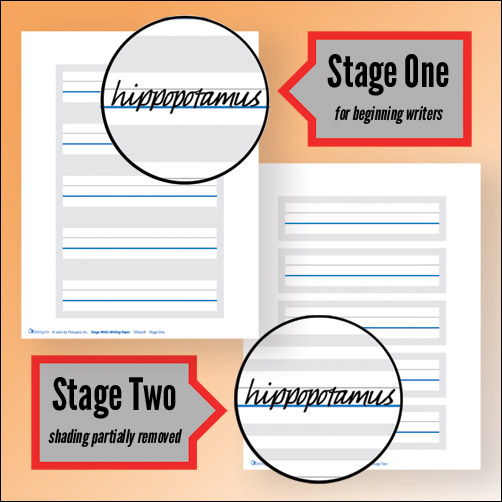
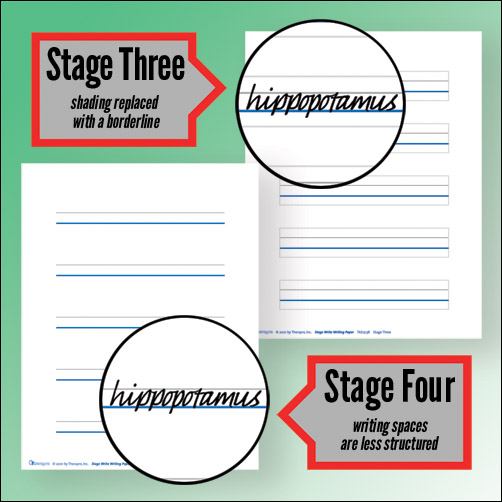
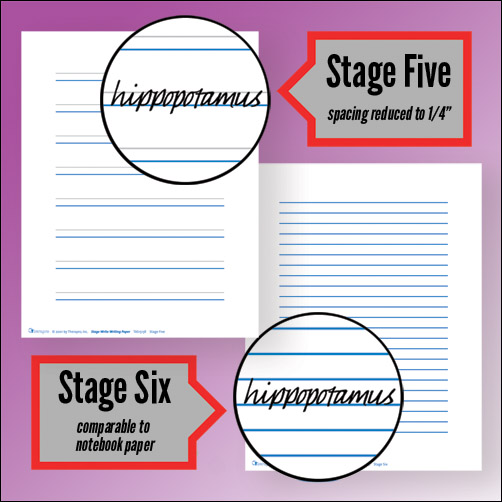
There is a product line that is able to take a writer from beginning stages right through advanced writing. This is a six stage series of handwriting papers that begins with clearly defined writing spaces and perceptual cues that fade in successive stages as the student gains mastery. The thick, colorful dark blue baselines are raised, providing not only visual cues, but also tactile cues. Pro Tip: Students advance at their own pace so having all the stages on hand is very helpful!
Stage One:For beginning writers. Clearly defined writing spaces.
Stage Two:Writing spaces are less defined as shading is partially removed.
Stage Three:Shading has been completely removed and replaced with a borderline.
Stage Four:Writing spaces are less structured; fewer distractions than typical notebook paper.
Stage Five:The most popular Stage Write paper! Spacing between blue baseline and gray guideline reduced to 1/4″.
Stage Six:Comparable to standard notebook paper. Still incorporates raised dark blue baseline and clearly defined margins.
Another great aspect of this paper is that it can be used with a variety of reading/writing/handwriting programs! Give your writers the tools they need to be successful, independent writers.
The school and classroom provide a wealth of sensory information. Whether or not your students have special needs, processing sensory information can be a real challenge and also impact their behavior (e.g. difficulty paying attention, sitting still, working cooperatively with others, etc.).
Sensory processing difficulties arise when the brain can’t sort, organize, analyze, or integrate sensory messages. It’s like a “traffic jam” in the brain, with a few snippets of sensory information “stuck in circulation”. When this happens, certain parts of the brain don’t receive the sensory information they need to do their job. (1)
Providing a sensory space helps students to calm down and is a way to avoid disorganization. It’s a simple solution for improving social-emotional behaviors and beneficial for cognitive development.
What Is A Sensory Corner? A sensory corner is a designated area inside your classroom that is dedicated to supporting the sensory development of all students. It allows the child to take refuge there completely independently. Their withdrawal into this space helps them regulate their emotions and energy level in order to be more available to learn and interact with others.
A sensory space stimulates the primary senses; sight, hearing, smell, touch, vestibular and proprioception without creating overload because the senses are chosen on a voluntary basis.
The Benefits Of A Sensory Corner These very precious moments, lasting at least 15 minutes, improve mood management by taking care of one’s emotions, increasing the feeling of security, and help reduce agitation and apathy (lack of energy). No wonder they allow for the improvement in attention and quality of concentration.
Regulating our senses is important in maintaining our mental and physical well-being and self-esteem. The sensory space allows for wonderful one-on-ones or supports a moment of guided learning, if the space is sufficient to accommodate the adult and child.
How To Design A Classroom Sensory Space
It must be welcoming, comfortable and a defined space. The area has boundaries and is large enough to accommodate at least one seat (armchair, cushion, carpet, etc.).
Make sure the child will be isolated from ambient noise or the hallway.
Make sure you can adjust the light intensity or filter it. Some children will seek intense light while others will benefit from dim lighting.
Try to find a corner of the class where the student can have some privacy, out of sight of their peers. To enclose this space, you could use a curtain or furniture such as a bookcase or shelf.
Ideally, provide storage for the items or equipment that your corner will offer. The space should not be overloaded with things.
The objective is to be able to immerse yourself in a “cocoon-bubble” atmosphere in order to experience better sensory stimulation and enjoy all the benefits.
The effectiveness of a sensory corner has nothing to do with your allocated budget. It’s therefore not necessary to invest in expensive and sophisticated equipment.
What equipment should you provide in your sensory corner? Your sensory corner can evolve over time and according to the needs of your students. Here are some suggested items that can stimulate the senses.
Smell – An accessory or cushion that you can put a few drops of essential oils on (ex: lavender) – Scented putty – Small cotton sachet (for the bottom of a drawer) with different smells
Sight – Mini flashlight, mini battery-operated candle – Hourglass or sensory tube – Homemade glitter bottle
And the most important… Once your sensory space has been established, take the time to show it to your students and teach how to use it, when, and why so that they understand the purpose of this space.
It’s also important to display the tools and resources available in the space. Don’t hesitate, for example, to demonstrate breathing techniques in a large group so that they know how to repeat them when alone.
Having a space like this is a great way to implement social-emotional learning strategies in your classroom.
And now, play on!
Guest Bloggers: The ManimoTeam
About manimo For 20 years, manimo has comforted thousands of children at home and school. manimo’s range of weighted animals are all equally attractive. It’ll be a must have in your sensory space to stimulate your student’s proprioception and touch senses.
Supporting reading means more than teaching literacy—it’s about building the underlying skills that make reading possible. This is especially true when reading is hindered by other difficulties such as visual inattention, visual impairments, or sensory processing difficulties. There are many low to high-tech assistive technology options that can help support reading. With so many options available, how do you decide which option is best for your needs? Here is a quick breakdown!
Use Light Filters When Glare Reduction is Needed Glare results when too much light enters the eye. It can come from either a direct or a reflected light source. Glare can be distracting and can also make it difficult to read text or see images. Overhead fluorescent lights are a major source for glare in classrooms and office spaces. Light Filters are a simple solution for minimizing glare that comes from overhead lights.
Use a Reading Guide Strip When Tracking is Difficult Difficulty with eye tracking can cause readers to skip lines or words and can decrease reading speed. This may also impact overall reading comprehension. Reading Guide Strips make it easy to track print through a transparent tinted window. Even better, they are available in a variety of colors making it easy to find the eye’s preferred color!
Use Colored Overlays When More Contrast or Clarity is Needed Colored overlays can help with print clarity. Improving print clarity can be helpful in decreasing eye strain and fatigue. It can also help by increasing reading attention and overall comprehension. Options to improve contrast include Highlighter Strips and Reading Guides. Highlighter Strips work by brightening written words. Reading Guides help improve contrast. Pro tip: color preference varies, try different colored reading guides to see which your eye responds to best!
Use Slant Boards to Increase Visual Attention Bringing visual material closer to the eye can help increase visual attention. Slant Boards and book holders are both great tools for this job! Pro Tip: Adjustable slant boards offer maximal flexibility with finding the right angle!
The ability to read is more than just literacy skills! Low tech adaptations and modifications can make the difference between a successful reader and a struggling reader.