Occupational therapy (OT) tools include equipment and materials used to support sensory integration, motor skills, coordination, and functional independence in children.
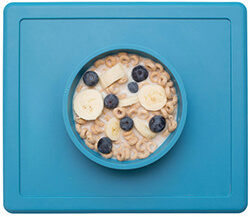
It seems as natural as can be; use a child’s meals and snack times as opportunities for teaching utensil use. In this atmosphere of “least restrictive environment” and push-in treatment, this sounds like a great plan for your therapy session. Although it seems like a good idea, there are circumstances in which separating utensils beyond mealtime, at least initially, can be more effective in treatment:
Children with tactile aversions and oral sensitivity may find combining manual and intra-oral exploration to be too overwhelming.
Children with both motor and sensory issues may find that they cannot work on practicing multiple skills at the same time.
Children with behavior issues can be faced with a difficult situation: they want to eat and they want to exert control over their body or an adult’s behavior.
Kids with minimal endurance or tolerance can lack the ability to complete a meal, leaving them dependent on adults or frustrated with their fatigue or a sense of failure.
Teaching utensil use without the expectation of food ingestion can solve these problems. As skills and tolerance grow, the two experiences can be joined successfully. Here are some suggestions to make practice effective and weave it back into functional experience as seamlessly as possible:
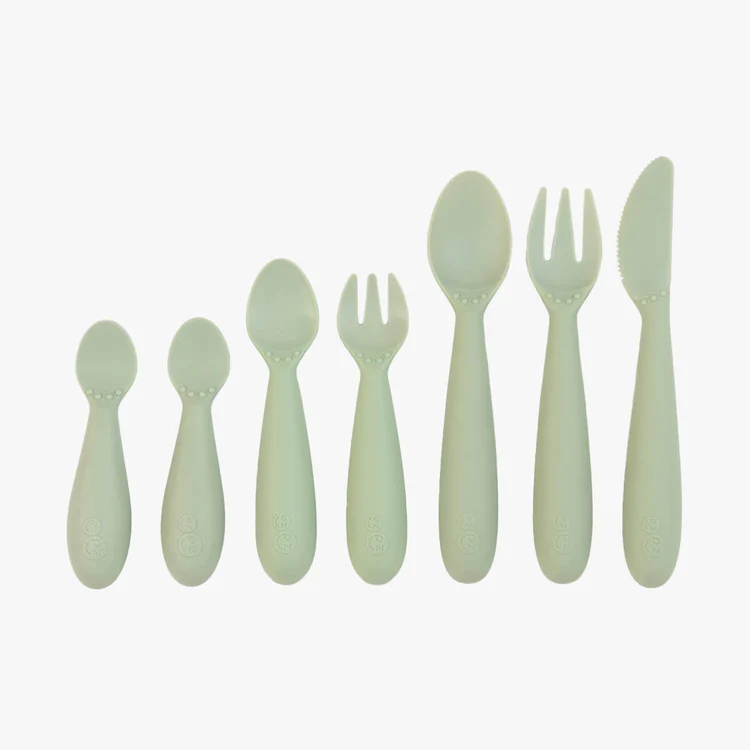
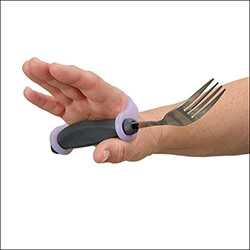
Have the child feed an adult or Chomper Champ using child-friendly utensils and foods. A child may decide to take a bite instead of feeding the adult, so a food’s size and texture should be safe for the child’s developmental level.
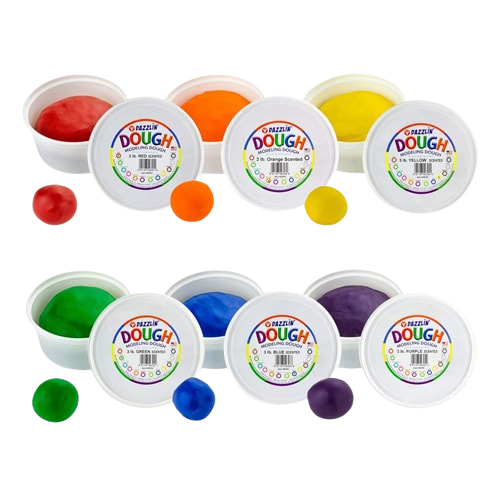
Playfully scooping and piercing non-food objects such as non-edible dough with utensils and other “real” tableware may extend practice sessions while decreasing the stress of multi-sensory exposure with food.
Watching the therapist eat food that the child has prepared or served with utensils reinforces the social and nurturing aspects of meal preparation and eating.
Using strategies such as backward chaining or graded exposure, activities that begin by separating utensil use from eating can become more like a typical mealtime experience over time. When children are given a “just-right” level of challenge, they make faster progress with ease.
Cathy Collyer, OTR, LMT, PLLC
Cathy Collyer, OTR, LMT has treated children with neurological, orthopedic and sensory processing disorders for over 20 years. She is the author of The Practical Guide To Toilet Training Your Child With Low Muscle Tone.
School-based occupational therapists are familiar with receiving requests for assessments or interventions for children with delays of all kinds. What happens when the service request is for a child that has been identified as gifted or talented, but has no diagnosed disorders (non-disabled)? Will OT treatment help a child whose brain is globally and permanently wired for intense responses?
Some common behavioral characteristics of the gifted often suggest that sensory processing difficulties could be present:
Sensitivity to lighting, fabrics, and other sensory stimulation.
Seeking strong sensory-motor input throughout the day.
Difficulty tolerating school rules such as taking turns or sharing the spotlight in discussions.
Pursues interests in isolation or with adults rather than with peers.
Resistance to complete assigned projects; pursues personal interests.
Theorists such as Kazimierz Dabrowski have attributed these and other behaviors to multiple “overexcitabilites.” He identified five primary areas of over-excitability in gifted individuals: psychomotor, sensory, intellectual, imaginational and emotional. Not considered to be signs of neurological disorders, they are thought to be the result of a brain that is wired differently than children of average abilities. Brain imagining studies suggest that the gifted make faster and more complex associations between stimuli. They perceive experiences and interactions with more depth and intensity than other children, and have an inborn drive to follow their passions.
These brain characteristics are not necessarily problematic for every gifted child. When teachers and parents know how to support children who learn differently, the gifted child can become a positive force and even a leader in the classroom. Although scores on the Sensory Profile or on other sensory-based assessments may suggest an SI diagnosis, there are gifted children that manage successfully in school and at home without intervention. They may even come up with their own sensory diet, having identified activities that provide what they need. For example, a child that seeks sensory input could engage in complex art projects or specific sports activities that provide visual, tactile, vestibular or proprioceptive input. A sensory-sensitive child may happily use an unoccupied corner of the room with indirect light for free reading time.
Some gifted children will have difficulty in class, especially when their behavior is at odds with school routines and social norms. A child that takes over discussions or refuses to work on a group project may disrupt a classroom or be unable to complete assignments even though their academic abilities exceed their peers. A child that refuses to wear a tie or participate in music class may need help to handle the demands of school.
Anne Cronin, OTR, FAOTA has recommended that gifted children can benefit from sensory diets and modulation strategies found in programs such as “ It is worth noting that gifted children may be able to comprehend and implement programs at earlier ages and stages than typical children. Children who were reading at 3 or creating complex imaginary civilizations at 5 may learn and incorporate a sensory diet almost immediately on accepting its value. Such students may even improve on your suggested activities with one of their own creation! This is the time to collaborate with them and provide them with the positive feedback they may need in order to try new ways of responding at school and at home.
Patterned Fluorescent Light Filter
Fluorescent Light Filter
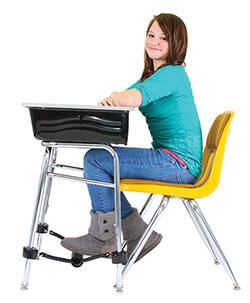
Attachable FootFidget® Footrest
The same sensory-based equipment that we recommend for other children with sensory processing problems could help gifted children as well. Fluorescent Light Filterseffectively dim harsh lighting, and fidgets for feet and hands can be effective tools that don’t disrupt productive work. Because gifted children need to learn to manage and modulate their intense and complex responses, there are many ways that OTs could be helpful to these children.
Gifted children may need a wider variety of tools to give them the desired novelty they crave, or they may reject many ideas rapidly. Always ask for an explanation and be ready with alternatives. A gifted child may be able to project many steps ahead of you and identify roadblocks that you don’t anticipate…yet!
Cathy Collyer, OTR, LMT, PLLC
Cathy Collyer, OTR, LMT has treated children with neurological, orthopedic and sensory processing disorders for over 20 years. She is the author of The Practical Guide To Toilet Training Your Child With Low Muscle Tone.
OT goals on IEPs and IFSPs for young children commonly include teaching scissor skills. There is a good reason for this: using scissors independently and safely is an important preschool classroom skill. For OT’s, it is also a benchmark for bilateral control, dissociation of the sides of the hand, and the ability to control and grade force. But what do you do with kids that aren’t interested or prepared to cut?
Many young children are eager to learn to cut with scissors. They are excited to control such a grown-up tool and they like to see the immediate effects of their actions as the paper bits fall to the floor. Not all interest results in a good outcome. At times, they are so enthusiastic that they act in unsafe manner or use scissors in inappropriate ways.
Some kids fear scissors; they are often the children who fear failure and shrink from a challenge. And finally, there are children who have little interest or excitement in participating in any fine motor tasks. Whether due to frustration or a preference to act on their environment with sensory-based or gross motor skills, their behavior suggests that they couldn’t be bothered by learning to use scissors.
Children that struggle to cut can become discouraged and lose their initial excitement for mastery of this important skill. By allowing them to observe and practice pre-training skills before you introduce the act of cutting, you can improve your chances that they will develop and sustain enthusiasm and good safety skills with scissor activities.
There are children over 3 who have never been allowed to use a scissor due to adult safety concerns, lack of appropriate tools/assistance or developmental delays. A child’s initial exposure to scissors can be as simple as directing a child’s visual regard to your use of scissors as part of a therapy activity.
Make sure that you narrate your actions in short phrases with emphasis on action words.
Use an enthusiastic tone and gestures that sustain the child’s attention and interest.
Make practice short: in fact, end practice before a child is frustrated or bored.
Finally, make it clear that you expect that the child will be able to use scissors as they grow and develop more hand skills.
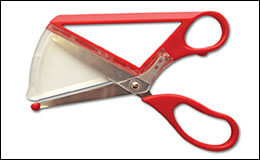
Children benefit from being able to see an adult’s hand movements while cutting. Your students may have been discouraged from being too close to an adult model due to safety concerns. Some adults are unaware that children need exposure to develop interest and excitement in the use of scissors. Use the safest scissors available with impulsive children who may reach for your scissor blades in their eagerness to learn about this exciting tool.
Ultra Safe Scissors
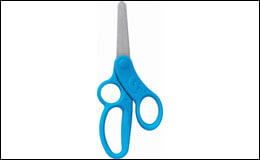
Once interest has developed, you may want to assist children as they open and close the blades. Scissors that are spring-loaded or have finger spaces for an adult can help, or you could place your fingers between the handles to facilitate movement. The sound of the blade movement is fascinating to young children, even without bringing the blades to the paper for cutting. Practicing alternating opening and closing the blades may be your entire activity for the therapy session. By breaking down the actions of scissor use into their precursor parts, you are decreasing a child’s frustration and increasing the likelihood of later success. Hand-over-hand assistance can be helpful when combined with independent scissor use. Gradually fade out this assistance out to allow maximal proprioceptive and kinesthetic input.
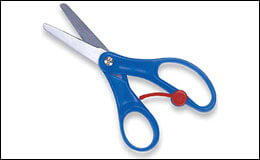
Children with hand and wrist weakness or poor sensory registration and discrimination benefit from scissors that provide more support and allow more of their hand to be involved in cutting. Create textured handles with tape on classroom scissors or use Fiskars Total Control Kids Scissors that provide more digital control and encourage activation of intrinsic musculature to support development of the horizontal and vertical arches in the hand while cutting.
Spring Action Blunt Tip Scissors
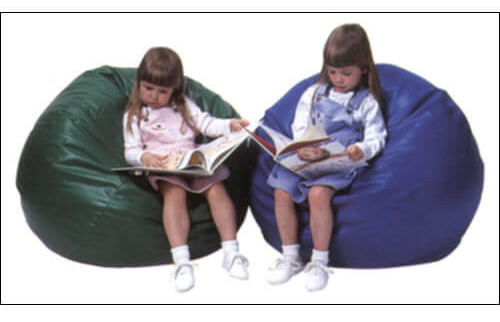
Provide additional postural support to children with instability and core activation issues. They may require more proximal stabilization than they appear to need for other tasks. Well-chosen classroom chairs or even a corner sitter may give a child the motor support needed to achieve optimal stability for learning a new motor skill. Beanbag chairs diminish sensory-based distractibility while providing full-body support. Once the new skill is mastered, the degree of support can be decreased gradually.
Bean Bag Chairs
By focusing more on pre-scissor activities and thereby maintaining a child’s enthusiasm and attention to task, you will increase their ability to persist with practice and have a more productive therapy session!
Guest Blogger: Cathy Collyer, OTR, LMT, PLLC
Cathy Collyer, OTR, LMT has treated children with neurological, orthopedic and sensory processing disorders for over 20 years. She is the author of The Practical Guide To Toilet Training Your Child With Low Muscle Tone.