Tag Archives: occupational therapy (OT) tools

Occupational therapy (OT) tools include equipment and materials used to support sensory integration, motor skills, coordination, and functional independence in children.

Getting Creative with Sweatshirts and Seat Cushions!

 Sensory Processing disorders (SPD) impact how children and adults respond to sensory stimulation such as sound, touch, what they see and movement. One basic principle of occupational therapy for individuals with SPD is to provide controlled, graded and individualized sensory stimulation to promote functional skills such as playing catch or writing one’s name. This means that activities such as tossing bean bags into containers while the child is suspended on a swing can be:

  • Controlled – as the therapist responds to the child’s reactions. For example, the therapist might push the swing faster, slower or in a different direction,
  • Graded- as the therapist chooses the type of swing used, how long the activity lasts, how heavy the bean bags are and how far away the container is positioned, and
  • Individualized – according to the child’s sensory, emotional and motor needs. For example, the child may wear a squeeze vest during the activity, name an animal each time the bean bag is thrown or have a special friend hold the container.

What is a Sensory Diet?

Parents can implement individualized sensory strategies at home in what is called a “Sensory Diet”. This is like a recipe book of activities and adaptations that the therapist designs for parents to carryover at home, school or in the community. It is important to frequently discuss with the therapist how these strategies are working out since children grow and change rapidly along with their sensory needs in different settings.

In my book From Flapping to Function: A Parent’s Guide to Autism and Hand Skills, I describe the 6 different subtypes of SPD and some general strategies to use with children who have each type. These strategies usually impact the following 3 sensory systems:

  1. Tactile – uses sensory receptors in the skin to interpret sensations, such as light and heavy touch.
  2. Proprioception – uses receptors in joints and muscles to tell us where the body is and how it is moving in relation to objects and space.
  3. Vestibular – tells our body how to respond to the pull of gravity and movement of the head. It is also called the balance system.

Now for the fun part…

child sitting on a seat cushion

Many children with or without SPD LOVE deep, heavy pressure experiences and movement. This includes children on the autism spectrum or those with other types of developmental disabilities. One very simple strategy is to provide some type of “dynamic seating”. This simply means that the child can bounce, wiggle, rock or move around in some other way while seated. Many teachers incorporate seat cushions and ball chairs in the classroom to help students focus. The Disco Seat is one popular product. An inexpensive alternative is to sit on a deflated ball, as I am doing in the photo. Don’t have one available while eating out or sitting in the movie theater? Consider rolling up a sweatshirt for the child to sit on or curl up inside of to get a full body squeeze.

 
a child using a homemade seat cushion

Speaking of sweatshirts, I have had great success in helping a young lady named Judy to be more focused and less agitated by placing a Disco Seat cushion inside the body of a sweatshirt. The photo shows Judy sitting on the cushion, enjoying some gentle bounces with the sleeves slung over her lap.

 
example of using a sweatshirt to make an innovative seat cushion

The sleeves are heavy because I put bags filled with sand inside of them. Next I sewed the wrist and shoulder ends of the sleeves closed so that the bags wouldn’t fall out. This adaptation can be used in a various of ways. The sweater may be placed over the back of a chair so that the heavy sleeves are draped over the child’s shoulders and body. Placing the cushion inside the sweater is optional.


A young man named Eddy, craves extreme movement and is typically agitated unless in a rocking chair, bungee seat or swing. You can see in the photograph that his chair is adapted to not tip over given all of his body rocking. He LOVED when I attached the sweatshirt with enclosed seat cushion to the back of his chair so that he could slam his back into it while rocking. I know that he enjoyed the deep pressure bouncy sensation because he became calmer, quieter and smiled. The heavy sweatshirt sleeves are draped over his lap. I did my best to capture how I set this up in the following video while maintaining his privacy.

example of an  innovative seat cushion

Seat cushions and lap bags that are a lot nicer than the ones I make with a deflated ball, sand and plastic bags are sold by Therapro, Inc. Whether you are reading this blog post as a caregiver, therapist or other type of professional, I hope that adding these simple sensory strategies to your tool box helps the people you love or work with improve their quality of life. This is why I love being an occupational therapist!

 
Disc O'Sit
Disc O’Sit
Weighted Snake Wrap
Weighted Snake Wrap
 
Barbara A. Smith

Guest Blogger:  Barbara A. Smith.

Barbara A. Smith has worked with children and adults with developmental disabilities for over 40 years! She is the author of the Recycling Occupational Therapist, From Rattles to Writing: A Parent’s Guide to Hand Skills and From Flapping to Function: A Parent’s Guide to Autism and Hand Skills. Learn more about her work at RecyclingOT.com.

Interventions for Toddlers and School-Age Children with Feeding Difficulties

Kerry Pearl, MS, CCC-SLPKerry Pearl, MS, CCC-SLP, Therapro’s Saturday Seminar speaker on February 11th   drew attendees representing a variety of backgrounds who work with children having feeding problems. She spoke about Interventions for Toddlers and School-Age Children with Feeding Difficulties to a rapt audience.

Kerry, of Boston Children’s Hospital, specializes in evaluation and treatment of pediatric feeding and swallowing disorders as the Coordinator of the Food School feeding therapy program. Her goal for today’s seminar was to provide information about feeding principles applicable in various settings and how to promote successful oral feeding across disciplines. Kerry has generously made her PowerPoint slides available at this link.

Kerry’s talk covered a lot of ground beginning with the components of the Clinical Feeding Evaluation, which include obtaining the child’s medical history, feeding history, and goals of the caregiver.  She stressed that it is important to understand where the child is in terms of his/her skill level and use that as a point of where to begin with treatment for building feeding skills. An interesting thing to consider when evaluating a school-age child, is the importance of exploring what motivates the child…for example, does the child eat their lunch quickly so he/she doesn’t miss recess?  Another important factor in evaluation is knowing the child’s eating environment, because it is essential for feeding success.  This includes positioning in an appropriate supportive seat that supports the child’s hips, knees, and feet at 90° angles. When considering the mealtime environment, Kerry advocated establishing a routine so the child knows what to expect, providing clear instructions, and a visual schedule.

Evaluation may identify a number of target areas that need to be prioritized with input from caregivers.  Kerry recommended planning intervention in 10 week blocks, which provides time to target several goals and subsequently focus on the skill deficit areas when they become more apparent as treatment sessions progress. Working with the child’s team is important in a number of areas including when it comes to prioritizing what foods to introduce with the child’s dietitian. When initiating therapy, discharge criteria must be in place so that the child’s set, measurable goals can be reviewed to determine whether the therapy has been successful.

A distinctive feature of Kerry’s presentation was her discussion of two intervention models: 1) Operant Conditioning and 2) Sensory Desensitization.  She distinguished between the two approaches by discussing how operant conditioning targets behavior directly, is child focused as well as parent focused where the therapist consults with parents to help the parent change the structure of mealtime and nutrition. It involves expanding the foods a child eats, improving volume of intake, and targeting specific behavior or skills. A prompt and immediate reinforcer (like a Wind-Up Toy) is given in treatment so that the eating behavior becomes linked to the prompt and the reward. In this approach, the child builds skills but must overcome their fear associated with eating. Individual therapy is provided and “homework” is given.

In the Sensory Desensitization approach, the child develops skills while gradually adapting, with the focus being on changing mealtime behavior by using modeling and positive reinforcement. In this model, the child progresses through “steps to eating” that include: tolerating the presence of food, interacting with the food, smelling the food, touching the food, tasting the food, and finally eating the food. The end result is that the child experiences less stress around foods and is more willing to try foods. This approach can occur in either individual or group sessions.

When selecting the approach that will be most effective for a particular child, Kerry recommended bearing in mind the child’s current skills and sensory profile as well as family concerns/goals. Considerations should include the child’s nutritional status, oral motor skills, and sensory processing ability.

Kerry provided many specific examples of therapeutic activities throughout her talk. Some examples of strategies she discussed to develop chewing skills included lateral placement in the mouth of tools such as the Baby Safe Feeder filled with chewable foods, Chewy Tubes, Y-Chew, or Theratubing dipped in pureed food, progressing to placing small pieces of dissolvable food inside the hollow tubes.  Using a Chu Buddy can help the child keep track of the chewy so it is always available.

Kerry’s thoughtful, organized, chock-full presentation provided us with a practical way to approach feeding difficulties in toddlers and young children. Her anecdotes, videos, and tidbits of interesting information gleaned from her extensive experience as a feeding specialist complemented her presentation and were greatly appreciated by all who attended her seminar.

As you can see from some the following comments, Kerry’s seminar left attendees with much information and useful treatment strategies:

“The seminar was well organized & relatable. Examples were provided. I enjoyed the contrast of therapy styles & when each were appropriate.” Lauren P., Speech/Language Pathologist

“I would recommend this seminar to a colleague! I loved the specific interventions discussed. I look forward to applying them in my practice.”  Marianna Q., Occupational Therapist

“This was a unique learning topic, and I was thrilled for this opportunity to gain more understanding and techniques.” Marisa G., Child Development Specialist

“It was very informative in many ways – I appreciated the intervention strategies given & how they should be implemented. Also, it was helpful to hear how to identify which intervention is best for individual children.”

Amy V., Occupational Therapist

“Very interesting from a teacher’s point of view. It broadened my understanding of the issue & encouraged me to reflect on how the issue can impact classroom learning.” Maura M., Teacher

Thank you, Kerry!

Filomena Connor, MS, OTR/L

Task Boxes: A Hands-On Approach to Life Skills

by Angela Mahoney

The importance of pre-vocational planning and opportunity is ever growing, yet when and where to begin can be so overwhelming for both educators and parents! Task boxes are a great way to introduce as well as develop a wide range of hands-on life and vocational activities for a range of diverse learners.

Task boxes are compartments that contain material for a certain activity. The activities are typically short and structured and they offer a nice blend of familiarity and challenge. Any activity that fits in the compartment may be used as part of the young adult’s curriculum both at school and home as well as in a therapy session such as OT, PT and Speech. Task boxes offer much more than organization for the young adult working on the activity:

  • Activities address various skills.
  • They encourage independence, as the young adult takes the task out of the box, completes it, and puts it away with minimal or no guidance.
  • They serve as excellent sequencing activities.
  • The boxes are visual, and the single-unit presentation is easy to understand.
  • They break down activities into small steps, which is an important aspect of applied behavioral analysis (ABA).

Task Boxes for Life SkillsTask Boxes for Life Skills

To create a task box you need to first gather a limited number of materials (10-20) related to the activity as well as a compartment with lid large enough to store materials.

Task_Boxes_for_Life_Skills_3

Next you will need to create a visual guide showing each step of the task in the compartment. This allows the young adult to visually see each step of the variety of task boxes and encourages independence when working.

Task_Boxes_for_Life_Skills_3

After the materials have been placed in the compartment, adhere the steps to the lid, number the box and add it to your task box area for future practice and success with a wide range of skills!

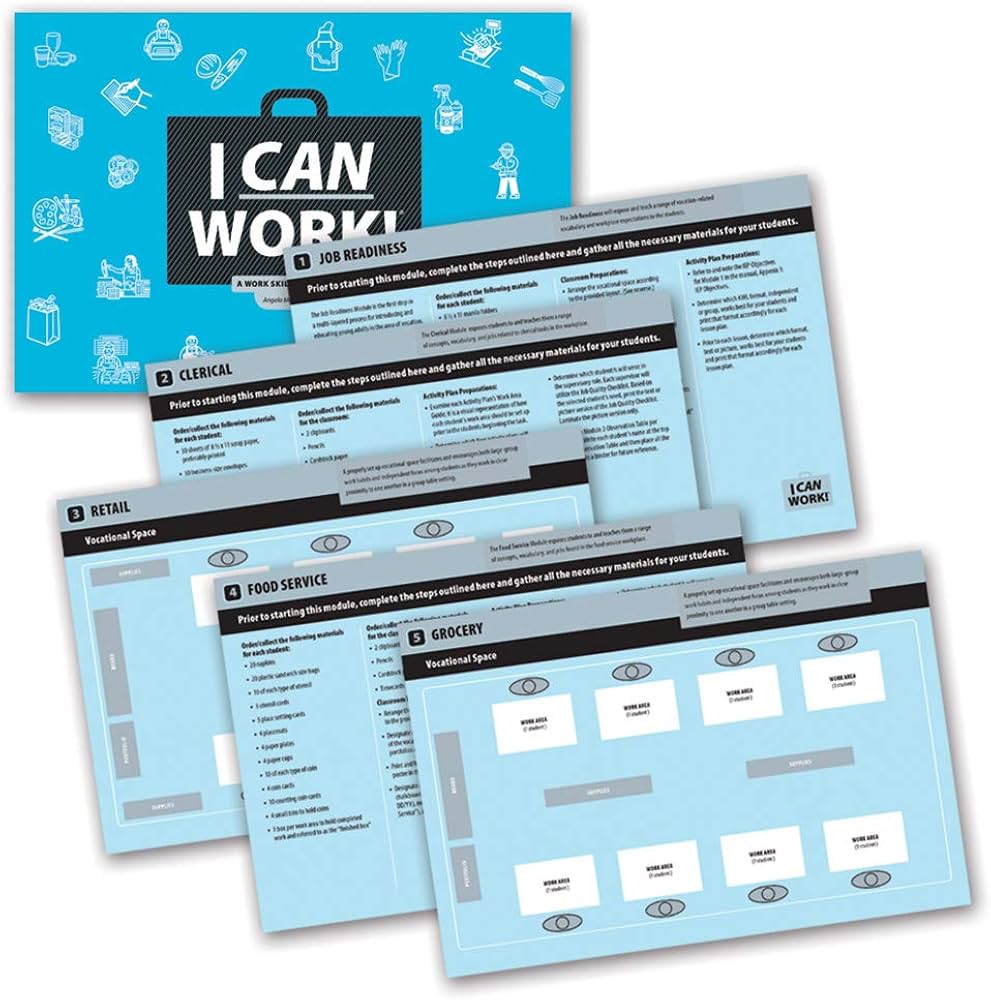
Below are some examples of task box ideas broken down by Module, adapted from the I Can Work! Program.

Clerical: Folding paper in thirds, Addressing envelopes, Filing by numbers or words

Task Boxes for Life SkillsTask Boxes for Life Skills

Retail: Folding t-shirts, Pairing and Sizing shoes, Buttoning Shirt

Task Boxes for Life SkillsTask Boxes for Life Skills

Food Service: Folding napkins, Setting a Table, Assembly of place settings

Task Boxes for Life SkillsTask Boxes for Life Skills

Grocery: Sorting hard and soft groceries, stocking shelves

Task Boxes for Life SkillsTask Boxes for Life Skills

By creating task boxes that apply to life, utilizing vocational materials, young adults are building a stronger foundation and confidence for future success!