Self-regulation includes managing emotions, sensory input, and behavior. Techniques and tools help children maintain focus and calmness, supporting learning readiness in structured environments.
I came across Educational Kinesiology in the early 1990s when searching for tools or techniques to help heal from a chronic illness. Little did I know that it would become an integral part of much of my OT practice. I began with Brain Gym I and II and loved the fact that the two trainers in South Africa were experienced occupational therapists trained in both SI and NDT.
Brain Gym is wonderful for assisting with goal setting, whole brain learning, stress release, and re-patterning. Although there is a specific process to follow, many of the exercises are both beneficial and transferable into a regular OT session. One that I use a lot is the Lazy 8 – a figure eight that lies on its side like the infinity sign.
What is the Brain Gym figure eight used for?
In Brain Gym terms, the Lazy 8 turns on or activates the eyes while also crossing the mid-line.
It can be used to improve ocular motor function, which assists with reading, and crossing the mid-line improves integration between the two hemispheres of the brain.
The repeated action of the Lazy 8 is also very calming. It can be used in several different formats – using the eyes, drawing the figure of 8 in the appropriate orientation, and in motion, as we shall see shortly.
The Lazy 8 can also be carried out as a motor activity, having the client walk, skip, or run around a figure eight. I love to use two hoops placed side by side on the floor to provide a visual cue. Varying the space between the hoops elongates or enlarges the figure eight. Make it more fun by having the client clap while moving around the figure of eight in time to music.
For added motor integration, combine the cross crawl with the Lazy 8. This often has to be carried out in stages:
Having the client carry out their cross crawl while standing until they are sufficiently at ease with the exercise
Upgrade to carrying out the cross crawl while walking on a straight line
Upgrade further to doing cross crawls while walking a figure eight
When I first began using components of Brain Gym in my treatment sessions, I would often make up my own worksheets. I am delighted to discover that Therapro has a range of products that bring the figure eight into practice for all occupational therapists. Two examples include:
The development of these tools shows how Brain Gym is becoming accepted as a beneficial modality to use within OT. It also provides an added level of professionalism, which is important for anyone who is skeptical of either how Brain Gym combines with OT or the extent to which OT itself is a recognized profession.
Once clients are familiar with the Lazy 8 through either Trace the 8s or Race the 8s, introducing the Alphabet 8 helps improve their motor memory. The Alphabet 8 incorporates lower-case letters with the Lazy 8 and is wonderful as a pre-writing activity to enhance work to meet writing goals. It’s designed for English letters but, with some creativity and practice, cursive letters for Hebrew can also be used. Note, I am not sufficiently familiar with other alphabets to know how well they can be used in the Alphabet 8.
I mentioned earlier the benefit of improving a sense of calm. The rhythmic movement of drawing or moving in the Brain Gym figure eight pattern is a wonderful addition to your toolbox for assisting clients in need of stress management and improving relaxation.
Guest Blogger: Shoshanah Shear
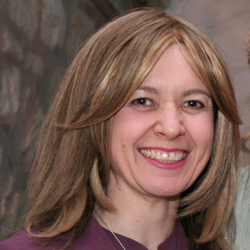
Occupational Therapist, healing facilitator, certified infant massage instructor, freelance writer, author of “Healing Your Life Through Activity – An Occupational Therapist’s Story” and co-author of “Tuvia Finds His Freedom”.
Therapro is excited to offer the Move Mindfully Card Deck, available at our store. This product helps integrate physical fitness, mindfulness and social emotional skills into practice. The deck not only offers individual poses, but also routines to address a variety of common needs, such as “accident prone” and “lethargic”.
As a Blog Bonus, we are offering a free download of three poses from the card deck to get you started with a simple routine. Read on to learn more about each pose and how it relates to your Occupational Therapy goals.
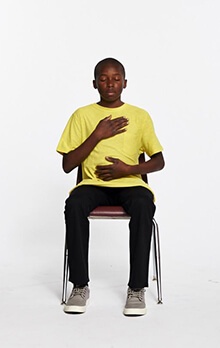
Belly Breathing
Getting into the Pose: Belly Breathing is often taught with the Hoberman Sphere. The brightly colored, collapsible tool offers a visual tracking point to feel the diaphragm expand and contract. However, hands can simply be placed at heart and belly when teaching belly breathing as well. To start, we recommend a seated position in a chair, for back support. As a modification, this pose can also be completed laying on the floor. In this position, try a small object or toy placed on the belly for extra visualization of the up and down movement.
Therapy Resource: Belly breathing is a great way to work on postural stability while maintaining an upright position without a collapsed trunk or slouched shoulders. This pose also taps into interoception and body awareness as breathing is tracked.
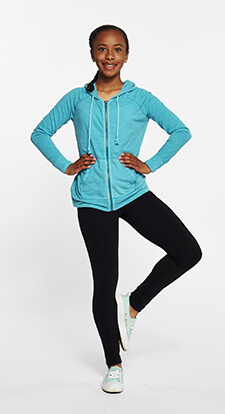
Tree Pose
Getting Into the Pose: Tree Pose is an introductory balancing pose that all body abilities can enjoy. We start by cueing the heel to touch the ankle. As balancing progresses, the foot can be placed on the calf or thigh. However, make sure to avoid any pressure on the knee joint. The hands press together at midline, palm to palm, providing additional input.
Therapy Resource: Like belly breathing, this pose works postural stability through core activation in a static hold. It also works on bilateral coordination as hands and feet press towards midline while maintaining balance and focus. The stacking of joints over the anchored foot (ankles, hips, wrists) taps into theproprioceptive system. If you need additional proprioceptive input in this pose, try stamping feet before attempting to hold static. Activate the vestibular system by experimenting with the foot and hand placement.. Also, try small movement, such as swaying, within the pose. Work on vision by providing various focal points experimenting with gaze up, out, down and even eyes closed. If you see the MORO Reflex in this pose, return to Belly Breathing.
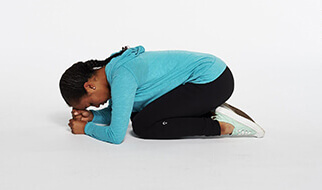
Child’s Pose
Getting Into the Pose: Child’s pose is often used at the beginning or the end of a session. However, it can be used whenever there is a need to decrease overstimulation. It can be completed on the floor or at a table.
Therapy Resource: As you cue stacked fists, you are working on bilateral coordination and proprioception as joints are stacked together at midline. On the floor, there is the additional tactile input from the legs and arms on the Earth. Seekers may need to rock, or add extra movement to the pose, while avoiders may have to stay more upright. Offer a vestibular system modification of seating in a chair, hands stacked on forehead and chin slightly tucked.
Guest Blogger: Stephanie Kennelly
About Us-
This blog post is a collaborative effort of Sweet Inside Yoga and 1000 Petals.
Sweet Inside Yoga is a company providing resources for occupational therapy, physical therapy, mental health practitioners, classroom teachers, yoga teachers, professionals, parents, and others in the community to use with individuals who can be found seeking and/or avoiding yoga activities.
1000 Petals is a well-being training and consulting company based on the science and practice of mindfulness and movement. They provide integrative mindfulness and movement solutions in workshops, events, retreats and self-care classes.
Hippotherapy is a specialized treatment area used by occupational therapists, physical therapists, and speech and language pathologists. It involves utilizing the sensory-motor aspects of horses to achieve therapeutic goals such as improving sensory processing to tolerate touch and motor plan sequential movements. Although the horse functions as a therapy tool, it is obviously much more exciting than a swing or therapy ball, offering opportunities to develop an emotional bond, communication and social skills.
Let’s look at the basics of hippotherapy
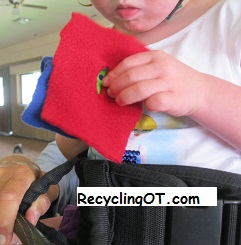
Although the healing power of horses has been recognized for thousands of years (Hippocrates mentions it in ancient Greek writings), hippotherapy only developed in Europe in the 1960s and soon after in the United states as an adjunct to physical therapy. Therapeutic goals might have included improving the rider’s strength, postural control, balance and coordination. Hippotherapy’s versatility as a treatment tool gradually expanded as SLPs used it to improve communication skills. Occupational therapists recognized the power of sensory stimulation in promoting engagement and functional hand skills, such as manipulating fasteners. For example, this rider enjoys opening the zipper on my glasses case and then handing me the sun glasses. She loves to help out and make both the horse and me happy!
Hippotherapy is a type of Animal Assisted Therapy
Please note that “therapeutic riding” (TR) is a different type of animal assisted therapy (AAT) that is offered by certified therapeutic riding instructors who teach riding skills to people with disabilities. A TR instructor may or may not be an OT, PT or SLP. However, hippotherapy is ONLY performed by a licensed OT, PT or SLP practitioner. Training and certification requirements vary at facilities and many require that the therapist have certification in both TR and hippotherapy. As an OT, my goal is not to teach my client how to ride a horse, although frequently that is the result and many children transition from hippotherapy to do TR and eventually earn medals at the Special Olympics.
Why are horses special therapeutic friends?
Well, many animals are special in their ability to connect with people nonverbally and provide unconditional love. Cats and dogs also provide great heavy pressure and tactile sensory stimulation as they lie on laps and cuddle. However, a child with cerebral palsy may improve range of motion by straddling a horse and the repetitive, smooth vestibular movement can gradually reduce muscle tone. A horse’s gait is similar to the human gait in terms of timing. Clients who have never walked or have an abnormal gait can kinesthetically experience what normal pelvic movement feels like.
I have primarily worked with very young children who received services through their early intervention programs. Many had developmental disabilities, including Down syndrome and autism spectrum disorders. My goals often focused on decreasing sensory defensiveness while increasing engagement, postural control and hand skills. Of course, this involves using a variety of reaching, grasping and manipulation hand activities.
Hippotherapy Provides controlled and graded Sensory Simulation
Simply being on a horse provides sensory stimulation. Actually, as soon as a client enters the hippotherapy facility, they are impacted by happy sounds, smells and scenery. Bouncing on the horse while walking and bouncing even more when trotting provides heavy duty proprioceptive and vestibular sensory input. I control and grade the sensory input with choices such as whether to:
walk slow, fast and for how long before stopping
walk in straight, curved lines or in circles
walk uphill, downhill or only on flat surfaces
the child faces forward, sideways, and backwards or rides in a different position such as in quadruped or kneeling.
Using Sensory-Based Materials
Hipppotherapy horses are selected for many specific attributes including tolerance for riders who may hit, kick or scream. I also use a variety of sensory materials that must first be introduced when there is no rider so that the horse becomes desensitized to materials such as:
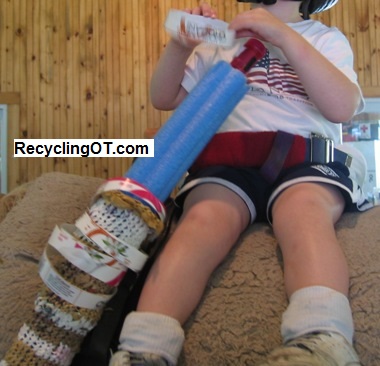
rings placed on top of a vibrating ring stack (see photo)
toys and sound puzzles that make funny sounds or vibrate
clothespins clipped onto or removed from the mane (this does not hurt the horse)
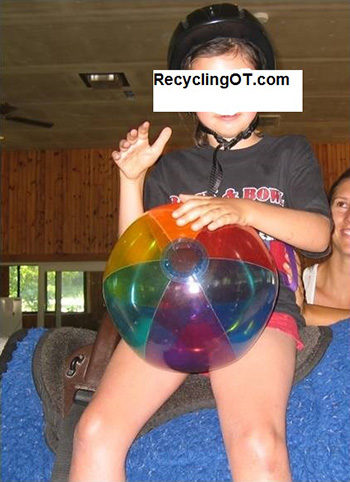
ball play, playing catch with toys like a Gertie Ball
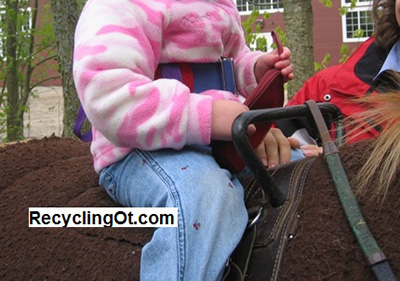
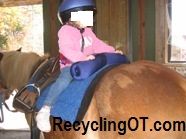
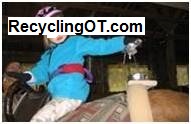
The little girl in the photo is facing backwards while her hands bear weight on top of a vibrating cushion like a Senseez Vibrating Pillow. This helps to decrease her tactile defensiveness before asking her to engage in more complex fine motor tasks.
This vibrating ring stack is made by inserting a motorized pen, like a Squiggle Wiggle Writer Pen inside a swimming noodle.
Adapting activities to vibrate is one of the many sensory strategies described in my book From Flapping to Function: A Parent’s Guide to Autism and Hand Skills.
Hand Activities to Develop Postural Control
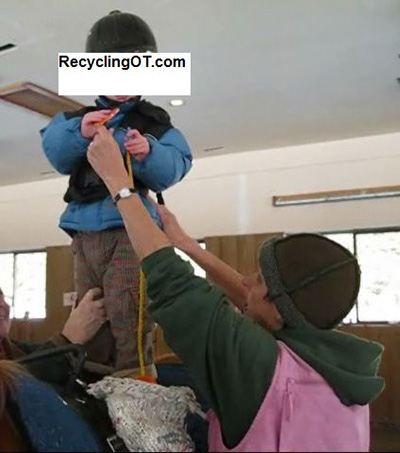
Clients may work on postural control while reach to touch body parts on the horse or therapist. I like to offer sensory materials to pull or squeeze such as Panic Pete (AKA Martian Popping Thing) while the client maintains a quadruped or kneeling position. The child in the photo squats to take rings out of the bag and stands up while stringing them. He typically has difficulty visually attending but it is difficult NOT to focus and be in the moment when standing on top of a large animal!
The girl in the photo reaches for rings positioned in front of her before rotating her body to place them over a ring stack. This “ring stack” is actually a cat toy and the mouse on top of a spring squeaks when moved. The sensory aspects of this activity help her to visually attend while developing postural control.
Hand Activities that Develop Cognitive and Manipulation Skills
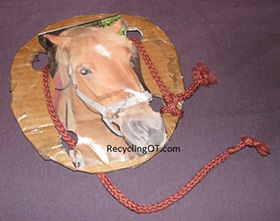
In my book – From Rattles to Writing: A Parent’s Guide to Hand Skills I describe many simple adaptations that make it easier for children with and without disabilities to develop manipulation skills. For example, lacing boards can be cut out of cardboard and made to have just a few, big holes and thick cord that are easier than string to control.
During a typical Hippotherapy session, I spend time walking and trotting, followed by stopping to complete a simple hand activity such as this lacing board. When finished I encourage the child to say or sign “go” to continue movement. Most children are eager to resume movement.
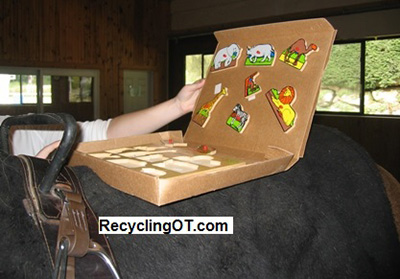
A horse’s rear end is wide and functions as a convenient work surface. I adapted this puzzle by attaching the pieces with Velcro to the box cover. I encourage the child to use one hand to stabilize the box lid while pulling them off. Of course, this activity also teaches children to identify animals and imitate sounds. The Pizza Party is another activity that would be fun to use in this position.
Creating Functional Hand Skills Objectives
It’s a good idea to create OT objectives to improve functional skills such as opening and closing buttons because:
occupational therapy is all about increasing independence
this skill is measurable
insurance companies prefer work on functional, achievable daily living skills rather than abstract goals such as improving coordination
Therefore, I provide activities such as:
opening and closing extra large fasteners
opening bags and other containers (like my sunglasses case)
putting the helmet and gait belt on and off
unbuckling and putting away the reins, neck strap or other equipment
The first video shows how I made and use the “Sensory Pull Toy” (that I designed) during Hippotherapy to develop:
reaching, balance and postural control
hand strength
visual attention
eye-hand coordination
color identification
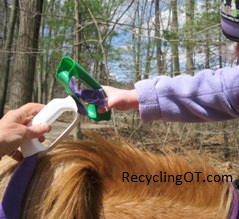
This toy is made out of detergent bottles and a strip of fabric. It’s simple to use – the child pulls the handle while in various positions. It can also be used during non horse activities to work on many skills. Please check out my book The Recycling Occupational Therapist for many other easy to make therapeutic activities.
The second video shows a few of the exciting ways therapists can use hippotherapy to develop hand skills. It is truly amazing how motivated children are to focus and engage in challenging hand activities because they love being cowboys and cowgirls!
Guest Blogger: Barbara A. Smith.
Barbara A. Smith has worked with children and adults with developmental disabilities for over 40 years! She is the author of the Recycling Occupational Therapist, From Rattles to Writing: A Parent’s Guide to Hand Skills and From Flapping to Function: A Parent’s Guide to Autism and Hand Skills. Learn more about her work at RecyclingOT.com.

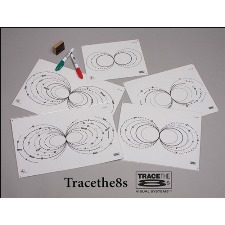 When I first began using components of Brain Gym in my treatment sessions, I would often make up my own worksheets. I am delighted to discover that Therapro has a range of products that bring the figure eight into practice for all occupational therapists. Two examples include:
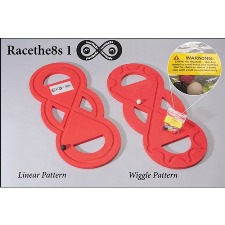 Once clients are familiar with the Lazy 8 through either Trace the 8s or Race the 8s, introducing the Alphabet 8 helps improve their motor memory. The Alphabet 8 incorporates lower-case letters with the Lazy 8 and is wonderful as a pre-writing activity to enhance work to meet writing goals. It’s designed for English letters but, with some creativity and practice, cursive letters for Hebrew can also be used. Note, I am not sufficiently familiar with other alphabets to know how well they can be used in the Alphabet 8.
 Occupational Therapist, healing facilitator, certified infant massage instructor, freelance writer, author of “Healing Your Life Through Activity – An Occupational Therapist’s Story” and co-author of “Tuvia Finds His Freedom”.