Tag Archives: sensory strategies

Sensory strategies are techniques used to help children manage responses to sensory input, such as sounds, textures, or movement. These strategies support self-regulation, attention, and participation in learning environments. They are essential for helping children stay calm, focused, and engaged throughout the day.

Getting Creative with Sweatshirts and Seat Cushions!

 Sensory Processing disorders (SPD) impact how children and adults respond to sensory stimulation such as sound, touch, what they see and movement. One basic principle of occupational therapy for individuals with SPD is to provide controlled, graded and individualized sensory stimulation to promote functional skills such as playing catch or writing one’s name. This means that activities such as tossing bean bags into containers while the child is suspended on a swing can be:

  • Controlled – as the therapist responds to the child’s reactions. For example, the therapist might push the swing faster, slower or in a different direction,
  • Graded- as the therapist chooses the type of swing used, how long the activity lasts, how heavy the bean bags are and how far away the container is positioned, and
  • Individualized – according to the child’s sensory, emotional and motor needs. For example, the child may wear a squeeze vest during the activity, name an animal each time the bean bag is thrown or have a special friend hold the container.

What is a Sensory Diet?

Parents can implement individualized sensory strategies at home in what is called a “Sensory Diet”. This is like a recipe book of activities and adaptations that the therapist designs for parents to carryover at home, school or in the community. It is important to frequently discuss with the therapist how these strategies are working out since children grow and change rapidly along with their sensory needs in different settings.

In my book From Flapping to Function: A Parent’s Guide to Autism and Hand Skills, I describe the 6 different subtypes of SPD and some general strategies to use with children who have each type. These strategies usually impact the following 3 sensory systems:

  1. Tactile – uses sensory receptors in the skin to interpret sensations, such as light and heavy touch.
  2. Proprioception – uses receptors in joints and muscles to tell us where the body is and how it is moving in relation to objects and space.
  3. Vestibular – tells our body how to respond to the pull of gravity and movement of the head. It is also called the balance system.

Now for the fun part…

child sitting on a seat cushion

Many children with or without SPD LOVE deep, heavy pressure experiences and movement. This includes children on the autism spectrum or those with other types of developmental disabilities. One very simple strategy is to provide some type of “dynamic seating”. This simply means that the child can bounce, wiggle, rock or move around in some other way while seated. Many teachers incorporate seat cushions and ball chairs in the classroom to help students focus. The Disco Seat is one popular product. An inexpensive alternative is to sit on a deflated ball, as I am doing in the photo. Don’t have one available while eating out or sitting in the movie theater? Consider rolling up a sweatshirt for the child to sit on or curl up inside of to get a full body squeeze.
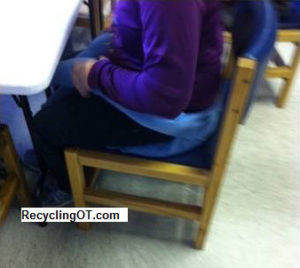
 
a child using a homemade seat cushion

Speaking of sweatshirts, I have had great success in helping a young lady named Judy to be more focused and less agitated by placing a Disco Seat cushion inside the body of a sweatshirt. The photo shows Judy sitting on the cushion, enjoying some gentle bounces with the sleeves slung over her lap.
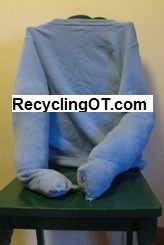
 
example of using a sweatshirt to make an innovative seat cushion

The sleeves are heavy because I put bags filled with sand inside of them. Next I sewed the wrist and shoulder ends of the sleeves closed so that the bags wouldn’t fall out. This adaptation can be used in a various of ways. The sweater may be placed over the back of a chair so that the heavy sleeves are draped over the child’s shoulders and body. Placing the cushion inside the sweater is optional.


A young man named Eddy, craves extreme movement and is typically agitated unless in a rocking chair, bungee seat or swing. You can see in the photograph that his chair is adapted to not tip over given all of his body rocking. He LOVED when I attached the sweatshirt with enclosed seat cushion to the back of his chair so that he could slam his back into it while rocking. I know that he enjoyed the deep pressure bouncy sensation because he became calmer, quieter and smiled. The heavy sweatshirt sleeves are draped over his lap. I did my best to capture how I set this up in the following video while maintaining his privacy.
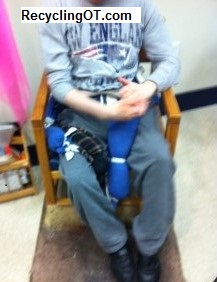
example of an  innovative seat cushion

Seat cushions and lap bags that are a lot nicer than the ones I make with a deflated ball, sand and plastic bags are sold by Therapro, Inc. Whether you are reading this blog post as a caregiver, therapist or other type of professional, I hope that adding these simple sensory strategies to your tool box helps the people you love or work with improve their quality of life. This is why I love being an occupational therapist!
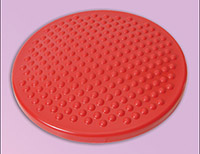
 
Disc O'Sit
Disc O’Sit
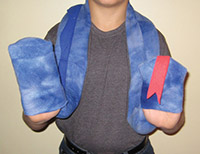
Weighted Snake Wrap
Weighted Snake Wrap
 
Barbara A. Smith

Guest Blogger:  Barbara A. Smith.

Barbara A. Smith has worked with children and adults with developmental disabilities for over 40 years! She is the author of the Recycling Occupational Therapist, From Rattles to Writing: A Parent’s Guide to Hand Skills and From Flapping to Function: A Parent’s Guide to Autism and Hand Skills. Learn more about her work at RecyclingOT.com.

Sensory Differences & Mealtime Behavior in Children with Autism

Jeanne-Zobel-Lachiusa presenting on sensory differences in mealtime behavior for children with autismEvidence-based practice (EBP) involves the integration of:

  1. Clinical expertise,
  2. Scientific research, and
  3. Patient/caregiver perspective.

The goal of EBP is the improvement of patient outcomes. It holds us accountable for our treatment plans, strategies and outcomes among our peers and other health care professions. According to the AOTA, generating research in the field of occupational therapy is “critically important for advancing the field and ensuring the viability of the profession.”

Jeanne Zobel-Lachiusa, EdD, OTR/L was the featured December Saturday Seminar Series speaker, who shared her research on Sensory Differences and Mealtime Behavior in Children with Autism (AJOT September/October 2015, Vol. 69, No.5).  In summary, the study results helped to identify problem eating behaviors in children with ASD that may be associated with sensory differences. Children with ASD were compared with typically developing age-matched peers. The study concluded that children with ASD who receive occupational therapy that offers sensory strategies might result in less stressful mealtimes.  The findings supported the need for further research in this area of self-care with children who have been diagnosed with ASD.

The seminar attendees were from varied backgrounds, including occupational therapy, speech therapy, special education, social work, psychology, child care, medicine, and parents. They engaged in a lively brainstorming session on sensory strategies in the different sensory domains that might provide mealtimes with less stress for both the child and family. They shared innovative as well as tried and true ideas with the group.

Just a few examples of the many suggestions include ideas for tactile and oral sensitivity:

  • systematic desensitization
  • using a Nuk Massage Brush paired with singing a song, and
  • vibration with a vibrating teether or Z-Vibe.

Hush Buddy headphones to help those with sensory differences For auditory sensitivity, Jeanne suggested:

  • noise reducing Hush Buddy Ear Muffs,
  • rhythmical background sound like drumming or a metronome, and soothing music.

For children with sensitivity to fluorescent lights that flicker and glare in the cafeteria or classroom, Fluorescent Light Filters, which are magnetic were recommended. Another suggestion was for the student to wear a visor to reduce vision sensitivity.

Jeanne suggested a number of resources for the group including the book, Autism Interventions, and recommended the AOTA website for its user-friendly handouts on mealtime and feeding.

Producing research is essential for validating assessment and treatment strategies. Jeanne shared that her research was motivated by the question of whether interventions are actually effective.  Her current research demonstrated that there was a statistically significant difference in sensory differences and in mealtime behavior between children with ASD and the typically developing group she tested.  This groundbreaking research paves the way for further studies to investigate specific treatment strategies discussed today for their effectiveness in helping make mealtimes a pleasurable experience for children diagnosed with ASD and their families.

To view Jeanne’s PowerPoint slides, click here.

Following the seminar, attendees provided feedback about the seminar.  Please see a few remarks below:

“It provided an opportunity to review recent literature and share strategies with other therapists.” Kristyn S., Occupational Therapist

“Loved the topic and the format. Jeanne was great!!   Diane H., Occupational Therapist

“Informative, interactive, insightful. It was interesting listening to other OTs experiences and suggestions.”  Sylvia K., OT student

“Helpful to organize sensory treatment with a food tolerance/mealtime behavior perspective.”  Anonymous Occupational Therapist

Thank you, Jeanne!

Filomena Connor, MS, OTR/L

A Sensory Approach to Supporting Teens with Emotional Regulation

 Karen Moore, OTR/L presented on  Sensory Approaches for Emotional Regulation

Karen Moore, OTR/L presented a superb seminar on Saturday entitled: A Sensory Perspective on Helping Adolescents and Young Adults Learn to Deal with Difficult Emotions. Working in the area of mental health has been Karen’s passion and career focus.  She is a highly respected and renowned therapist in her area of practice. In her seminar, Karen shared information from her most recent publication of The Sensory Connection Program called The Sensory Connection Program: Curriculum for Self-Regulation, which teaches self-regulation skills through the use of sensory strategies and social engagement. It was evident from her creative and heartfelt approach that her clients benefit greatly from her knowledge and experience. Today she focused on the emotionally charged years of middle and high school, when students benefit from learning fun and engaging strategies to help them deal with emotions. She described how to teach adolescents to recognize signs that they are having emotional difficulty, how to teach them to seek help, and how to help them learn to use effective self-regulation skills.

Karen’s discussion of the value of mastering self-regulation made good sense; when an individual is able to cope with emotions, he/she is able to “tune back in” to the self, which in turn results in being back in control and greater self-confidence.  She emphasized that without mastery of self-control, it would be difficult for an individual to explore new adventures including higher education, travel, or entering the job market. When applied to adolescents, whose pre-frontal cortex and cerebellum are still developing, the need for learning self-regulation strategies is crucial.

Sensory Connection Program- An example of an Approach used for Emotional Regulation

When Karen reviewed the evolution of the stress response, it was easy to see that the vagal level of “freezing” when confronted by a stressor is not a useful response because it results in being overwhelmed by fear.  In the next level in the hierarchy she explained how the sympathetic “fight or flight “ response is more effective than the “freeze” response, but has a long recovery time.  The optimal response to stress involves appraisal of the situation and communication, which promotes a calm state. She shared research evidence that shows that adolescents who have experienced trauma respond with more primitive responses, have difficulty with communicating verbally, and are more reliant on sensory responses than cognitive strategies for coping. Teaching adolescents self-regulation skills prevents them from resorting to the dangerous lower levels of the hierarchy when responding to stress.

Karen employed some of techniques for calming with her audience today, including several different ways of using deep breathing as a group activity, resulting in a feeling of socialization and engagement.  The pneumonic “Pause – Connect – Engage” helps adolescents to “short-circuit” fear by signaling them to stop and think what made him/her upset, make a social connection by reaching out to someone trusted, and then do something positive that helps, which may be tool-based or non tool-based, i.e. squeeze a ball, do deep breathing, exercise, use a fidget, etc. The group tried out several calming strategies, but one called “seaweed” which involved rooting the feet on the floor and swaying gently and slowly with body and arms, was simple and effective immediately.

Karen guided us in learning how to avert a crisis by helping adolescents gain self-control with the use of a variety of sensory strategies that can be personalized.  The strategies are highly effective for the teen population, but can be valuable tools for any individual who is in a state of emotional distress.

Here’s what attendees had to say about Karen’s seminar:

“As a pediatric OT at elementary school level, learning about sensory curriculum at adolescent level guides me in treatment.  Really enjoyed Karen’s stories/real examples to associate to curriculum.” Jen M., Occupational Therapist

“This topic is relatable to everything I do as a COTA. It ties emotions and sensory input. Every student I work with will benefit!” Beth M., COTA

“Very informative.  Wonderfully explained with explanations in brief & practical exercises to experience.”  Rajini K., Parent

“I would recommend this seminar to a colleague because of the scientific/physiological information, therapeutic activities, and hands on demonstrations.  Very knowledgeable speaker.  Excellent examples.” Joann W., Occupational Therapist

“Useful information for sensory techniques to calm/alert children effectively. New concept/less traditional routes for sensory strategies.” Megan Z., OT student

Thank you, Karen!

Filomena Connor, MS, OTR/L