
Oral Motor Treatment Strategies: Part 2

On June 16, 2020, Therapro hosted an overwhelmingly popular webinar presented by Dr. Kate Barlow on the topic of Oral Motor Treatment Strategies. As one viewer stated:

This was a totally amazing webinar on oral motor feeding. I learned so much information, and Kate was a wonderful speaker.” DSM

Dr. Barlow is an Assistant Professor at American International College (see her full bio here).   In part one of this blog series, we recapped some great takeaways from Dr. Barlow’s June 16 webinar; one of those takeaways was that all children should be screened for feeding disorders.  In this blog post, we will dive deeper into the screening and assessment strategies Dr. Barlow shared with viewers during the webinar.  

Dr. Barlow shared great tips, resources, and strategies for appropriately screening and assessing feeding disorders, noting that a good assessment is the driving force behind a good treatment plan. Dr. Barlow identified key areas to assess: lip closure and strength, reaction to gum massage, posterior cheek strength, tongue range of motion and strength, jaw strength, motor planning, and sensory assessments when appropriate. Dr. Barlow shared a decision tree that she created, explaining that it is a great way to ensure all relevant areas are covered during the screening and assessment process. With this, she highlighted key questions to ask caregivers during the screening process, like the three Ps: “pain, past medical history, and poop.” Other recommended questions to ask included: 

  • Is the child eating more than 10 foods?
  • How is the child being fed?
  • Where does the child eat?

Dr. Barlow’s experience in the area of pediatric feeding was clearly evident in some great pointers she offered when assessing feeding difficulties. For example:

  • Always ask about teeth brushing because of the correlation between difficulties with brushing teeth and difficulties with feeding.
  • Be sure to check that the child’s nutrition is adequate, even if they are at an appropriate weight. 
  • Monitoring oxygen saturation, temperature changes, and respiratory rates during feeding can give you clear indicators of difficulty during feeding.

Viewers left this webinar with an awareness of how crucial it is to understand the deficit areas that are causing the feeding problem. That understanding is a key piece in developing an appropriate treatment plan. We will discuss Dr. Barlow’s treatment recommendations in part three of this three-part recap of the Oral Motor Treatment Strategies webinar.
Oral Motor Treatment Strategies: Part 1

On Tuesday night, Therapro was pleased to host a highly attended webinar presented by Dr. Kate Barlow, focusing on Oral Motor Treatment and Feeding strategies. This blog is part of a multi-post series that explores key points from Dr. Barlow’s webinar. In this entry, we specifically highlight treatment strategies related to feeding.

Dr. Barlow is an Assistant Professor at American International College. She is also the current ambassador for the CDC’s Learn the Signs Act Early program for the state of Massachusetts. She has over 20 years of clinical experience, including public school practice, early intervention, and a pediatric hospital-based outpatient clinic, as well as management. Dr. Barlow’s passion is in global outreach; she founded the International Interprofessional Mentorship Program that currently provides mentorship to over 100 therapists in developing countries in Africa and South America.

Dr. Barlow’s extensive knowledge in this area was evident as she seamlessly broke down this complex topic into manageable bits of information. Dr. Barlow set out with the main objectives of providing viewers with specific intervention strategies for oral motor deficits and relaying the importance of screening all children for feeding difficulties. As one viewer stated:

“This was one of the best courses I’ve taken in a long time. The instructor was knowledgeable with practical assessment and treatment strategies that I can even use in collaboration with SLPs. So many OTs are intimidated to address feeding, especially in the school setting, but I think it is so important!” -LB

Viewers left with some great take-aways that we will recap in this post:

1. Guidelines for making food recommendations. 

2. The importance of enjoying food.

3. All children should be screened for feeding disorders.

Guidelines for Making Food Recommendations. Match food choice with skill level. When Dr. Barlow discussed guidelines for recommending appropriate food choices, she stated simply  “look at the child in front of you and where they are developmentally.” This bit of advice was a great reminder for new and experienced therapists alike; a child’s skill level isn’t necessarily defined by their age. Dr. Barlow highlighted this further by showing that the development of circular rotary chew could occur on a widely varied timeline, anywhere between 18 to 36 months! 

The Importance of Enjoying Food.  Another important takeaway from Dr. Barlow’s webinar was the importance of enjoying food. She spoke passionately about the importance of understanding underlying medical problems when addressing feeding difficulties. Dr. Barlow explained that behavioral problems around eating can often be addressed when the feeding difficulty is appropriately treated. Another point she raised is the importance of a child being included at the family table. She stressed the importance of this inclusion, in whatever capacity the child is capable (even if it meant that they were just sucking on a lollipop), because the mealtime experience is an important cultural ritual.    

All Children Should Be Screened for Feeding Disorders.  A third take away from Dr. Barlow’s webinar was the importance of screening all children for feeding difficulties regardless of why that child is on your caseload.  She highlighted the prevalence of feeding difficulties as a key factor in this; I was struck by how prevalent feeding difficulties are even in typically developing children.  Dr. Barlow cited research indicating feeding difficulties are present in one in four typically developing children. In children with developmental disabilities and cerebral palsy, the prevalence is significantly greater.  With this information, I found myself reflecting on all that I knew about the role of nutrition in supporting optimal behavior for participation.  The concept of screening all children for feeding difficulties truly makes sense when considering the prevalence of feeding difficulties and the role that nutrition plays in a child’s ability to attend and participate in all of their daily activities.  

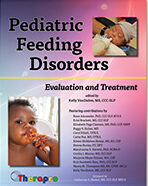
Pediatric Feeding Disorders: Evaluation and Treatment

A great resource for information on oral motor and feeding treatment is a book published by Therapro: Pediatric Feeding Disorders Evaluation and Treatment.  It covers topics ranging from the progression of feeding development, to the role of the gastrointestinal system in feeding difficulties, to the evaluation of feeding difficulties, along with a broad range of other feeding topics!  Stay tuned for future blog posts where we continue our review of Dr. Barlow’s webinar, exploring her tips and suggestions for screening pediatric feeding difficulties as well as some of her great treatment strategies! 

Advanced Treatment Strategies for Youth with Complex Behavior

Speaker John Pagano, PhD, OTR/L who present Advanced Treatment Strategies for Youth with Complex Behavioral Challenges

On November 16, John Pagano, PhD, OTR/L presented his Therapro Saturday Seminar, Advanced Treatment Strategies for Youth with Complex Behavioral Challenges, to a captivated audience. The energy in the room was palpable throughout the two hour talk. Dr. Pagano ‘s passion was evident as he discussed assessing and treating children and adolescents who have complex behavioral disorders. He shared clinical examples and anecdotes to highlight his talk, peppered with humor. Leading the audience through many experiential activities provided them with examples of practical tools to use with individuals and groups.

John is an occupational therapist who practices at an adolescent psychiatric hospital and school. He is a certified instructor of Positive Behavioral Support and Movement Based Learning Strategies. His years of experience include working in various settings including adolescent juvenile detention, psychiatric hospital, adolescent group home, and in special needs, regular education and preschool classrooms. He is the author of the recently published book, FAB: Functionally Alert Behavior Strategies: Integrated Behavioral, Developmental, Sensory, Mindfulness & Massage Treatment.

John discussed the importance of setting functional behavioral goals when providing OT, PT, and Speech/Language therapies for students with complex behavioral disorders. He frequently reiterated the value of a team approach, including ABA specialists, to working with this population.

FAB Strategies® are Dr. Pagano’s evidence-based, practical strategies that use “clinical reasoning based on current clinical research and neurology to develop the individualized strategies needed to address complex behavioral challenges.” John reviewed Sensory Processing Disorders, how they interact, and how to treat them using sensory based interventions. In his discussion of Sensory Modulation Disorders, John stated that his research and experience have shown that the olfactory sense is a powerful teaching tool for those with ASD and for those who have experienced trauma. He has found that pairing a scent is very effective for achieving the desired Quiet Alert state of arousal. He advocated using materials like Scented Dough and scented markers as treatment materials.

John disclosed that research supports that mindfulness strategies are an effective and powerful treatment methodology for improving special needs students’ behavior and executive functioning. John led the group in breathing and movement activities that he uses with his students that also increase body awareness. John taught the group a number of quick, easy, and practical strategies to circumvent problem behaviors. For example, his FAB Turtle Strategy involves 4 steps: 1) Notice environmental & body triggers – STOP 2) Go to the sensory coping area 3) Do your individual coping strategy 4) Later problem solve with help. Fidgets like Loopeez, Boinks, Panic Pete, and Theraband were mentioned as some of John’s favorites for calming.

Dr. Pagano is a dynamic presenter who generously shared resources and evidence-based, practical treatment strategies for working with children and adolescents who have complex behavioral challenges. He integrates all that he has learned in his years of experience with current research so adeptly!! Attendees left this seminar with ideas they could put to use immediately in their practice.

Take a look at some of the overwhelmingly positive comments from those who attended John’s seminar:

“I left full of simple/functional strategies to try with my students, all ages. John is simply AMAZING!!!” – Christie H, Speech/Language Pathologist

“John is an excellent speaker who was very helpful, evidence based, and offered suggestions for treatment.” – Renee S., Physical Therapist

“Offered many resources & activities that can be used immediately in my practice & therapy.” – Rose O, Occupational Therapist

“John’s sense of humor made this important topic fun. Many teachers & therapists are struggling in the classroom. These are strategies that can be implemented Monday. In addition, his strategies come from evidence based research of strategies/techniques that help our students make progress.” – Jennifer H, Occupational Therapist

Thank you, John!

Filomena Connor, OT, MS, OTR
November 16, 2019