Tag Archives: product spotlight

Featured therapy products highlight tools and resources that improve fine motor, sensory, language, gross motor, self-help, functional skills, and so much more. Learning about featured therapy products helps select effective solutions.

Get A Grip on Pencil Grips and Adapted Writing Tools!

Therapro is making it simpler for users to choose the right pencil grips and adapted writing tools.  After reviewing all of the pencil grips and modified writing tools available at Therapro, we concluded that there are basically three groups that these tools fall into: comfort, positioning, and sensory.  

Comfort.  Comfort is an important feature for writers across the lifespan. These types of grips and writing tools are great for writers who fatigue during longer writing tasks or who have underlying conditions that cause pain, like arthritis. The PenAgain was designed to help reduce hand cramping during writing. The Standard Foam Grip and the Bulb Shaped Grip are basic, low profile grips that can be added to a pencil or pen to provide a softer surface for the fingers.  These grips and writing tools may help a writer perform writing tasks longer.

Positioning.  Appropriate pencil grasp is the key for successful, legible handwriting.  Atypical grasp patterns can lead to decreased comfort and endurance for writing tasks. When to use a pencil grip or a modified writing tool often prompts debate.  

Young writers often benefit from developing the foundational skills needed for successful handwriting before a grip is used. These writers benefit from activities that assist in developing foundational postural musculature and hand skills. Working with putty, incorporating yoga, doing activities on the therapy ball,  or incorporating activities like those found in the Fine Motor Olympics or Fingermania are all great ways to target underlying foundational skills needed for functional hand use. During this stage, it is also important to incorporate writing “tools” such as short pencils or crayon rocks that naturally support functional grasp patterns.

Pencil grips for positioning come into play primarily when 1) the student is still working on developing underlying foundational systems, and they need to keep up with peers or  2) when the student benefits from the tactile cues provided by these grips or writing tools to maintain a proper pencil grip.  There is a wide range of grips and writing instruments available, allowing for grading of the support provided. 

Writers who are just learning to get their fingers into a tripod grasp benefit from a grip that provides more support.  Therapro suggests the following:

  • The Grotto Grip has contours that place the fingers in a tripod grasp and promote an open webspace, this type of grip is also great for writers with hypermobility in their finger joints.  
  • Grips like the Writing Claw, the Pointer Grip, the Crossover Grip or StartWrite Pencil Grip have features that block fingers from “crossing over” or reverting to immature grasp patterns.   

Writers who need less support may benefit from grips that are “low profile”.   Grips like the Solo Grip, and the Stetro Grip are smaller in size than some of the other grips in this category. They  provide light tactile cues to remind the writer where to place their fingers but do not actively block the fingers from moving out of a tripod pattern. 

As the writer’s abilities progress, they may be ready to move away from using a grip but may not be quite ready for a standard pencil. This is where triangular-shaped pencils like the Try Rex Pencil come in. The triangular shape offers a subtle tactile reminder for proper placement of the fingers.   

Sensory. The final category of pencil grips and writing instruments is sensory.   To simplify this, the sensory category can be viewed as two ends of the sensory spectrum: alerting or calming/organizing.  

Light touch sensations are interpreted by our sensory systems as alerting, think about a spider crawling over your arm!  The grips and writing tools in the alerting category provide light touch sensations to  help writers “wake up” their sensory systems.  This type of input can improve the ability to attend and focus.  Great options for this are:

  • The Spike Tactile Grip.  The Spike Tactile Grip is covered in spiky protrusions that provide opportunities for light touch sensations. As a bonus, these protrusions can be used as a “fidget” to help with attention and focus during writing tasks. 
  • Grips like the Bumpy Grip and The Extreme Grip offer slightly more subtle raised tactile features but still provide great sensory input to help maintain attention and focus during writing.  

Some writers have poorly organized sensory systems; these writers benefit from organizing input and input that provides clues about where the writer’s body parts are. Sometimes these writers use too much force when they are writing or they have a hard time writing on the given baseline.  Adding weight to writing tools is a great way to help these systems become more organized, try the following:

A bonus tip, adding weight to writing tools may help those with hand tremors! 

In summary, understanding both the needs of the user and the type of support and the level of support grips and writing tools offer is a great starting point for determining the most appropriate grip or writing tool to choose.  Starting with the least restrictive option is a great way to ensure the writer is getting the support they need without overdoing it.  Conversely, using a grip or writing tool that provides a lot of support may be appropriate for the student who is working on developing foundational skills to ensure a positive writing experience.  For therapists, this grading system is a great way to show progress as students move from a more restrictive tool to one that offers less support.   The information contained in this post is condensed in the Get A Grip on Pencil Grips and Which Writing Tools or Accessories Handy Guides.  We hope these handy reference guides help you quickly identify the tool that will best fit your needs! 

The functionalhand® Supports Your Child’s Learning!

For children who have difficulty with muscle tone, movement and motor skills, they may lack the hand control to hold writing utensils.  This may impact their ability to complete academic skills at the level they are capable of. The functionalhand® supports learning by reduces fine motor demands allowing your child to focus on discovering letters, numbers, counting skills and so much more.

Child using the functionalhand to write the letter A

Children learn through a variety of sensory experiences. Processing auditory and visual cues in combination with movement enhances cognitive or academic concepts.  The functionalhand® reduces the physical demands of academic tasks and allows the child to have more energy to focus on learning. Tracing and copying activities are completed with less effort.

Child using the functionalhand tool  to participate in a writing activity

The functionalhand® allows children to participate in formal writing programs that teach letters such as “Handwriting without tears”.

Child using the functionalhand® to support participation in a math activity

Dot markers are another “tool” that the functionalhand® assists children to hold and practice number recognition and matching skills.

Child using the functionalhand® to support participation in a counting activity
Child using the functionalhand® to support a learning activity

In addition to number recognition, there are a variety of activities a child can participate in that supports math skills.  This universal device enables individuals who cannot hold a writing utensil in their hand, to complete academic skills.

Guest Bloggers: Linda Merry, OTR/L, NDT/C and Celine Rosati Skertich, PT, MS, PCS, NDT/C, creators of The functionalhand®.

6 FAB Strategies to Improve Pediatric Therapy Behavior

By John Pagano, Ph.D., OTR/L

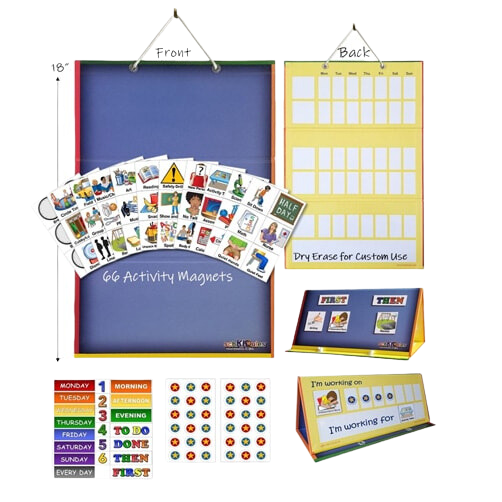
  1. Increase structure – Especially with students (e.g. sensory seekers) who trash your therapy room getting increasingly dysregulated, increase the structure. One way is by starting the session with all the toys locked up, and listing or assembling pictures of all the activities the client will do in order, before starting the session. Praise the client and check off each activity after they complete it and clean up, then unlock and begin the next activity. Another option for motivating clients when developing the activity list is to alternately have them choose the first activity and the therapist chooses the next one. Groups can also be structured with pictures listing the activities in order, or by having group members draw and review a praxis comic depicting the group activities in sequential order.
  2. Preferred Activities & Choices – Clients will work better if given choices between 2 or more activities, and presented with tasks they like to do. To assure that therapeutic goals are addressed you can present 2 choices addressing the same therapeutic goals (e.g. for deep pressure to reduce arousal offer wheelbarrow walking or wall pushups).
  3. Alternate seated with preferred gross motor tasks – For evaluation and treatment sessions it is often helpful to alternate seated fine motor writing tasks with preferred gross motor activities.
  4. Intersperse Easy – Instead of giving 10 challenging tasks, help improve the client’s motivation and effort in trying challenging new tasks by presenting 5 new tasks (covering all the concepts in the original 10 tasks you were going to teach), and alternating so every other task is something the client likes to do and has mastered, then reinforce him for doing it correctly.
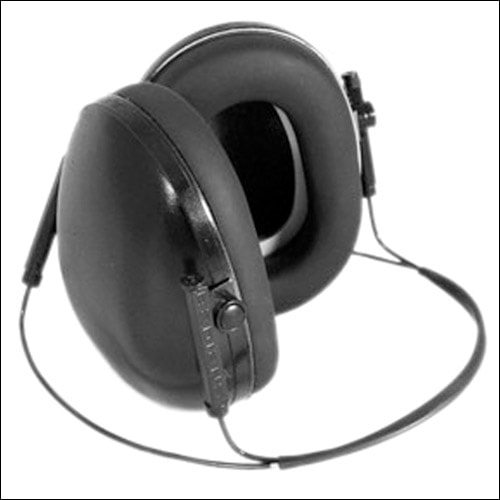
  5. Reduce distractions – Especially in groups or the classroom, minimize problematic sensory distractions to improve attention. Study carols help minimize visual distractions, while noise canceling headphones are useful for auditory distractions. It often helps to give the teacher noise canceling headphones to help a student who has difficulty behaving appropriately due to the loud sound of fire drills.
  6. Increase sensory stimulation of challenging therapy tasks – Particularly for students who are under-responsive it can be helpful to add sensory input that accentuates therapy and academic tasks. This can be done by highlighting important print, plus signs, emphasizing the guide lines of the paper, or simultaneously having the student listen to and read a story.
  7. Getting clinic clients to leave – Many skilled clinic therapists who use sensory integration strategies have a problem getting clients to leave when their session ends. While it’s a compliment showing the client enjoys and can learn better during therapy, it’s a problem because the therapist has another client waiting and aggressive behavior in the clinic is bad for business. Think about this ahead, and if it is a problem structure the last task in a special room with only the door leading outside unlocked. Use this as a last activity room with their parent present (a good place to review home programs), give five and two minute warnings, do deep pressure calming sensory activities, then escort them out and give them a prize if they leave appropriately.
John Pagano PhD OTR/L, presenter for Therapro's webinar 6 FAB Strategies to Improve Pediatric Therapy Behavior

John Pagano, Ph.D., OTR/L is an occupational therapist who developed FAB Strategies® to help students with complex behavioral challenges. He just completed his first book called FAB Functionally Alert Behavior Strategies.  Dr. Pagano has been presenting FAB Strategies® workshops internationally for over twenty years, and is known for his humorous interactive presentations.  

He will be offering a free Therapro webinar on Tuesday, 10/29/19:  Integrating Behavioral, Sensory, & Mindfulness Interventions in your Pediatric Therapy and a seminar at Therapro on Saturday, 11/16/19: Advanced Treatment Strategies for Youth with Complex Behavioral Challenges. For more information about these events, please refer to the Therapro website at www.therapro.com and click on the News & Events tab.