Category Archives: Therapist Resources

Comprehensive resources, strategies, and tools designed to support therapists in delivering effective care and ongoing professional growth.

RAPPER SNAPPERS AKA POP TUBES in purple, red, green, and blue

Therapy Activities On A Budget: Rapper Snappers

Rapper Snappers are a multi functional therapy tool perfect for creating fun, budget friendly therapy activities! In this post, Physical Therapist and creator of The ABCs of Movement, Laurie Gombash, PT, M.Ed, shared five different ways to use Rapper Snappers (also known as Pop Tubes) as a therapeutic tool.  Be sure to check out her video below!

Demonstration of rapper snapper activity:  pulling a pink rapper snapper open

Arm Strengthening

Place hands on either end of the Rapper Snapper and pull! Work with the arms overhead to target shoulder strength or work with arms away from the body to target core strength. Target different muscles of the upper body  by pulling in different directions. Try holding the rapper snapper in one hand, at hip level, and using the other hand to pull up and across the body. Alternatively, hold the rapper snapper at shoulder level and uses the other hand to pull down and across the body.

Pro Tip, using the fingers to scrunch the Rapper Snapper back to size is great for finger strengthening!

Self Regulation

Rapper Snappers are a fun way to learn about self regulation.  Help kids visualize concepts like fast breathing or rapid heart beat by opening and closing the Rapper Snapper rapidly. Alternatively, demonstrate slow or rhythmic breathing by slowly pulling apart  or closing the rapper snapper.

Pro Tip, the sound made by the Rapper Snappers as it is opening and closing provides great auditory feedback!

Demonstration of rapper snapper activity:  squeezing a pink rapper snapper closed

Fine Motor & Motor Planning 

Looking for a fun and engaging activity? Use Rapper Snappers to make a marble run!  Bend and twist the Rapper Snapper to make a maze, drop the marble in, and let it run through.  Using two or three fingers to grasp the marble and inserting it into the Rapper Snapper’s narrow opening is a great way to get the small muscles in the hand working.  Planning a successful maze for the marble to run through takes planning abilities!

Pro Tip: This activity can be done holding the Rapper Snapper and moving the marble through or you can use Velcro or other adhesives to adhere Rapper Snappers to a wall or other vertical surface. 

Demonstration of rapper snapper activity:  blowing into a pink rapper snapper

Oral Motor

Shape the Rapper Snapper like a smile and try to imitate it with your lips, now flip it upside down to make a frown!  Purse your lips, give a big blow, stick out your tongue!  There are so many ways to use a Rapper Snapper to help build and strengthen oral musculature! 

Academic Skills

Use the Rapper Snappers to build shapes, letters, and numbers. Connect multiple Rapper Snappers for bigger numbers or shapes. Work as a team to build a giant letter on the floor!  

Rapper Snappers are a small, easy to transport, budget friendly tool that can be used across multiple settings and to target a variety of treatment goals making them the perfect tool when creating therapy activities on a budget!

Watch the Video!

Tips for Back to School Success

The transition from the relaxed summer schedule to the more structured school schedule can be tough for everyone involved. Here are some tips for making the transition back to school, a little easier.

Add Structure Back Into The Schedule

Schkidules a visual schedule used to help transition to back to school, blue board with picture icons depicting daily tasks and yellow board depicting stars earned

As the long days of summer start to wind down, slowly adding more scheduled events into the daily schedule will make the transition into a fully scheduled school day much easier. This could be as simple as a set time for breakfast or adding in a scheduled chore time during the day. Try using SchKidules to make a daily visual schedule.  The easy to use magnetic schedule lets you slowly add in more and more structured activities to the daily lineup and it is in a similar format most kids will see in their classrooms. Once the school year gets going a weekly schedule will be a great way to keep track of school activities and extra curriculars.

Practice Important Self Help Skills

Kids will be expected to do many of their daily self care activities independently or with minimal assistance once they return to the classroom. Lots of practice at home will help kids be ready for this! The resource Self Care With Flair is a great way to teach children important skills like handwashing, putting on coats, and managing their clothing in the bathroom. The Busy Bee Sensory Activity Plush is helpful for practicing the fine motor skills needed for these tasks like lacing, tying, zipping and buttoning.  Pro Tip for kids who have not yet mastered shoe tying, replace standard laces with elastic shoe laces for a slip on and go option.

Green dinosaur Busy Bee Lacing Sensory Activity showing lacing through loops numbered one to five used to prepare fine motor skills needed for back to school

Get In Tune With Sensory Needs

Cover of the product Sensational Fun a card deck of sensory based activities.  used to discover sensory preferences for back to school success

Every sensory system is different, figuring out the particular needs for each system will help kids start off the school year on the right foot! Riding the bus may be hard for kids who have difficulty with loud noises or who struggle with motion sickness. These students may benefit from sensory tools for the eyes and ears. The cafeteria may be especially difficult for students with aversion to certain smells; these students may benefit from fidgets that calm and organize an over responsive sensory system. Students who are not use to early mornings or who are use to afternoon naps may benefit from fidgets that help alert or wake up the under responsive sensory system.   Sensory based activities such as playing with floof, scented dough, or any of the activities found in Sensational Fun will help give insight into sensory needs.

Refresh Academic Skills

 The summer slide happens but there are many ways to keep academic skills sharp. For a fun refresher try learning games. Novenops offers a quick refresh on sentence structure, and Letter Treasure Hunt is great for a review of letter concepts!

Letter Treasure Hunt

Planning ahead for the first day of school can help students make a smoother transition back into the academic year!

picture of a boy in a wheelchair completing an art project using the functionalhand to help hold his tools.

Executive Function – Making Strategies Inclusive

Linda Merry, OTR/L, NDT/C

What is Executive Function?

The phrase “executive function” as described in the Harvard Journal, Developing Child, refers to a set of skills.  These skills underlie the capacity to plan ahead and meet goals, display self-control, follow multiple-step directions even when interrupted and stay focused despite distractions, among others.  

No one is born with executive function skills but nearly everyone can learn them.  Adults set up the framework for children to learn and practice these skills over time by establishing routines, breaking big tasks into smaller chunks, and encouraging activities involving rules, directions and planning skills.  

As our child becomes more competent and these areas of the brain develop, it enables them to plan for themselves.  It also allows them to focus and stay engaged with information to complete tasks.  Research has shown by 12 months of age, a child’s experiences are helping to lay the foundation for the ongoing development of executive function skills. 

Get Ready, Do, Done

Sara Ward and Kristen Jacobsen’s  framework, “get ready, do, done”, to support skill development provides a process to develop the executive functioning abilities.   This system is easily incorporated into all activities.  

Implementation

The first step is to help your child or student visualize what the project will look like when it is done i.e., what does the end look like.  Children need the opportunity to visualize the end before they plan their steps. This is especially true for a child who lacks the motor control to move their body or communication skills to verbalize their intent.  A child may have the ability to plan a task but lack the opportunity when others bring materials to them, place them on their surface and physically help with each step.

Next, you want the child to visualize the steps they need to take.  It may involve cutting a circle, drawing a picture, gluing, etc.  You want your child to think through the process. Let the child tell you what steps they want to take before beginning.

Last, to “get ready” the child should tell you what materials they need.  Is it markers, paper, ruler, glue stick, etc.?

Accessibility For The Child With Special Needs.

When a child can visualize what their completed project looks like, they can talk through the process and collect needed materials as independent as possible.  What if a child is unable to communicate verbally or walk over to get what they need?  Here are strategies that provide inclusive opportunities to use this framework.  It allows the child with neuromotor difficulties to participate in opportunities that lay the foundation for executive functioning.  The goal is to support their abilities and not allow their impairments to limit their learning.

Get Ready, Do, Done provides a visual or template to clearly demonstrate the thinking process.

Strategies To Support Inclusive Learning

  • Positioning Needs of the Child: When completing activities that require attention, concentration and upper extremity control, optimal positioning is important.  A child seated upright so they can view what their project looks like when completed.  Positioning  the child at 90:90:90 for the hips:knees:ankles  with feet supported is usually preferred.  
  • Tray Surface: Supporting the upper arm on a table surface provides a base of support for upper extremity control.  By increasing the contact surface of the forearm and hand, it provides stability and increased sensory awareness of movement in space. We have found a tray surface that supports the elbows, by curving around the body, makes a significant difference. The work surface should be large enough to fit materials and support the upper body.  Common errors are elbows falling off the table or not enough room for materials. 
  • Organization of Work Surface:  For the individual with motor coordination, it can be helpful to have a container where materials are placed avoiding knocking them off the tray.  This can be a small bowl or box that serves as a “waiting area” for items such as scissors and glue.
  • Vision Considerations: The size, colors and position of the project are important.  Placing the project that is “done” and showing what the end looks like should be of a size, position and contrast that supports vision needs.  Placing it on an easel, on the wall or at an angle that allows for easy viewing is helpful and allows the child to visually reference the project that they are completing.  Adjusting the size by enlarging pictures or having a black contrasting background may help the individual with vision impairments.
  • Activity Selection/Material Considerations:  Using templates and/or pre-made cut outs may help the individual with motor impairments.  If the end is a picture of a farm, using a template that supports coloring inside can be helpful.  Using stickers that allow the individual to place or glue them reduces the motor demands.  Forming Wikki Stix into shapes that allow the child to color inside simple shapes is another option.
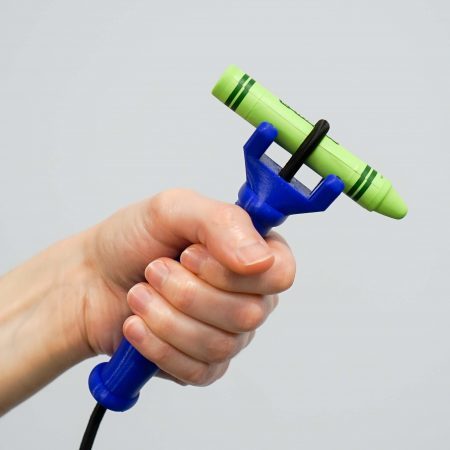
  • Tool Use: Using adaptive crayons or adapted markers, glue sticks and other materials may allow the child to do the task without hand over hand assistance.  You want to reduce the motor demands when you increase the cognitive requirements.  There are many options to help children hold their own tools.  The Functionalhand allows children to hold objects in either the  horizontal or vertical orientation.  Any size crayon, marker, glue stick, dry erase markers or school tools can fit into the flexible cord system.  For children who are unable to sustain a grasp on the Functionalhand independently, the Eazyhold strap is the ideal complimentary product.  
 Finished project displayed on a slant board as a visual reference for "Done"
Finished project displayed on a slant board as a visual reference for “Done”
Alistair references done while he uses the Functionalhand to paint his cow.  

Do 

Keeping the activity initially simple and building on the concept once the child is familiar is important. Initial activities may be to color pictures and glue them in position.   Having two sets of icons, one showing the action and the other showing the tool helps them to understand the difference.

Visual of a girl cutting- an example of an inclusive executive function strategy
Use a picture of the action for “Do”
Scissor Visual- - an example of an inclusive executive function strategy
Use a picture of the item for “Get Ready”

You may start by showing  the pictures and asking, “do we cut first or color first”.  Using “first” and “then” concepts allows your child to know there is a progression to activities and reflect on the order.  The child can point, answer or place the icons in order. 

Get Ready

Several strategies will assist the individual to be actively engaged in the “ Do” and “Get Ready” process.

  • Use picture icons that allow the child to point to or grasp to put in the “Get Ready” column. Using Velcro to keep the pictures in position may be helpful.
  • Use an augmentative communication device with a page that lists options and allowing the child to point to or use a stylus to access their selections individually. The child can then grasp the item to put into their “waiting area” bowl or box or you place them upon making their selection.

Summary

How does a child with neuromotor impairment that may lack the postural control to move, reach and communicate get the same opportunities to develop executive functioning skills as other children?  Structuring the learning opportunity and providing activities in a manner that supports their thought processes to plan and participate in the execution of tasks is important. Incorporating alternative strategies to minimize hand over hand assistance is the start.  The key is to  let the child do as much for themselves as possible both in terms of thought process and motor participation.  Learn more about Executive Functioning by listening to Therapro’s Lecture series on this and other topics.

References

Ward, S., & Jacobsen, K. (2014). A clinical model for developing executive function skills. Perspectives on Language Learning and Education, 21(2), 72-84.

What Is Executive Function? And How Does It Relate to Child Development? (N.D.) Center for the Developing Child Harvard University. https://developingchild.harvard.edu/resources/what-is-executive-function-and-how-does-it-relate-to-child-development/